
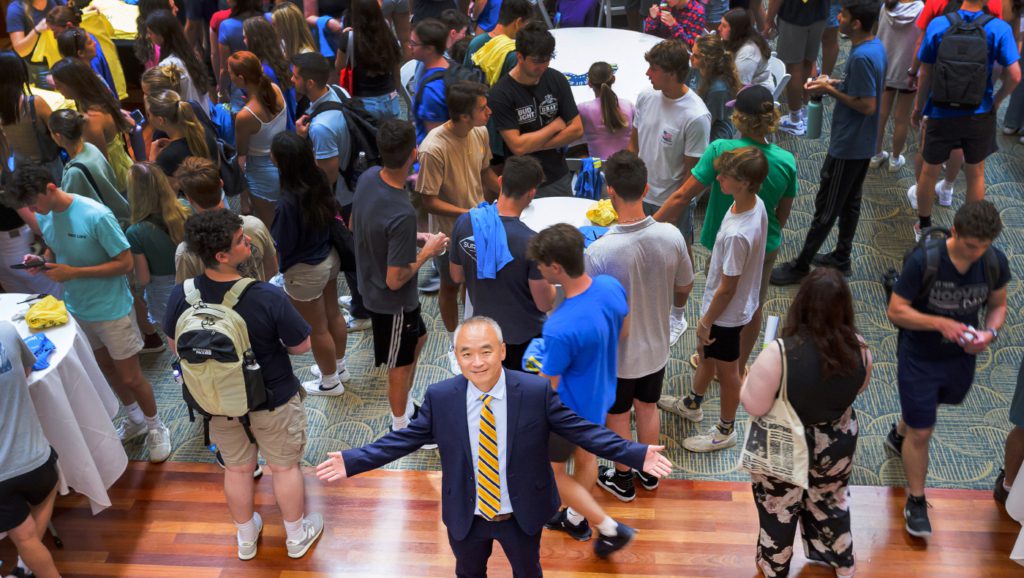
Dean Oliver Yao during an ice cream social with undergraduate students at the University of Delaware’s Lerner College of Business and Economics. “We’re not content to be a regional school,” Yao says. “We’re building a business college that’s relevant, responsive, and nationally recognized. And we’re just getting started”
When Oliver Yao became dean of the University of Delaware’s Alfred Lerner College of Business and Economics in August 2023, he took the helm of a school with strong roots — and even bigger ambitions.
Now, as he enters his third year, Yao is unveiling the full scope of those ambitions. Through a five-year strategic plan called Transformative Excellence, Lerner is investing $120 million to reshape its academic programs, research culture, and national standing — and more than $60 million of that has already been secured.
“This is not just an aspirational plan — it’s fully in motion,” Yao says. “We’re making long-term investments in students, faculty, and infrastructure to push Lerner forward in every direction.”
A STRATEGIC ROADMAP WITH NATIONAL ASPIRATIONS
Lerner jumped up 13 places this year to No. 52 in Poets&Quants’ annual ranking of the Best Undergraduate Business programs in the U.S. It also jumped five spots to No. 41 to our 2025 ranking of the Best Online MBA Programs in the U.S. The college offers 18 undergraduate majors, 18 minors, 10 master’s programs, and four doctoral programs. It holds AACSB accreditation at both the institutional and accounting levels.
The Transformative Excellence plan focuses on three pillars — Distinctive Lerner Education, Pioneering Scholarship, and Operational Excellence — as well as three interdisciplinary frontiers that Lerner aims to lead nationally: AI Transformation, Innovation & Societal Change, and Leadership & Organizations.
“We didn’t pick those frontiers at random,” Yao says. “They’re areas where we already have faculty strength and student interest — and where we believe Lerner can become a known leader in five years.”
NEW BUILDING, NEW MOMENTUM
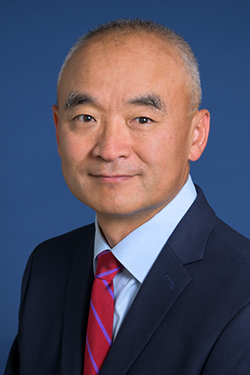
Delaware Lerner Dean Oliver Yao: “We’re not walking away from globalization. We’re preparing students to lead within it”
The biggest single investment in the Transformative Excellence plan is a new business school building — what Yao calls “a beacon” designed to attract top students, faculty, and employers. A substantial portion of the $120 million will support its design and construction.
But the transformation isn’t limited to bricks and mortar. An additional $20 million is earmarked for launching new academic programs and hiring faculty and staff — strengthening Lerner’s capacity to lead in fast-moving fields like data analytics, fintech, and applied AI.
“We’re aligning our investments with areas where we can have real national impact,” Yao says. “That means bringing in top talent and building programs that meet both student interest and industry demand.”
DEFINING ‘DISTINCTIVE’ IN BUSINESS EDUCATION
Yao’s approach to a “distinctive Lerner education” combines academic rigor with real-world relevance.
“First, we want our students grounded in strong disciplinary knowledge — finance, data analytics, marketing, accounting — taught by top faculty using the most current materials,” he says. “But just as important is ensuring what we teach is aligned with what employers need.”
Lerner’s advisory boards — composed of industry professionals — meet regularly with faculty to ensure curriculum reflects emerging market demands. That includes a focus on experiential learning, now a core part of the undergraduate journey. In addition to internships, students participate in research, consulting capstones, and a growing co-op program, where 25 students recently completed full-year placements with major employers.
“We want students learning by doing,” Yao says. “That’s what makes them competitive and job-ready.”
GLOBAL PERSPECTIVES REMAIN CENTRAL
At a time when some business schools are pulling back from global initiatives, Lerner is doubling down.
“We believe that even if a student works for a local company, they need to think strategically on a global scale,” Yao says. “Technology is shrinking the world, and our students need to understand international markets.”
Lerner’s global offerings include study abroad programs, the World Scholars track, and a range of international business courses. “We’re not walking away from globalization,” Yao says. “We’re preparing students to lead within it.”
AI INTEGRATION IS MOVING FAST
Since the release of ChatGPT in late 2022, Lerner has moved quickly to build academic offerings around generative AI and applied machine learning.
In less than two years, the school has launched three graduate-level programs: a graduate certificate in Generative AI for Business, an AI concentration within the MBA, and a full MS in Applied AI for Business.
“I truly believe we were the first in the country to launch a generative AI certificate at the graduate level,” Yao says.
Plans are now underway to bring AI into the undergraduate experience through new courses, proficiency options, and a possible AI minor. Yao says students will learn both baseline skills and more technical competencies tied to language models and advanced AI tools — all with a clear focus on business application.
OPERATIONAL EXCELLENCE: STRUCTURE & STRATEGY
Lerner is also restructuring how it operates. A new departmental model will better reflect emerging academic fields and improve collaboration. At the same time, Yao is pushing for greater efficiency.
“Housing, health care — higher ed — we all face cost pressures,” he says. “We’re reorganizing to ensure our spending goes toward students, faculty, and academic missions — not unnecessary overhead.”
RESEARCH REPUTATION ON THE RISE
A decade ago, Lerner was primarily known as a teaching college. That’s changing quickly.
Today, the school is climbing in research rankings, with faculty publishing in top-tier journals and driving new scholarship in finance, operations, marketing, and analytics. “We were ranked outside the top 90 nationally. Now we’re in the 80s, and we’re aiming for the 50s in the next few years,” Yao says.
The plan includes policies and incentives to support faculty in producing high-impact, interdisciplinary research — especially aligned with Lerner’s strategic frontiers.
CAREER OUTCOMES: 95% PLACEMENT, $70K STARTING SALARY
Yao’s philosophy is clear: “A business school must place its students.”
Lerner’s placement rate stands at 95%, with an average starting salary of $70,000. The school maintains its own dedicated career services team, hosts frequent employer engagement events, and runs an executive mentoring network that now includes over 650 active mentor-mentee pairs.
Lerner grads are landing jobs at companies like JPMorgan, Sallie Mae — even Goldman Sachs. “Our alumni are opening doors,” Yao says. “And our students are ready to walk through them.”
AFFORDABILITY REMAINS A CORE VALUE
While many top business schools are increasing tuition, Yao is keeping Lerner’s costs stable — and accessible.
“As a public university, affordability is part of our mission,” he says.
Yao points out that for most students, the payback period for a Lerner business degree is just three to four years. “We’re delivering high ROI,” he says. “And we plan to keep it that way.”
A SCHOOL WITH MOMENTUM
With tens of millions already raised, a new building on the horizon, multiple AI programs launched, and national rankings climbing, Lerner is in motion — fast.
“We’re not content to be a regional school,” Yao says. “We’re building a business college that’s relevant, responsive, and nationally recognized. And we’re just getting started.”
DON’T MISS WOW! UNIVERSITY OF DELAWARE’S LERNER COLLEGE GETS HISTORIC $71.5 MILLION GIFT
The post Inside The $120 Million Plan To Transform Delaware’s Lerner College appeared first on Poets&Quants.