
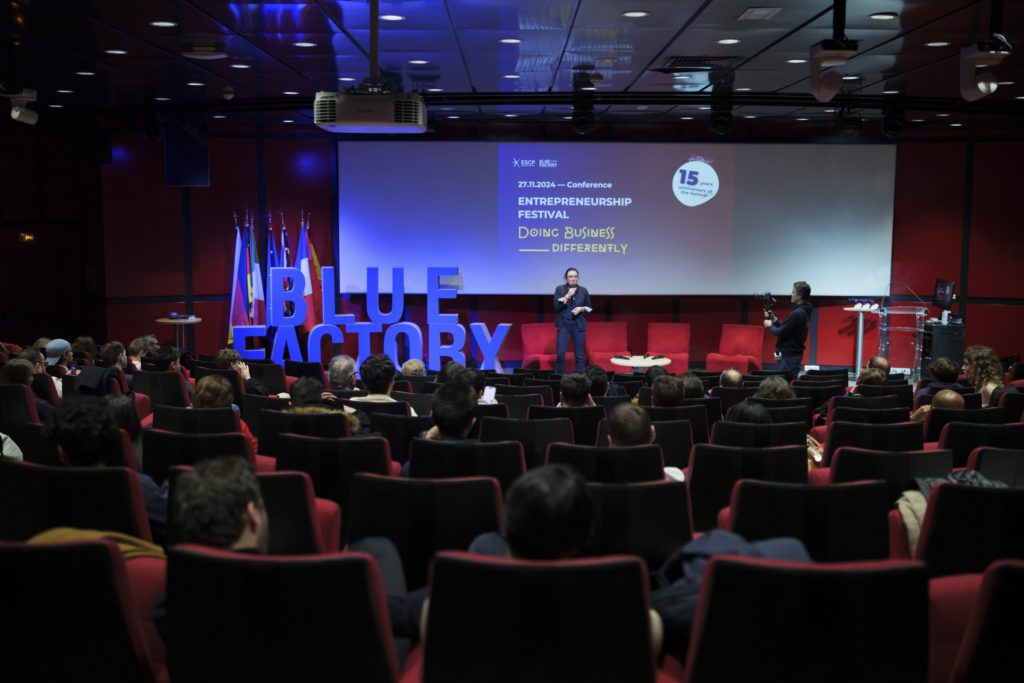
Entrepreneurship Festival 2024 at ESCP’s Paris campus celebrated 15 years of the Blue Factory and marked its expansion into a truly European incubator, now active across five campuses in Paris, Berlin, London, Turin, and Madrid. Courtesy photo
Leaning over laptops at a bright blue table inside ESCP’s Paris incubator, three young founders are building a data platform they hope will fight against one of the most alarming environmental trends of a generation: biodiversity loss.
Younes Boual and brothers Aristide and Hippolyte Bruguiere are co-founders of Maa Biodiversity, a company helping European forest owners and managers better understand what’s happening amongst the trees. Sensitive microphones capture the sounds of birds, bats, and other species that reveal the forest’s health without disturbing it. Soil samples provide environmental DNA, or eDNA, uncovering traces of fungi and amphibians that are otherwise hard to spot. From above, satellite images map canopy density and species composition, helping the team model how resilient a forest might be to fire, disease, or a shifting climate.
They are now working to combine that data in a single, user-friendly platform that can tell managers and stakeholders where trees are diseased and should be cut, where trees should be left standing, and what new trees to plant.
“We have lost more than two-thirds of global diversity in just 50 years, which is an alarming figure,” says Boual, managing director of Maa.
“Given the fact that roughly 80% of terrestrial biodiversity is found in forests, we wanted to increase forest resilience long term. We also want to increase forest capital, which is both financial and emotional for our clients.”
Last October, the three cofounders took their concept to ESCP’s Blue Factory, an incubator that prioritizes both profit and purpose when choosing startups to join France’s entrepreneurial ecosystem. The incubator recently finished an expansion across all of ESCP’s European campuses.
“Philosophically, being part of the Blue Factory has been essential. Building a mission-driven startup like Maa Biodiversity can be isolating, especially when navigating complex topics like forest ecology and carbon finance,” says Aristide Bruguiere, who serves as Maa’s partnership manager, building relationships between forest owners, businesses, and public stakeholders.
“Having a supportive environment where other founders are facing similar operational and strategic challenges while working in different sectors, brings perspective, accountability, and fresh ideas. The diversity of viewpoints within the Blue Factory has really helped us stay grounded while refining our long-term vision.”
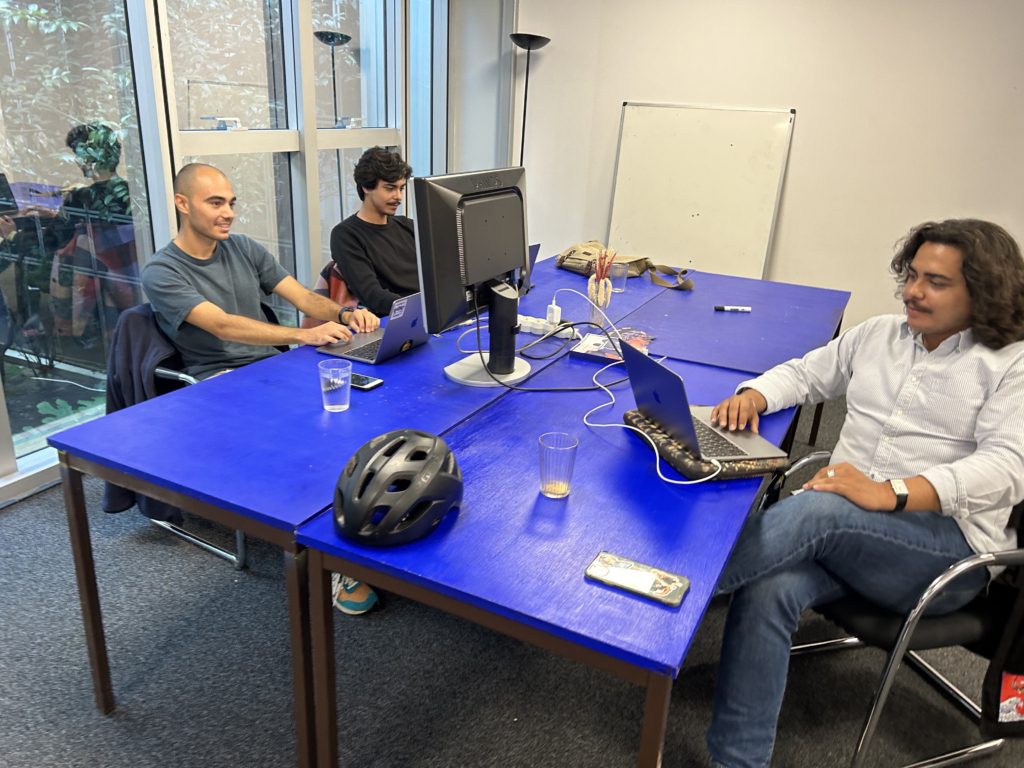
Maa Biodiversity co-founders Younes Boual, Aristide Bruguiere, and Hippolyte Bruguiere working in a Blue Factory workroom at ESCP’s Paris campus, where their startup is developing data tools to help forest owners protect biodiversity.
‘COMPLEX THINKING HAPPENING IN THIS ROOM’
The story of France’s startup ecosystem can be traced in part through ESCP’s Blue Factory and in the entrepreneurial journey of its director, Maëva Tordo.
Twenty-five years ago, French entrepreneurship was largely niche, underfunded, and often considered a back up for those who didn’t land a prestigious corporate gig. That began to change with policies such as the 1999 Law on Innovation and Research, which made it easier for public researchers to create startups. The dot-com boom inspired a wave of French tech companies, many of which collapsed in the early 2000s but left behind a culture more open to risk.
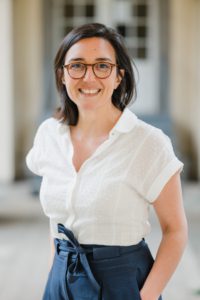
Maëva Tordo, director of ESCP’s Blue Factory
ESCP Business School and others started experimenting with entrepreneurial programs, incubators and accelerators. Blue Factory, in fact, grew out of ESCP alumni who’d gotten a taste for entrepreneurship at the school, launched ventures, and came back looking for help.
Tordo, meanwhile, came to ESCP in 2006 for a Master in International Business. While most French Lycée students study one general subject, Tordo studied three: She completed her A-levels in mathematics, went to preparatory school to study philosophy, history, and literature, then went to ESCP for business. As a student of literature and philosophy, she was struck by economic inequality, but had no idea how to address it. She thought business school would help her understand how business worked in the social space.
On her very first day at ESCP, Tordo joined a three-day seminar with Jacqueline Fendt who had just been hired to develop entrepreneurship at the school. Fendt explained that, for her, entrepreneurship was the ability to embrace contradiction and paradox, to think beyond binary systems.
“I thought, ‘Yes, there’s complex thinking happening in this room,’” Tordo says. She became Fendt’s assistant, and started helping her develop the entrepreneurship track at ESCP. When she graduated in 2011, Fendt asked her to stay on to build out the school’s new incubator, The Blue Factory. (The factory formalized its mission – what Tordo describes as balancing “profit with purpose” – during ESCP’s first Entrepreneurship Festival in 2009.)
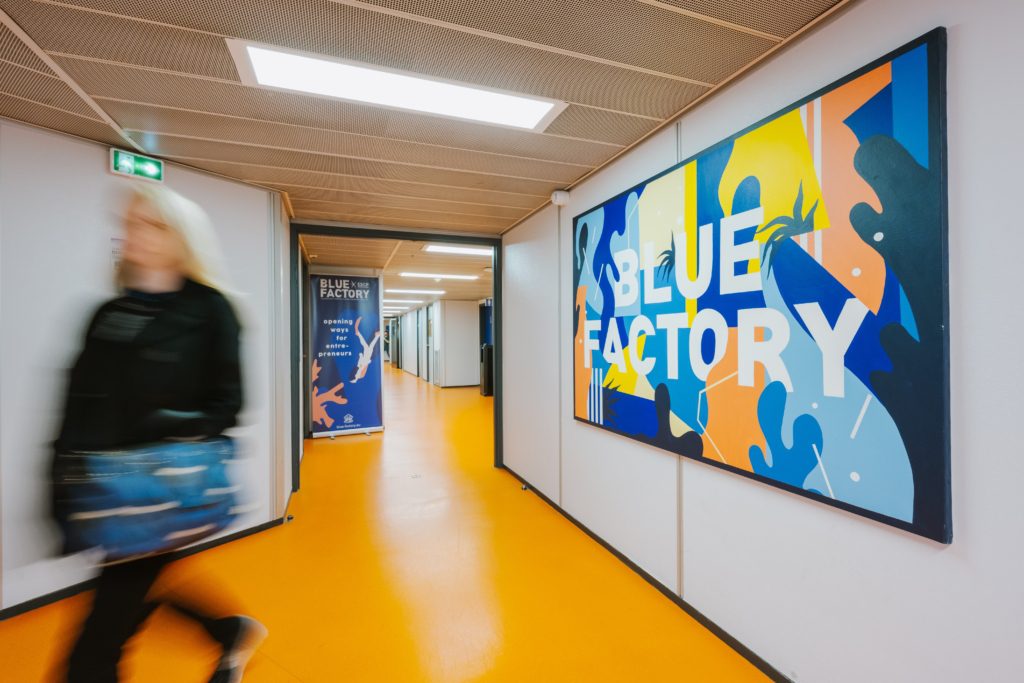
A hallway at ESCP’s Paris campus features the Blue Factory’s bold signage. Since its creation, the incubator has supported more than 1,200 entrepreneurs and trained over 4,500 students, executives, and budding founders through workshops and community events.
PROFIT WITH PURPOSE
With her diverse educational background, Tordo is keenly interested in how targeted ventures big and small can improve the lives of people across diverse communities. It is increasingly rare, Tordo says, for entrepreneurs who come to Blue Factory to be solely focused on profit and the heart of the incubator’s work is with these founders, not necessarily with their ventures.
“The real question is usually: Can I pursue both profit and impact? For me, the turning point is time. If a founder is willing to start slowly and build with quality, without rushing, and focus on creating a strong product or service that truly satisfies 100% of clients and stakeholders, then yes, it’s absolutely possible,” Tordo says.
“People often think, ‘This is a startup incubator from a business school, so we are going to do tech global startups. We say, ‘You can create an association, you can create a restaurant. Of course you can create a tech company. But entrepreneurship is much broader.’”
Since its creation, Blue Factory has supported more than 1,200 entrepreneurs through its selective programs and trained over 4,500 students, executives, and budding entrepreneurs in workshops and community events. In 2018, Blue Factory co-founded La Boussole des Entrepreneurs, a national association that now connects more than 85 incubators and accelerators across France. It will soon join France Digital, Europe’s largest startup and investor network. Most recently, Blue Factory signed a strategic partnership with Bpifrance to support deeptech founders, connecting scientists with business students to support from business modeling to commercialization.
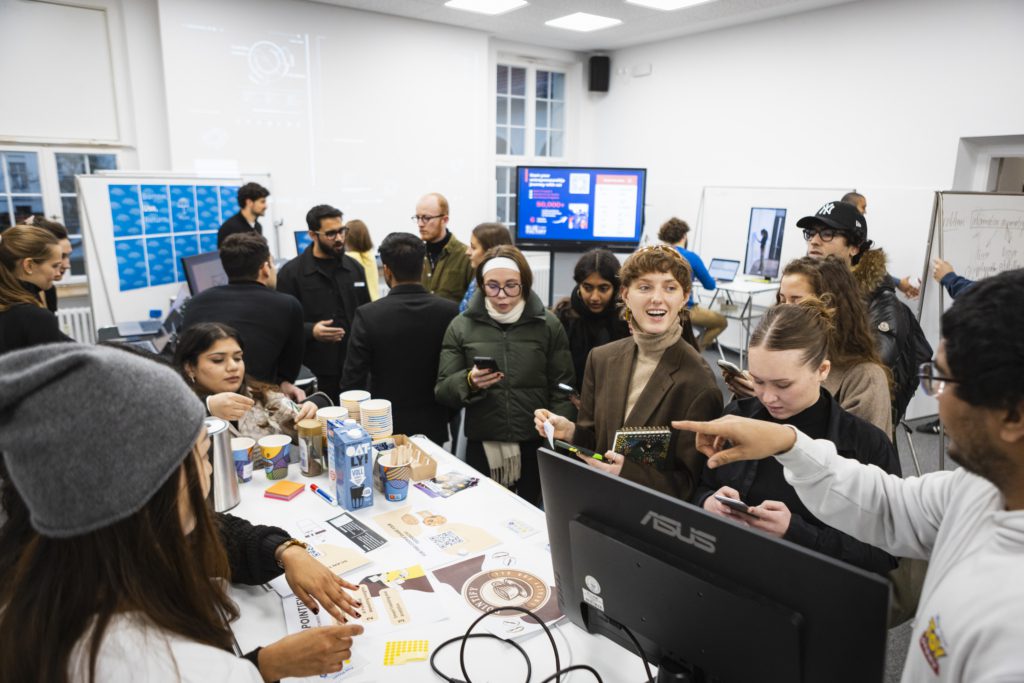
Students and young entrepreneurs take part in a Blue Factory workshop in Berlin.
EUROPEAN EXPANSION
This March, Blue Factory completed a two-year expansion across ESCP’s five European campuses in Paris, Berlin, London, Turin, and Madrid. The expansion was made possible with support from the ESCP Foundation and alumnus Nicolas Motelay (‘87).
The local hubs add specialized programs such as Berlin’s Women in Tech program supported by the German Exist Grant. The London Blue Factory was recently accredited with the Small Business Charter enabling it to launch programming for local Small and Medium-sized Enterprises. And Turin’s program renewed its partnership with Fondazione Compagnia di San Paolo for the second edition of its From Zero to Startup which will also be opened to high school students.
“This balance between local specificity and European cohesion enables us to harness the strength of a diverse entrepreneurial ecosystem, fostering innovation that is both globally connected and locally relevant,” Tordo says.
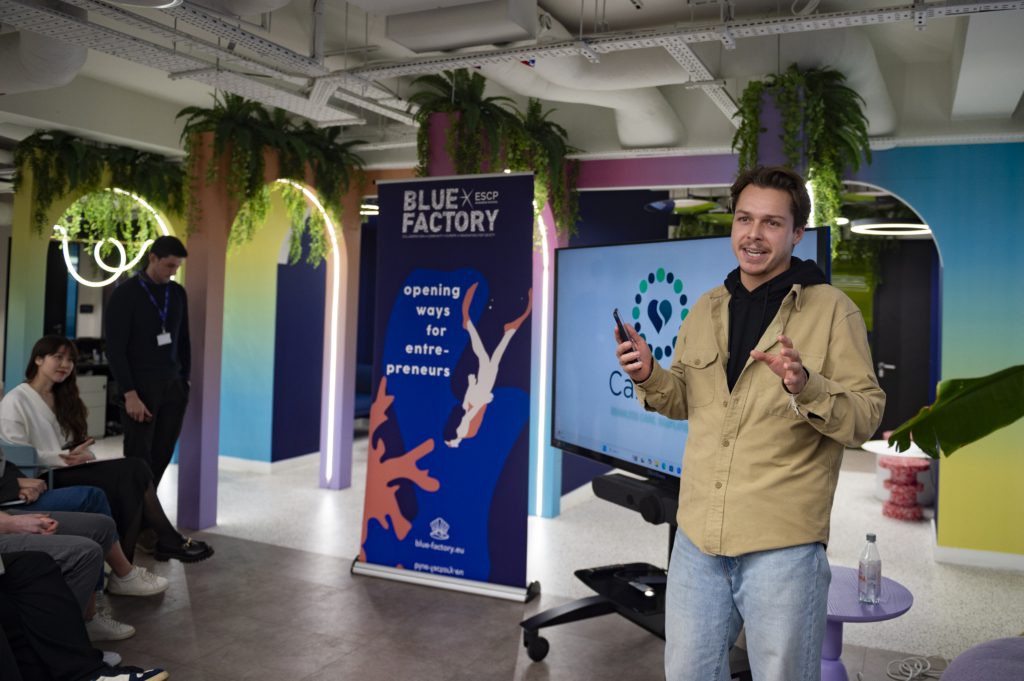
A founder presents at a Blue Factory event in London. The London hub was recently accredited with the U.K.’s Small Business Charter, enabling it to launch new programs tailored to local small and medium-sized enterprises.
FROM EXPLORE STAGE TO SEED
Blue Factory walks founders through four critical steps, offering guidance at each stage of their growth.
- In Explore, the factory sponsors open events, workshops, and personalized consultations for anyone curious about entrepreneurship or who want to spark and refine their ideas.
- Start is a comprehensive structure program on the fundamentals, from ideation to prototyping.
- Launch provides support for entrepreneurs in the prototyping stage and looking to attract first users or clients.
- And Seed offers tailored support for reaching product-market fit.
“Being in a business school, Blue Factory really has two jobs,” Tordo says. “One is raising awareness around entrepreneurship and demystifying it. The other is supporting those who are ready to go.”
Last fall, the factory partnered with ESCP’s bachelor program to organize a webinar for more than 1,000 students to both showcase success stories while expanding what students think entrepreneurship is. Yes, it can be about scaling and launching tech startups with broad appeal. It can also be about helping smaller, more localized ventures.
The webinar highlighted Blue Factory founders ranging from an industrial hardware startup, to an Uber-for-hospitals platform, to a mango-drying cooperative led by women in Senegal, to a Paris dance studio where all instructors are refugees.
One student, just 18, told her professor afterward: “Before, I thought entrepreneurship was not for me. Now, maybe it is.”
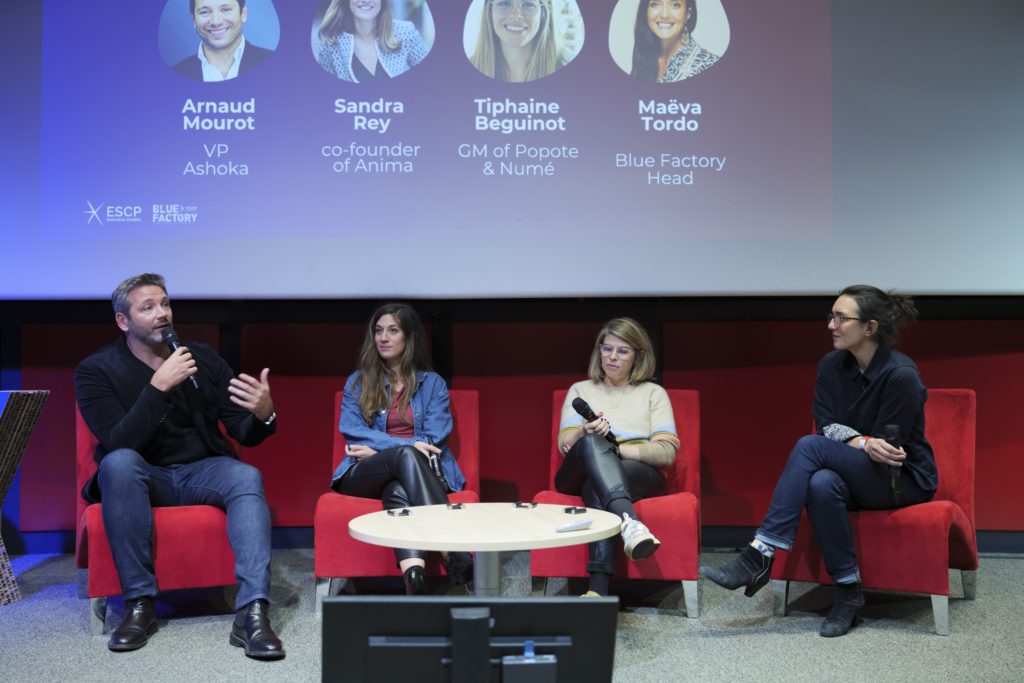
From left: Arnaud Mourot, VP of Ashoka; Sandra Rey, co-founder of Anima; Tiphaine Beguinot, GM of Popote & Numé; and Maëva Tordo, Head of Blue Factory, speak during the Entrepreneurship Festival 2024 event in Paris.
IMPACT & ALUMNI
In 15 years, Blue Factory has helped build a community of entrepreneurs, across sectors and industries, that balances experimentation with resilience. Alumni include founders such as Clément Delangue, co-founder of unicorn Hugging Face; Alexis Fogel, co-founder of Dashlane and Stonly; Justine Lecallier, co-founder of Circul’egg; and Victoire Bach, co-founder of Hopia.
For Maa Biodiversity, joining Blue Factory in October 2024 was pivotal. While its founders had a strong concept and early traction, they needed structure – both operationally and strategically. Mentors helped simplify their value proposition without sacrificing scientific integrity. It provided business model validation, pitch training, and early exposure, while connecting the founders with forest contacts across Europe to help scale their impact.
Since then, the company expanded partnerships from two forest managers on 800 hectares in Sologne, France, to 2,000 hectares while seeing new interest from Normandy.
The company has completed detailed biodiversity and risk diagnostics on over 600 hectares and have begun ground operations. Its initial focus is on two key priorities: the removal of diseased or vulnerable trees, and reducing fire-related risks while protecting more sensitive areas of the forests. In one area, they confirmed the presence of the rare and engaged Black Stork, causing them to create a site specific management plan to protect its habitat.
Today, Maa Biodiversity is actively growing its team, hiring interns to support both field operations and data processing. Its next big milestone is completing the data aggregator to centralize and automate the analysis of biodiversity, forest health, and carbon data – a must for scaling operations to new regions.
“Day to day, the incubator offers real support, whether it’s feedback on a funding application, a sounding board for strategic decisions, or just sharing doubts and wins over coffee,” Bruguiere says.
“What makes the Blue Factory unique is the mix of structure and openness: you’re constantly exposed to different perspectives, which helps you stay sharp and avoid tunnel vision. For us at Maa Biodiversity, that environment has been a real asset in navigating the early stages of development. And the Blue Factory team feels like a family in the support they offer us.”
DON’T MISS: ESCP’S NEW STRATEGIC PLAN: A ‘THIRD WAY’ BETWEEN U.S. & CHINA IN BUSINESS EDUCATION and EXIT INTERVIEW: JENS WÜSTEMANN ON BUILDING GERMANY’S MOST AMBITIOUS BUSINESS SCHOOL
The post ESCP’s Blue Factory Expands Its ‘Profit With Purpose’ Mission Across Europe appeared first on Poets&Quants.