
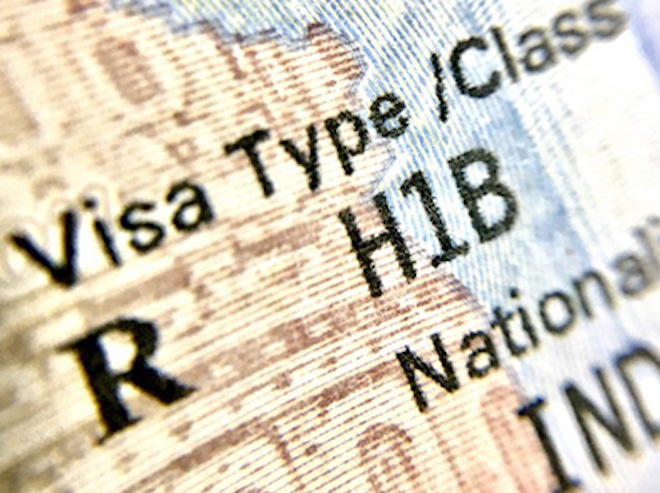
In a sweeping move that has stunned employers, immigrants, and universities alike, President Donald Trump has signed a proclamation imposing a $100,000 annual fee on H‑1B visa applications — an extraordinary escalation in costs for companies seeking to hire high-skilled foreign talent.
The new rule, which takes effect September 21, 2025, also prohibits entry of H‑1B holders into the U.S. unless the fee has been paid by their sponsoring employer.
Legal analysts are already raising red flags, questioning whether the administration has the authority to implement such a fee without legislation from Congress. The new policy is part of a broader immigration overhaul that includes so-called “gold card” and “platinum card” pathways for wealthy immigrants, and many believe it could run into constitutional and procedural legal hurdles.
‘SHOCKWAVES ACROSS BOARDROOMS’: SYMONDS ON WHO’S HIT HARDEST

Sameer Kamat, founder of MBA Crystal Ball: “We’re seeing a variety of reactions and application strategies. Some younger applicants are considering delaying their plans, others are skipping the U.S. completely”
“This just dropped from the skies when we were sleeping,” writes Sameer Kamat, founder of MBA Crystal Ball, in a LinkedIn post reacting to the news. “Here’s what it means, and what you can do about it: The company applying for your H‑1B will have to shell out an additional 88 lakhs [in Indian rupees], and then there are legal costs, procedural hassles.”
“The decision sent shockwaves across boardrooms, graduate campuses, and international student networks,” writes Matt Symonds in a column for Bluesky Thinking. “The H‑1B visa has long been the bridge between the world’s best and brightest graduates and the U.S. companies that want them. But with the cost of sponsorship rising so dramatically, the calculation changes for both employers and students.”
Symonds points out that the executive order raised the previous $1,500 fee by 6,566.7% and has already prompted major tech companies to advise visa holders to stay in the U.S. or return before the rule took effect.
He also highlights the irony behind the policy: “Nadella, Musk, Melania Trump and Sundar Pichai … all benefitted from an H‑1B visa to pursue their careers in the U.S.” He adds: “So what do they make of the proclamation signed by President Donald Trump on Friday that will ask companies to pay a $100,000 fee for H-1B worker visas?”
FROM AMAZON TO GOLDMAN, THE BILL JUST SKYROCKETED
Symonds’ column outlines just how expensive the new policy could become. Amazon, with 3,871 H‑1B approvals in 2024, would face more than $380 million in new annual costs. Apple, with 864 petitions, would owe $85 million more, while Goldman Sachs — with 678 approvals — would see an increase of over $66 million.
“That may be a speed bump for tech giants and big banks rather than a roadblock,” Symonds writes. “These firms already spend heavily on recruitment, training, and retention, and $100,000 may be absorbed as part of the cost of securing elite global talent.”
But for startups and mid-sized companies, the picture is different: “The new barrier could prove prohibitive,” he writes. “The unintended consequence? A less dynamic, less competitive labor market where graduates have fewer pathways into entrepreneurship and high-growth companies.”
‘TACO MOMENT’? MBA EXPERTS ADVISE CAUTION
Jeremy Shinewald, founder of mbaMission, strikes a more measured tone. “Like anything Trump-related, this is subject to change,” he tells Poets&Quants. “My guess is that this will be another Trump TACO — Trump Always Chickens Out — moment, after CEOs push back and the market reacts.”
“There are also legal questions about whether he is authorized to do this,” Shinewald continues, “so expect significant legal challenges.”
For international MBA applicants currently weighing U.S. study, Shinewald emphasizes the longer timeline: “If they are applying now, they will graduate in 2028 and then they should have three years of STEM-based OPT status after that, taking them to 2031, deep into the next administration.”
“My best guess,” he adds, “is that, by then, this policy will revert back under pressure from the tech lobby, the processes of the judicial system, or a mere whimsical change of heart from the president.”
IS THE U.S. STILL ‘THE LAND OF OPPORTUNITY’?
Symonds also warns that the fee shift changes the value proposition for studying in the U.S. “Now … the new $100K visa cost changes the equation,” he writes. “Companies may become more selective, preferring to reserve sponsorships for only the most in-demand roles or the most prestigious schools. Graduates from Stanford GSB or MIT Sloan may still find sponsorship pathways open, while those from second-tier programs might discover the door narrowing.”
He continues: “Some international students may begin to question whether the U.S. is still the best destination for study. Countries such as Canada, the U.K., Australia and Germany are actively courting global talent with more accessible post-study work visas and clearer immigration pathways.”
The long-term risk, Symonds concludes, is that “top global talent opts for these alternatives, eroding the long-term competitiveness of American universities and employers.”
A TWO-TIERED IMMIGRATION SYSTEM EMERGES
In Symonds’ view, the policy effectively formalizes a split system: “Winners: Elite graduates from the very top schools, and large corporates who can afford to pay for them. For this group, the visa process may actually become smoother… Losers: Smaller firms, bootstrapped startups, and graduates from mid-ranked programs. They may find themselves squeezed out.”
Even as the administration argues the high cost will reduce abuse, Symonds notes the paradox: “By solidifying the program—even at a steep cost—the U.S. may paradoxically make itself more attractive to those who can clear the new financial hurdles.” For those attending top 20 business schools or targeting firms like Google, Microsoft, or Meta, the certainty may outweigh the price tag.
‘WAIT FOR CLARITY’—BUT WHO STAYS, WHO LEAVES?
For this contemplating applying to U.S. business schools, the mood is unsettled. Sameer Kamat writes, “We’re seeing a variety of reactions and application strategies. Some younger applicants are considering delaying their plans, others are skipping the U.S. completely, and some are going with a balanced approach — picking schools in Europe, Asia, and the U.S.”
Still, he cautions against a full retreat. “Our advice doesn’t change. Diversify. When you’re applying, there’s no harm in adding U.S. schools to the mix. Don’t drop a whole country just on the basis of news articles.”
And while Elon Musk — himself a former H‑1B holder — once said, “The reason I’m in America, along with so many critical people who built SpaceX, Tesla and hundreds of other companies … is because of H‑1B,” he has yet to publicly respond to the $100,000 fee.
DON’T MISS HOW THE TRUMP ADMINISTRATION IS STRONG-ARMING HIGHER EDUCATION and TRUMP’S IMPACT (SO FAR) ON B-SCHOOL APPLICATION TRENDS
The post The $100K Visa Fee That Could Redefine U.S. Business Education appeared first on Poets&Quants.