
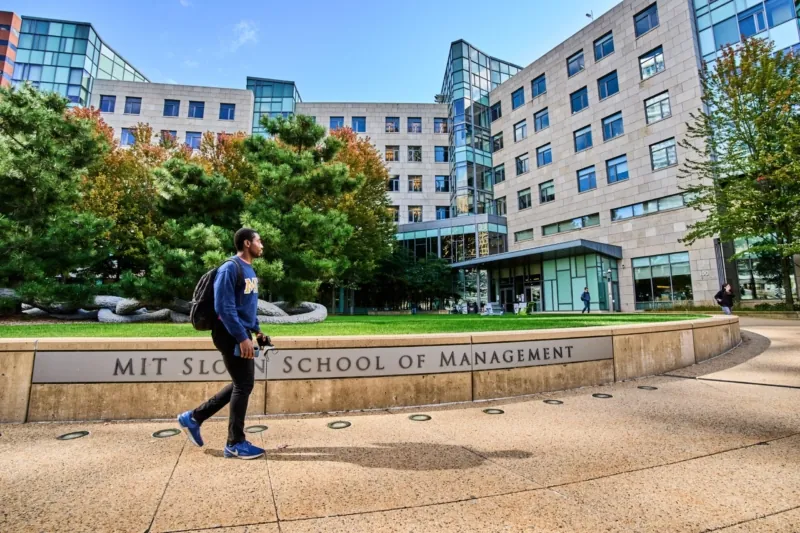
MIT Sloan Exterior (Courtesy: Above Summit/MIT Sloan)

Myth: MIT Sloan is solely tech-focused.
Reality: “Whenever I tell people I go to MIT Sloan School of Management, I often hear, “Does MIT have a business school?”—a surprising question given Sloan’s consistent ranking among the top business schools globally. This stems from a common myth: that Sloan is solely a tech-focused institution, rather than a full-spectrum business school.
While it’s true that Sloan thrives at the intersection of business and technology, this perception overlooks broader sectors like finance, consulting, entrepreneurship, venture capital, healthcare, and impact financing. My experiences across entrepreneurship, as well as having secured roles in investment banking and consulting, reinforced the fact that Sloan isn’t limited to tech. Instead, it is focused on developing global business leaders who thrive in every facet of industry.
Sloan’s action-learning approach, world-class finance programs, and leadership development initiatives equip students to excel in consulting, investment banking, entrepreneurship, and beyond. Whether in tech or traditional industries, Sloan produces leaders who drive impact across sectors—not just in technology.”
Toritse David Maroh, MIT (Sloan)

Myth: Nanyang MBA program is a “Tech-MBA,” mainly because Nanyang Business School (NBS) is part of Nanyang Technological University (NTU).
Reality: “I get why some people might assume that, but honestly, nothing could be further from the truth. While Nanyang MBA does integrate technology into its curriculum—just like any top-tier business school would—it doesn’t place an overwhelming focus on tech, at the cost of other crucial business areas.
In reality, the Nanyang MBA program is much more than just technology. It’s a well-rounded, holistic curriculum designed to provide a solid foundation in essential business principles like leadership, strategy, and decision-making. The program also offers specializations in areas like Strategy, Sustainability, and Finance, giving us the flexibility to tailor our learning based on our career goals.
One of the unique features of the Nanyang MBA is the emphasis on leadership development, particularly in the context of Asian markets. The capstone leadership modules and the Business Study Mission are designed to help us become a leader with a nuanced understanding of the region’s rapidly evolving business landscape. So, while technology is certainly a key component, it’s just one piece of the broader, more comprehensive approach that sets the Nanyang MBA apart.”
Ashwin Charles, Nanyang Business School
Myth: The city gets in the way of community.
Reality: “I would argue that it’s the city itself that makes the community. NYC turns every street, café, and late-night bodega run into an opportunity to connect. From post-class hangs in Washington Square Park to industry events just a subway ride away, the city becomes an extension of the school itself. The energy, diversity, and sheer number of experiences bring people together in ways that no other campus can. Instead of isolating us, NYC amplifies our sense of community. It’s just a community that happens to come with skyline views.”
Julian Sutton, New York University (Stern)
Myth: UNC Kenan-Flagler’s Full-Time MBA Program is too academically focused and lacks real-world business exposure.
Reality: “Before joining, I wondered if the program would be heavy on theory with limited hands-on experience. That myth was quickly shattered. From STAR (Student Teams Achieving Results) projects to case competitions, consulting engagements, and leadership simulations, experiential learning is woven into everything at UNC Kenan-Flagler. In my STAR project, I worked on real strategic decisions that directly impacted a local business—applying frameworks beyond the classroom and tackling real-world challenges alongside industry professionals.
By the time I started my internship, I wasn’t just armed with knowledge—I had already experienced solving business problems in action. UNC Kenan-Flagler isn’t just about learning concepts; it’s about applying them in real-time, ensuring students graduate ready to hit the ground running.”
Bhumika Agarwal, University of North Carolina (Kenan-Flagler)

Myth: Kellogg is primarily a marketing school.
Reality: “While Kellogg does have a strong reputation for marketing and offers exceptional programs in this area, it is also equally exceptional in many other areas. For example, Kellogg has invested heavily in data science and artificial intelligence, offering cutting-edge courses and research opportunities in these fields. Through my experiences at Kellogg, I witnessed firsthand how the school continually evolves to meet the demands of a rapidly changing landscape. Rather than rejecting the realities of AI, Kellogg is adapting its use to augment learning without diminishing critical thinking. In several of my classes, we were encouraged to use AI tools for brainstorming and even used AI as a teaching assistant to deepen our understanding of complex concepts. Kellogg’s comprehensive and adaptive curriculum created by forward-looking professors truly sets it apart as a business school that prepares its students for the future.”
Will Tan, Northwestern University (Kellogg)
Myth: Notre Dame is for Catholics only.
Reality: “Although Notre Dame is known for its Catholic roots, the university embraces diversity and fosters a community where people of all backgrounds are welcomed and respected. Throughout my time here, I’ve met people from various walks of life, which has broadened my worldview and deepened my empathy. The Basilica of the Sacred Heart and the Grotto of our Lady of Lourdes stand as symbols of reflection and respect, not just for those who share the Catholic faith, but for everyone seeking a moment of peace and connection.”
Cristina García Abedrabbo, Notre Dame (Mendoza)
“One of the biggest myths I’ve heard about Notre Dame prior to attending was that the school is only suited for Catholics or those who closely follow traditional doctrine. Although the university is deeply rooted in Catholic tradition, the community is incredibly diverse in thought, faith, and background. The university encourages reflection and ethical leadership, but not in a dogmatic way. Themes like human dignity and the common good, core elements of Catholic social teaching, are frequently reflected in university programming and communications. Yet these principles closely align with widely accepted best practices in the business world, such as corporate social responsibility and servant leadership. While some might expect Notre Dame’s faith tradition to feel rigid, I’ve found it to be a place where values-driven leadership is deeply respected, no matter one’s personal beliefs.”
Mark Giesey, Notre Dame (Mendoza)
Myth: Everyone comes from a privileged background or follows a traditional academic path.
Reality: “While Oxford has a long-standing reputation for prestige, the reality is that the student body is incredibly diverse, with people from different socioeconomic backgrounds, industries, and life experiences.
Many students are career changers, first-generation graduates, entrepreneurs, and professionals from non-traditional paths. The Oxford MBA, in particular, attracts a global cohort with a strong focus on impact, entrepreneurship, and innovation, challenging the stereotype that it’s only for academics or elite professionals.”
Surayyah Ahmad, University of Oxford (Saïd)

Myth: The University of Pittsburgh School of Business is just a regional school with limited national or global reach.
Reality: “Before starting my MBA, I often heard that Pitt was primarily known for its strong local business ties, but lacked the broader alumni network and recruiting reach of larger programs.
However, my experience proved otherwise. While Pitt does have deep connections within Pittsburgh, the alumni network is far more extensive than many assume. Pitt graduates hold leadership roles across major companies worldwide, and I had the opportunity to connect with professionals in consulting, tech, finance, and healthcare at firms like Amazon, Bank of America, McKinsey, and Delta. Additionally, through conferences, case competitions, and career treks, I accessed both national and international opportunities, far exceeding the regional scope often associated with the school.
This experience reinforced a key lesson, your network is what you make of it. Pitt provides the tools and connections, but it’s up to us as students to take the initiative and leverage them.”
Blessing Unwana Umoh, University of Pittsburgh
Myth: Texas A&M is a cult.
Reality: “While I understand and initially shared that perspective, it is predominantly for positive reasons. Aggies are taught and reinforced the schools core values of respects, excellence, leadership, loyalty, integrity, and selfless service. These values are expectation that Aggies are accountable to holding.
When I got to College Station, I noticed how every store was called “Aggieland (Insert Business),” which was strange at first. However, I found that when using these businesses like Aggieland Storage for example, they were the beacon of the Aggie spirit by taking pride in quality products and customer services. Seeing “Aggieland” became a symbol of a high-quality business that would go out of their way to satisfy customers. So, while I understand Texas A&M may be a cult for its deep traditions, I also recognize that it is that same culture that reinforces doing good work and being good people.”
Adam Baldwin, Texas A&M (Mays)

Myth: Rotman is all about Finance and Consulting, and other functions like tech, healthcare, marketing, and entrepreneurship are not equally endorsed or supported by the school.
Reality: “This myth seems to find its footing in the fact that Finance and Consulting have the largest student-run clubs at the school, which is a direct function of the number of interested students forming these clubs. By virtue of their size and popularity, over time, these student clubs have indeed developed more substance in their events, more breadth in their resources and more strength in their networks and are able to support students in a more structured manner.
However, I have always taken the view that the MBA program is a platform for students to shape their own recruitment and academic journeys; every student should take the initiative to seek the relevant resources and networks that will enable them to meet their individual goals, leveraging the club resources whenever possible, but not limiting oneself to a spoon-fed regime by the school. In my opinion, Rotman offers all the necessary resources, systems, affiliations, and networks to be able to support students with all kinds of recruitment needs. However, it warrants effort and planning on the students’ part to explore and identify the right ones at the right time or create new channels and networks when needed. In short, the MBA is truly what you make of it!”
Sanchaita Kohli, University of Toronto (Rotman)
Next Page: Myths about UC Berkeley Haas, Wharton School, and Virginia Darden.