
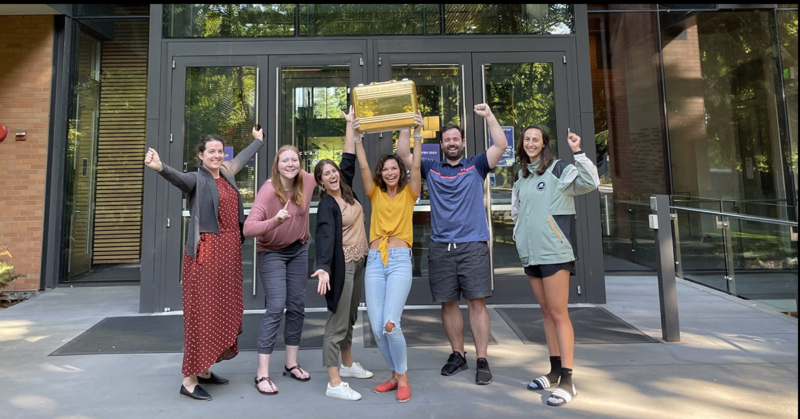
Foster MBAs hoisting the Challenge For Charity Golden Briefcase for community service
When you talk about business schools with serious tech muscle, Foster stands out. It isn’t just dangling the promise of tech jobs—it’s built around tech in a meaningful way. One of the first things you’ll notice is how the school has embedded artificial intelligence literacy into its programs. Foster explicitly states that “across every program, Foster integrates AI into coursework, projects, and research, empowering students to think critically about technology’s business, ethical, and societal impact.”
That speaks volumes, because today tech isn’t just a specialization or an elective—it’s everywhere. At Foster, the agenda is already there to integrate it into core business education. And that means students are not only learning about management and finance—they’re learning how technology drives, disrupts, and creates business. It’s one thing to teach strategy; it’s another to teach it in the age of machine learning, cloud, and digital transformation.
Location plays a big role too. Foster is in Seattle, one of the world’s premiere tech hubs—with giants like Microsoft Corporation and Amazon.com, Inc. entrenched in the city’s DNA. Being in Seattle means tech anchors the region. Amazon and Microsoft make the city one of the world’s leading innovation hubs. That location gives Foster students proximity—not just in theory but in practice—to the tech sector in a way many business schools can’t match.
The programs themselves show the commitment. For instance, Foster’s Technology Management MBA (TMMBA) is an 18-month accelerated program specifically aimed at people working in or moving into tech roles. On the school’s website: “The 18-month, accelerated Technology Management MBA program features award-winning faculty, exceptional career support, and a comprehensive curriculum that can transform your tech career.” That kind of specificity matters—it signals that the school isn’t simply adding “technology” into generic business tracks; it’s tailoring one for it.
And because it’s tailored, you find outcomes to match. As the website states, “80% of alumni change jobs within two years” of finishing their tech-focused MBA. Career mobility is a testament to relevance: when you move into or up within the tech sector, you know your training aligned with the demand.
Foster’s tech strength isn’t just about jobs, though. It’s about research and collaboration. The broad university ecosystem—Foster partnered with the College of Engineering, the Paul G. Allen School of Computer Science & Engineering, and the CoMotion innovation hub—gives students access to cross-discipline tech and business intersections. The school’s own site highlights this synergy, noting the support from private industry as well. For students, that means opportunities to work on real problems, tech-enabled initiatives, and innovation projects that straddle business and engineering.
Another dimension: technology ethics and society. It’s one thing to build an app; it’s another to ask how the app affects people, data, privacy and fairness. Foster’s focus on those questions (via its AI integration statement) suggests a program mindful of the bigger picture. That matters more as tech becomes less of a tool and more of a system shaping lives.
What about the day-to-day student experience? Because many students come from or will go into tech roles, Foster offers cohorts, networks, and connections that reflect that reality. The TMMBA program emphasizes a tight-knit cohort of tech-savvy professionals and leadership in change management and innovation. When you’re surrounded by classmates who speak tech, that accelerates learning in very concrete ways.
One of the oft-mentioned advantages at Foster is the high percentage of graduates going into the technology industry. Foster placed a remarkable 47% of its Class of 2024 MBA graduates into the technology industry with median base salaries of $144,328. That’s way more than Berkeley Haas (24%) or Stanford (22%), despite those schools’ close proximity to tech-heavy San Francisco and Silicon Valley. If you’re aiming for tech, Foster’s numbers are more than suggestive—they’re compelling.
The school’s reputation also helps. While tech strength is its feature, the broader brand of Foster and University of Washington enhances the credibility. Foster combines the reach of a world-class public research university with the focus of a program built around you. That helps when you’re entering competitive tech-enabled fields.
Finally, thinking ahead: as technology evolves, so must business education. Foster seems to be ahead of that curve. With programs that explicitly integrate tech/AI, location in a tech hub, strong outcomes, and a purpose-driven mindset, the school is not just keeping up—it’s helping define what a tech-focused business education looks like.
So if you’re writing about “why Foster” and its strength in technology, here’s the takeaway: it offers more than a foothold in tech—it offers a launchpad. From location to curriculum, from outcomes to ethos, the school has woven technology deeply into the business education experience—and that makes it a standout for 2025.
The post 2025 MBA Best In Class Award For Technology: University of Washington (Foster) appeared first on Poets&Quants.