

PROFESSORS FROM 45 SCHOOLS MADE THE LIST
2025’s Best Professors list features 20 inspiring women. They include Mònica Casabayó Bonàs, 50, an associate professor of marketing at Esade Business School in Spain. Using AI techniques, she studies youth engagement in cause-related campaigns and the societal impact of materialism.
If she had her way, business schools would “prioritize curiosity, social and emotional intelligence, communication, and ethical decision-making as core competencies (not just soft skills) essential for coexisting with intelligent machines,” she tells Poets&Quants.

Mònica Casabayó Bonàs, Esade Business School
“I would expand our collective intelligence by embracing artificial intelligence and other innovative technologies not as ends in themselves, but as tools to address humanity’s most pressing global challenges.”
Our 50 stellar undergrad professors hail from 45 different schools, including six international schools. Five business programs had two professors each including Indiana University’s Kelley School of Business, New York University Stern School of Business, University of Michigan Ross School of Business, University of North Carolina at Chapel Hill Kenan-Flagler Business School, and University of Washington Foster School of Business.
Ages range from 25 to 70. They are new parents, self-proclaimed Swifties, second degree black belts, and world-ranked hurdlers. They run marathons, play pickleball and the viola, and have surprising bragging rights to Tom Hanks’ Castaway.
Jared P. Harrell, 46, Associate Professor of Practice at Texas Tech’s Rawls College of Business, has transformed undergraduate real estate education since joining the college in 2015. He is founder of the Center for Real Estate as well as the annual Real Estate & Banking Case Competition. He recruited a 67-member Advisory Council, fostering deep connections between students and professionals throughout commercial real estate.
A commercial lawyer, Harrell started as an adjunct in University of Texas at Arlington’s master’s program and became hooked by designing practical curricula rooted in real-world experience. He won Rawls’ highest award for undergraduate teaching in 2022.
Asked for one word to describe his first time teaching, and his answer is awkwardly relatable: “Unzipped … My pants were unzipped for the entire first class I ever taught at Texas Tech. Thankfully, I don’t think any of the students noticed.”
CLASSROOM INNOVATORS
For 2025’s list, we looked for professors who are redefining what a business classroom can be. We found many.
Take Jessica A. Magaldi, 55, the Ivan Fox Professor and Scholar of Business Law at Pace University Lubin School of Business. After years of hearing students analyze legal questions using Taylor Swift’s myriad lawsuits as examples, she built a course around them: Music Industry Law (Taylor’s Version).
“I didn’t start out as a Swift fan, but through developing the course I came to respect her as an artist, a businessperson, and someone who works hard at maintaining a strong connection to her fans,” Magaldi tells Poets&Quants.
“My students and I ask questions to push ourselves to think differently — about power, strategy, fairness, and innovation — and together we unpack how the law intersects with the complexities of business, technology, and human behavior. I love watching them make connections between doctrine and lived experience, and I especially enjoy designing courses that tap into their passions and use that to more deeply engage with legal analysis.”

Matthew Lanham, Butler University’s Lacy School of Business
Matthew Lanham, 43, Assistant Professor of Business Technology and Analytics at Butler University’s Lacy School of Business, studies how experiential learning and analytics competitions can ensure equitable, outcomes-based success for all students, not just those at the top of the bell curve. So, he embedded the National Data4Good Analytics Competition, which he founded and leads, directly into his courses.
“When competitions are embedded directly into coursework, and not offered as optional extras, they can guarantee that every student gains tangible evidence of competence, confidence, and calling,” he says. “This approach reflects a philosophy of stewardship: designing analytics education that multiplies opportunity, elevates collective success, and honors the responsibility we have to develop every student’s potential.”
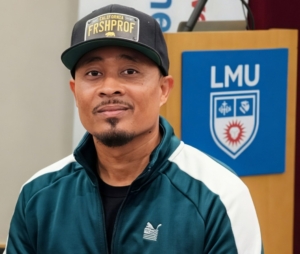
Mitch Hamilton, Loyola Marymount University
And, at Loyola Marymount University, Mitch Hamilton blends authenticity with real-world partnerships to teach culture-driven branding through the A-LIST capstone – Applied Learning in Societal Transformation. Students collaborate with industry leaders across sports, entertainment, and social enterprise to tackle real marketing challenges while promoting equity and inclusion. Students have partnered with the NBA Players Association, Sony Pictures, Think Watts Foundation, and others.
He has perhaps the best nickname we’ve heard bestowed on a business academic: The Fresh Professor.
“Dr. Hamilton style is very… cool. I don’t mean that lightly,” says student Gina Galvin in her nomination.
“He gives students hope (and skills/tools) that they can do something with marketing, research, sharp insights, and data that can transcend fiscal KPI’s and can truly make change in this world. I specifically remember him teaching the ‘triple bottom line approach’ where businesses can consider people, planet and profit as their Northstar – and that ultimately this is a strategy that is both needed and will prevail.”
MULTIPLE AI APPROACHES
As AI reshapes nearly every aspect of work – and every corner of business education – this year’s professors are expanding their AI research in both scope and impact.
Vijay Pandiarajan, 63, studies how Fourth Industrial Age technologies, especially AI, digital twins, and automation are reshaping innovation and meaning at work. A former engineer at Hindustan Aeronautics Limited who helped build Jaguar fighter aircraft, he believes the most enduring technological progress is human-centered.
“Over the years, I have realized that true technology-driven innovation is not about replacing people with machines but about unlocking human imagination, empathy, and strategic insight,” says Pandiarajan, named a 2025 Michigan Road Scholar, a university-wide initiative that fosters collaboration between faculty and communities across the state.
“Each project I study reinforces my belief that progress becomes lasting and purposeful only when people remain at the center of technological change and feel empowered to shape it.”

Callen Anthony, New York University Stern School of Business
At NYU Stern, Callen Anthony, 38, examines how AI is changing the way expertise develops in investment banking. Using 75 years of company archives and interviews with bankers from different generations, she’s looking at how bankers’ work has evolved alongside new technologies. One of the biggest shifts is that junior tasks once essential for learning the job, now rely less on human expertise because so much is automated. The way people at different levels work together is becoming more rigid, making it harder for true expertise to grow.
Althaf Marsoof studies how AI is reshaping management education itself. Marsoof, 41, Associate Professor of Business Law at Nanyang Technological University in Singapore, is looking at how students use AI throughout the learning process. His most significant finding so far is that critical thinking no longer shows up only in the final written answer. Instead, it unfolds across multiple stages — in how students frame questions, refine prompts, evaluate AI-generated responses, and choose what to accept or reject.
“This shift requires us to pay close attention to the process, not just the outcome,” he says. “It carries significant implications for assessment design, classroom activities, and the responsible adoption of AI in education.”
Next page: Presenting the 50 Best Undergraduate Business Professors of 2025