

Anna Wylly (L) and Amanda Chen (R), PropertyPals
MAKING MAINTENANCE EASIER FOR PROPERTY OWNERS AND RENTERS ALIKE
Not surprisingly, this year’s disruptive startups often made technology a centerpiece of their solutions. At the University of San Francisco School of Management, three student founders developed Globana, which they describe as a “multi-currency digital wallet” to help “unbanked individuals to store, send, and receive money internationally.” Compare that to PropertyPals, a startup launched out of Georgia Tech’s Scheller College. The platform targets a gap ignored in the marketplace: property owners who operate a small number of units – or don’t live near their properties. Due to these constraints, when tenants make repair and maintenance requests, they often lack the time and resources to address them quickly. To combat this, renters can submit requests using the PropertyPals platform, with contractors assigned from the owners’ preferred lists. Not only does the platform streamline the process, but protects all parties’ interests as well.
“[The property owner] approves the quote. We handle the rest,” say co-founders Amanda Chen and Anna Wylly. “PropertyPals ensures repairs are handled quickly and fairly. For those using property managers, our platform also acts as a check-and-balance to prevent overcharging or unfilled work orders. By bringing accountability and simplicity into every step of maintenance, PropertyPals helps landlords save time and stress, protect their income, and trust that their properties are being cared for the right way.”
The idea for PropertyPals, says Amanda Chen, originated with the duo’s experiences with rental management. Wylly often pitched in on small fixes, learning just how “stressful and time-consuming” maintenance could be. At the same time, Chen’s father – a “passive landlord” – would spend hours “glued to his phone” over repairs When Wylly and Chen sat together in a Business Lab course at Scheller, they quickly discovered a mutual problem…and the opportunity that comes with it.
“Our first big milestone was manually coordinating a repair for a local landlord while he was on vacation with his family,” Chen adds. “That experience showed us the true value of a hands-off solution like PropertyPals. We saved him money, time, and stress by handling the entire process. From there, we built our MVP in under eight weeks, presented it at Create-X Demo Day, and have been showcasing it at Atlanta real estate meetups to gather feedback and build relationships.”
FUNDING PSYCHADELICS IN THERAPY
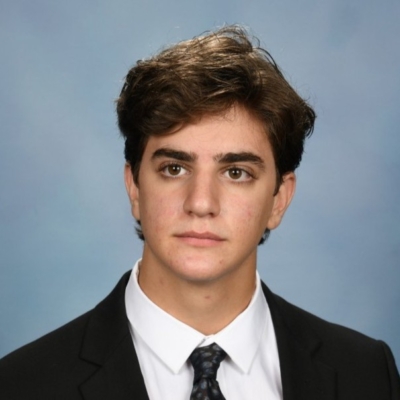
Luca Drago, The Silent Storm Foundation
In some cases, startups were grounded in a commitment to serve the public. Take The Petition Co., which was started by Michael Korvyakov, a student at Georgetown University’s McDonough School. He has developed a software solution that validates the voter registration for people who sign political petitions. In the process, he hopes to reduce the time and complications that come when the validity of signatures is challenged. At Cornell University’s Dyson School, Luca Drago started a non-profit – The Silent Storm Foundation – with an unconventional mission. He hopes to better connect trauma survivors with psychedelic assisted therapy. The mission began during a weight lifting session with a Marine veteran.
“He confided in me that he had been silently suffering from depression and PTSD; his relationships were deteriorating, and a strong sense of alienation from everyone around left him in a life-threatening state. After learning of the primitive yet extremely promising effects of psychedelic experiences, I set up everything and sent him on his way. After treatment, he’s enrolled in med school with hopes of starting his own private practice. He is also eager to start a family with his new partner.”
Retail was another popular niche for business students to disrupt industries. At Indiana University’s Kelley School, Joshua Grinberg markets a “lactose-free, high-protein cottage cheese called Plainfield. The product has gained such traction from social media and pop-up events that he had to start a waiting list. Rachel Snow, a sophomore at the University of Maryland’s Smith College, is developing Alcclear, a cup that can instantly detect common date-rape drugs. It claimed first prize in the Idea Track at the university’s Pitch Dingman Competition. And AssisTech SmartShower has also proven popular at competitions, says Sasha Ovalle. Two years ago, the solution placed in the Top 10 of the Blue Ocean Competition, the world’s largest high school entrepreneurship competition with nearly 10,000 submissions annually. The product – a hands-free shower accessory guided by voice control – was designed by Ovalle to support her uncle.
“In my first innovation competition at the age of 10, I set my sights on producing a device that might improve quality of life for my uncle who was born with spina bifida, a condition that relegated him to a lifetime on crutches,” writes Ovalle, now a student at Rice University’s Virani Undergraduate School of Business. “Although I didn’t win, the motivation to help my uncle and special needs individuals like him has been ingrained in me ever since.”
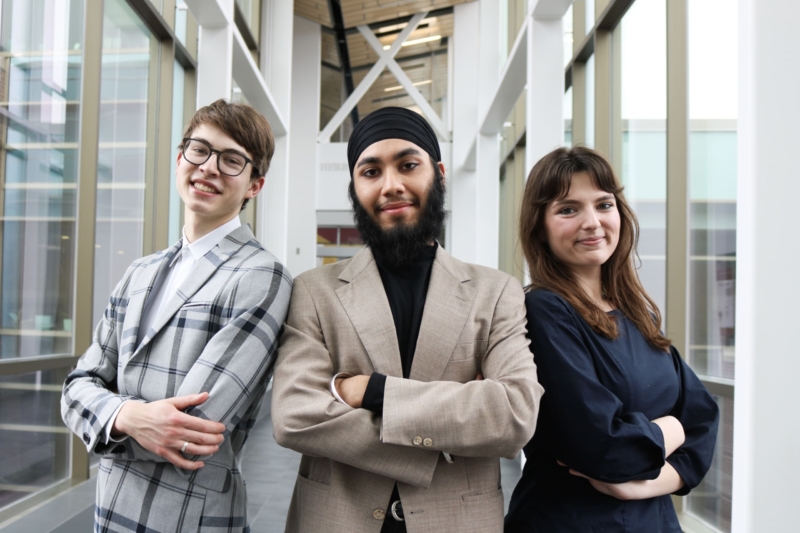
Isaac Porter (L), Gurasis Singh (C), Samra Bojcic (R), Echo Learn
FOCUS ON THE PROBLEM, NOT THE SOLUTION
The AssisTech SmartShower wasn’t the only product rooted in the challenges faced by student founders. Exhibit A: FrontRow Notes, a note-taking platform from the University of Texas’ McCombs School. It was inspired by one founder’s struggles to keep up with the pace of lectures. By the same token, Echo Learn was informed by Gurasis Singh’s academic struggles stemming from remote learning during the COVID shutdown. Now a student at the University of Minnesota’s Carlson School, Singh recalls going through the motions as a student, which required him to “learn how to learn again” when he started college. His platform, powered by AI, works in tandem in faculty, whose course materials are converted into personalized sessions where students learn by teaching back the content.
For Singh, starting a business was, in itself, a learning experience. “When I first started, I had a perfect vision of what our solution would look like,” he admits. “But after dozens of interviews with educators, institutional leaders, business experts, and tech specialists, I uncovered layers and perspectives I hadn’t even considered. Listening to your customer validate your problem is not only music to your ears, it’s ammunition to push the business. I often find myself both humbled and energized when I catch myself wondering, “Why didn’t I think of that?” during these interviews.”
Those ‘aha’ moments come courtesy of the business school programming. In his Entrepreneurship In Action course, for example, Singh learned a maxim that continues to inform the growth of Echo Learn: Marry your problem, not your solution – a warning not to put the proverbial cart (idea) before the horse (pain points). That point was hammered home in the Scheller College’s Business Lab, where the founders of PropertyPals were required to conduct 20 discovery interviews a week. At Babson College, Daniel Berlin was paired up with an alumni CEO in his Professional Sales Practicum course. The big takeaway? Selling is less about closing and more a process of building relationships and solving real issues. For Hannah Wissotzky, her Leadership & Creativity course at Haas seemed to speak directly to her venture.
“Everything we talked about – loneliness, belonging, connection, and how people show up for one another – directly shaped Quilly. I even collaborated on the curriculum, helping turn Quilly into a case study for the class. My biggest lesson: you can’t build community without designing for human behavior. People need nudges, structure, and leadership to form meaningful relationships.”

Akeil Smith, Basics
FACULTY MAKE A DIFFERENCE
Margaret Zhu credits the Wharton School with grounding her in business fundamentals like modeling and cash flows. However, she also praises her Business Communication course for hammering home an unforgettable lesson: Simplify, Simplify, Simplify!
“Tree care is a dense field that most people know little about. A large part of my role is communicating both the “why” behind our mission and the “how” behind our technology. It’s easy to get lost in engineering details, but this class taught me how to break down complex information into clear, compelling narratives that resonate with any audience. That ability has been especially important in investor pitches and partner meetings, where clarity and genuine enthusiasm make a huge difference.”
Beyond coursework, faculty members supplied invaluable support. At Babson College, Daniel Berlin describes Professor Brad Johnson as a sounding board, someone who would advise him on everything from navigating a dicey supply chain issue to crafting an attention-grabbing pitch deck. More than insights, faculty provided inspiration. That was certainly true of Dave Mawhinney at Carnegie Mellon University’s Tepper School, says Akeil Smith.
“From my first day at Carnegie Mellon, Dave created an environment where anyone, no matter their background or experience, felt empowered to start something of their own. He encouraged us to take action, send cold emails, show up, take risks, and do the things others might avoid. What I appreciated most was his openness to being questioned and challenged, which gave me the confidence to start my own company as an undergraduate and learn by being curious rather than complacent.”
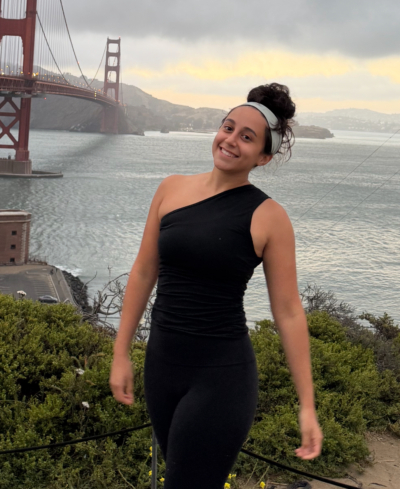
Sofia Marin, InvoGenix
ROLE MODELS TO FOLLOW
Disruptive student founders also found inspiration closer to home. Smith points to his parents, who launched their own accounting firm after working at Ernst & Young. Their example showed him the rewards that come when you commit to a vision and believe in yourself. Watching her mother pursue real estate inspired Georgia Tech’s Anna Wylly to dabble in ventures like depop resales before business school. While Sofia Marin’s father once warned her that he wouldn’t wish starting a business on anyone, his example ended up motivating her to do the same.
“He created his own rebellion, broke the odds, and channeled the love he was raised in – from the South Side of Chicago – to impact hundreds of people,” writes Marin, a junior at the University of Illinois. “He helps people with life insurance and money. That’s not what I want to do, but I want to be able to impact the way he does…He’s designed a bubble to impact and change people’s lives. My dad inspires me every day. He’s much more than my dad. He’s my mentor, companion and best friend.”
Student founders have also found inspiration in the leaders they’ve studied in business school. For the Wharton School’s Margaret Zhu, that person is Kiichiro Toyoda, the automaker’s namesake and pioneer of Kaizen, a management philosophy anchored in incremental and continuous improvement. Toyoda’s example has provided a template for her Serpent Robotics startup to follow.
“Like Toyota’s early years, our process is built on testing, refining, and learning from every prototype. We’ve developed multiple iterations of our system, improving performance and usability each time through close collaboration between designers, engineers, and business minds within our team. We’ve cultivated a talented and multidisciplinary group that ensures every decision incorporates technical function, user experience, and commercial viability. We hope that, just as Toyoda revolutionized the automobile industry, we can revolutionize the tree care industry.”
FROM IDEA TO IMPACT
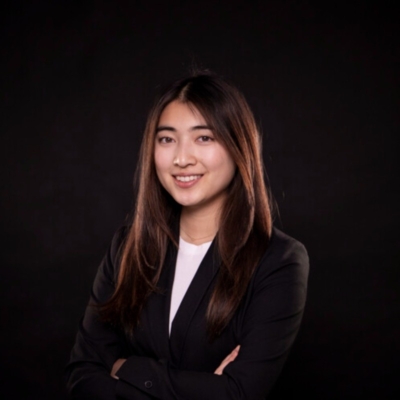
Margaret Zhu, Serpent Robotics
And Serpent Robotics’ ambitions don’t stop there. Long-term, they plan to become the global leader in “rope suspended robotics for dangerous vertical work.” That will require the firm to stretch its capabilities even further, adds Zhu.
“Ultimately, Serpent Robotics aims to be remembered as the company that made dangerous vertical work safe and accessible, just as JCB and Caterpillar transformed ground-level construction, and Boston Dynamics advanced legged robotics. For us, working on Serpent isn’t just about building a successful business or building cool robots; it’s about fundamentally changing the risk-reward calculus in industries where people currently trade their safety for their livelihood.”
When Serpent Robotics achieves this milestone, business writers will trace the firm’s success back to the Wharton School, along with the larger Penn community.
“We’ve been deeply supported by Venture Lab, which is Penn’s entrepreneurship hub,” Zhu continues. “We’re now part of VIP-X, Venture Lab’s accelerator program, and it’s been wonderful to have a cohort of founders to meet with every week, alongside the mentorship and support that comes with the program…Truly, we owe so much of our progress to the Penn ecosystem. From funding to mentorship to community, these programs have been instrumental in helping us turn Serpent from a student idea into a real company with real impact.”
Next Page: In-Depth Profiles of 22 Student Startups