

Yoram (Jerry) Wind, The Lauder Professor Emeritus and Professor of Marketing at Wharton, argues that creativity is an essential leadership skill as artificial intelligence reshapes how leaders think and decide.
For nearly 50 years, pioneering Wharton Professor Jerry Wind helped define how generations of MBA students think about markets, strategy, and leadership. He pioneered how creativity could be taught in business schools long before artificial intelligence entered everyday work.
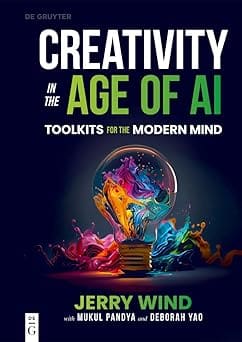
Now, as generative AI reshapes how ideas are formed and decisions are made, Wind’s new book Creativity in the Age of AI (De Gruyter, October 2025) argues that creativity is the leadership skill that matters most, and that AI, used thoughtfully, can become a powerful catalyst.
“Creativity is not just for artists. It applies to every individual and to every decision—personal, organizational, and societal. Our collective inability to address fundamental challenges such as inequality, education gaps, homelessness, gun violence, and political polarization represents a broader failure of imagination and creative problem-solving,” says Wind, The Lauder Professor Emeritus and Professor of Marketing at Wharton.
“AI doesn’t replace creativity, it amplifies it. The quality of the outcome reflects the creativity of the person using it.”
Q&A WITH JERRY WIND
Yoram (Jerry) Wind joined the University of Pennsylvania in 1967. Before taking emeritus status in 2017, he taught nearly every marketing course, ran Wharton’s SEI Center for Advanced Studies in Management for three decades, led development of the school’s Executive MBA, created the Lauder Institute, and led the 1990 MBA curriculum redesign that helped propel Wharton to the top of rankings.
He also founded the Wharton Fellows Program, taking senior executives around the world to study organizations redefining industries, a front-row seat to creativity in action.
That work ultimately led to the creation of Wind’s pioneering creativity course, one of Wharton’s most popular MBA electives, which he taught for more than a decade. The course explored how people from business to music to medicine generate new ideas, challenge mental models, and push past institutional inertia. When Coursera later asked Wind to scale those ideas, the result was a creativity course designed for learners of all ages and professions, featuring insights from 60 creative leaders across fields.
Then came AI. As generative tools reshaped how people write, design, compose, and decide, Wind wrote Creativity in the Age of AI as both a course companion and a guide for people looking to scale their own potential. Drawing on neuroscience, decades of teaching, and practical experimentation, Wind and co-authors Mukul Pandya and Deborah Yao lay out 12 approaches anyone can use to become more creative as well as how AI can enhance each one.
Poets&Quants recently sat down with Wind to talk about what business education gets right about AI, what it gets wrong, and why courageous, persistent creativity may be the most important leadership skill of the AI era. Our conversation has been edited for length and clarity.
To start, when did you start thinking about creativity as an MBA course at a place like Wharton, which is traditionally known for finance? How did that begin?
The core courses I taught over the years were always marketing strategy. My orientation has consistently been marketing as a lens for business strategy and corporate strategy, and marketing naturally goes hand in hand with innovation. The only way to develop effective marketing strategies—especially as the world keeps changing—is to come up with more innovative approaches.
Over time, I realized that in my marketing strategy courses, and others, there was an increasing emphasis on creativity and innovation. The students really responded to it, and I began to feel that this dimension was missing from the broader curriculum.
That realization probably goes back 25 or even 30 years. I ultimately developed and taught the creativity course at Wharton for about a dozen years.
The title of your book, Creativity in the Age of AI, gets to a fundamental tension between the two. My college-age son is something of an AI alarmist. He worries about a future where people are listening to AI-generated music, watching AI-generated movies, and reading AI-generated books. How do you think about what AI means for creativity as a human endeavor?
 I think it’s a great question, and I’m glad your son is at least thinking seriously about it. AI is a tool—an incredibly powerful tool. There are areas where AI can do things better than humans, and I’ll give you an example from customer service.
I’m working with a firm called Quant AI, an exceptional company in New York. It was founded about 25 years ago by Chetan Dube, who had been an assistant professor of mathematics at NYU before leaving academia to start a technology company. Over time, the firm evolved into AI and became one of the pioneers in conversational AI. About three years ago, they also moved into agentic AI and developed a very powerful agentic customer service system that can replace roughly 70% of the workforce in that area.
What’s interesting is that the system isn’t just more efficient—customers actually like it better than human agents. The Net Promoter Scores for AI-driven customer service are far higher than those for human service. That makes sense. When you deal with humans, you’re often transferred from one person to another, repeatedly asked for identification, and still don’t get your problem resolved. With agentic AI, the system can actually solve the problem. It doesn’t just provide information; it takes action.
So there are areas where AI can effectively replace humans. At the same time, in many other domains, AI is an extraordinary tool that enhances creativity, problem formulation, and the kinds of decisions executives need to make.
I would encourage your son not to see AI as something that replaces him, but as something that enhances what he can do. For example, ask him to use an AI platform—whether ChatGPT, Claude, or another—to plan a trip he’s interested in taking.
I recently did exactly that. In Paris, there’s a major celebration of the 100th anniversary of Art Deco, with exhibitions across multiple museums. We’re planning to go after Christmas, which is a tricky time because many museums have limited hours. I used ChatGPT to plan the trip. I explained our interests, the dates we’d be there, and asked it to identify the exhibitions worth seeing and create an itinerary. After about 45 minutes of interaction, it produced an excellent plan.
Another example: about two years ago, I was asked to give a lecture to a group of CEOs on AI, innovation, and the future of marketing. I wanted to end with something creative to illustrate AI’s potential. I asked an AI platform—at the time it may have been an early version of ChatGPT—to write a poem about AI innovation and the future of marketing. After less than 15 minutes, and a few rounds of interaction, it produced an excellent poem. I have zero talent for poetry. It would have taken me a year to come up with something inferior. The AI did it in minutes.
So I would tell your son: don’t dismiss AI as something that will replace you. It will enhance you. It will give you extraordinary capabilities.
And when you think about the publication you lead, Poets&Quants, it’s actually an ideal metaphor. You’re combining poetry—leadership, creativity, ethics, meaning—with analytics, rigor, data, and performance. That’s exactly what AI enables. It allows you to fuse quantitative power with human creativity to arrive at better solutions.
In business, the benefits of AI seems clear – better employee productivity, higher sales, etc. But what about purely creative endeavors? If someone is a composer using AI as a tool, does that devalue the final product, or is AI simply enhancing what they could have done anyway?
It’s interesting you mention composers, because that’s one reason I’m on the board of the Curtis Institute of Music. I’ve been very involved there and have worked closely with the provost, who also happens to be a composer and the head of composition.
AI is already being used by composers today. It’s part of the tool set, much like the typewriter once was, and later the computer. Composers are using AI all the time now, and there are many ways to think about what that means.
I edited a special issue of Management & Business Review on AI and customer engagement. One of the papers, “Resurrecting Jimi Hendrix,” is remarkable. The researchers looked at a group of 25 composers and musicians who died very young, before the age of 25. They took the existing music of these composers and asked AI to continue composing, to generate what might have been their next piece. They then brought in experts who deeply knew the work of these composers, and most of them could not tell the difference between the original compositions and the AI-generated continuations.
That’s an extreme application of AI. A related and more current area of interest is the idea of unfinished works, asking what might happen if AI were used to complete them.
There was also a fascinating example involving the Philadelphia Orchestra and the work of Refik Anadol, who is one of the leading AI artists today. He took a piece of music—I believe it was Beethoven—fed it into his AI system, and asked it to generate images based on the AI’s “hallucinations” or reactions to the music. During the performance, a large screen behind the orchestra projected these AI-generated visuals in real time as the music was played.
It was an extraordinary experience because it completely changed how the audience engaged with the performance. Instead of just listening and watching the conductor and musicians, the audience had a fully immersive visual and auditory experience.
These are powerful examples of how AI can be used effectively in music. For composers working day to day, AI is becoming another tool they can draw on. Ultimately, the results depend on the composer’s own creativity and how thoughtfully they use the tool. AI doesn’t replace creativity—it amplifies it, and the quality of the outcome reflects the creativity of the person using it.
One more question and I’ll get off this tangent: If there were a song you loved and later found out it was created mostly by AI, would that take away any of its artistic value for you?
No, not really. For me, it would actually be quite exciting. But I think we need to distinguish between two different situations. One is a song created purely by AI, with no human involvement at all. You feed the system the scene, the mood, whatever you want to convey, and it generates a song on its own.
The other scenario—and this is the one I find far more compelling—is when AI is used in collaboration with a human creator. You might start in the same way, using AI to generate ideas or a first version, but then you work with a composer or a lyricist, and together they shape the final piece.
That’s really the model I advocate. In the book, each chapter opens with an image that was created through a collaboration between AI and a human designer. I provided the direction and the concept for each chapter, the AI generated an image based on that prompt, and then a designer refined and perfected it.
For example, there’s a chapter on overcoming obstacles to creativity and innovation. The idea we gave the AI was to imagine a runner trying to clear hurdles. The resulting image came from the AI, but the final version in the book reflects a human designer’s judgment and refinement.
That’s the key distinction. AI alone can produce something interesting. But when AI and a human creator work together, the result is usually stronger, richer, and more meaningful. So going back to your example, I would feel better—and I think the outcome would be better—if the song were created through a collaboration between AI and a composer, rather than by AI alone.
Who is this book for? Executives, workers, professors, students? All of the above?
Actually, it’s for everyone. The idea grew out of the Coursera course, which they approached me about because they wanted to expand their global reach. They asked me to identify a few topics, and creativity was one of them. My mandate for the course was to develop it for all ages and all professions.
The book is even broader. It’s intended for people of all ages and across all professions, including those who will never take the course but are intrigued by the idea that everyone can enhance their creativity by using the right approaches. The book lays out 12 sets of approaches to enhancing creativity and encourages readers to experiment with them in their own lives and work.
It also encourages people, as they use any of these approaches, to incorporate AI in order to turbocharge and amplify their creative efforts.
My hope is that the book reaches a very wide audience. For example, I recently sent a digital copy to a colleague in another country, and he shared it with his teenage daughter. She loved it and has already started experimenting with some of the approaches. That wasn’t my original expectation, but the more I talk about the book and share it, the more I see people passing it along to their children. The kids seem to enjoy it and are using both the creativity approaches and the AI tools of their choice to enhance what they’re working on.
Do you have one or two approaches from the book that really illustrate what you’re talking about?
There are two fundamentals that really frame everything else.
The first is what I call the “challenge your mental models” approach. This is absolutely critical, because you cannot be creative—and you will not come up with creative ideas—if you simply continue doing exactly what you’ve done before. The environment is changing so fast and so dramatically. That’s true whether you’re looking at politics, technology, advances in medicine, the attitudes of younger generations, or the deep political divisions we see in many countries. The changes are so profound that continuing to rely on old assumptions just doesn’t work.
Yet most people are very comfortable doing exactly what they’ve always done. So rule number one, and the first approach in the book, is to challenge your mental models and challenge the status quo. This idea actually goes back to a book I published about 12 years ago, The Power of Impossible Thinking, which focused entirely on challenging mental models and outlined different ways to do that. The first chapter of this book draws heavily on that thinking.
There are many ways to challenge your mental models. You can ask, “What if what I’m doing is wrong, and I should do the opposite?” You can develop radically different scenarios about how the environment around your product or service might evolve. You can ask, “What if this became obsolete?” or “What if a completely new competitor entered the space?” AI can be incredibly helpful here, because it can generate alternative scenarios and perspectives you might not consider on your own.
One of the specific techniques I use to illustrate this is morphological analysis. In this approach, you take a problem or solution and break it down into components. For example, if you’re trying to raise funds for a nonprofit, you might identify categories such as: Who are you approaching? What message are you using? How are you approaching them? Who is delivering the message? When are you reaching out?
Within each category, there are many possible options. The message, for instance, could focus on education, on saving children, on community impact, or on any number of other motivations. Morphological analysis encourages you to generate as many categories and options as possible, and then look horizontally across them to explore different combinations. Each horizontal combination becomes a distinct strategy.
When you bring AI into this process, it becomes even more powerful. You can ask the AI to suggest additional categories you may have missed, generate more options within each category, and then question those options. You can ask, “Why is this a good idea?” “What evidence supports it?” “What if this assumption isn’t true?” “How else could this be improved?” By interacting with AI as a smart assistant in this way, you dramatically expand the range of possibilities beyond what you initially imagined.
The other fundamental approach, which comes at the end of the book, is courage and persistence. Without the courage to challenge existing mental models and experiment with ideas that may feel risky, and without the persistence to keep going despite resistance and inevitable setbacks, nothing will actually change. Creativity requires action, not just ideas.
So the message I’d want to leave with your readers is this: use some of the approaches in the book to enhance your creativity, use AI to amplify each of those approaches, consistently challenge the status quo, and have the courage and persistence to experiment and implement them.
In the context of creativity and AI, what do you think business education is doing well today and what does it need to do better?
You’re touching on one of my favorite topics, and it goes far beyond creativity alone. About 11 years ago, I co-founded the Reimagine Education Global Competition and Conference. I did this while I was still running the Wharton think tank, SEI Center for Advanced Studies in Management, in collaboration with QS.
Each year, we issue a global call for the most innovative pedagogical approaches in higher education. We receive about 1,500 applications annually, and over the years, that has totaled roughly 15,000 submissions. At the end of each cycle, we award prizes across about 28 categories, including major awards with $25,000 in cash and an additional $25,000 in Amazon Web Services credits for the winners.
So I’ve been deeply focused on creativity and innovation in education for a long time. What business schools do well at both the MBA and undergraduate levels is provide a forum for interaction with other very smart people. They create powerful, lifelong networks, both among classmates and through alumni, and they deliver a strong institutional brand.
Unfortunately, the content itself has become increasingly commoditized. Today, many students choose schools based primarily on brand and network, not on what is actually taught. The core content is often very similar across institutions. One difference at the very top schools is that students may be taught by the people who wrote the books, rather than by faculty who are only a chapter ahead of the class, but even so, the overall curriculum looks remarkably alike.
I believe higher education, in general, needs major change. In many ways, we have failed. Look at society today: people are increasingly unwilling to listen to opposing views. There is deep ideological division, rampant greed, widespread corruption, and a lack of shared values. These outcomes reflect, at least in part, a failure of our education systems. We educate people for four, six, or more years, and then we see the results.
Business education, in particular, does well on the analytical and quantitative side. That’s partly due to selection bias—programs admit students who already perform well on quantitative exams—but the emphasis is clearly there. Where business education performs very poorly, across the board, is in developing creativity, imagination, and the ability to frame problems when information is incomplete, biased, or entirely missing.
Creativity is not just for artists. It applies to every individual and to every decision—personal, organizational, and societal. Our collective inability to address fundamental challenges such as inequality, education gaps, homelessness, gun violence, and political polarization represents a broader failure of imagination and creative problem-solving.
That’s why I think Poets&Quants is uniquely positioned to lead this conversation. Business education today is heavily weighted toward the quantitative side, without enough emphasis on integration. Creativity offers a powerful bridge. The goal isn’t to replace analytics, but to integrate rigor, data, and performance with imagination, ethics, meaning, and creative thinking. That integration is really the hope behind this book.
Can you give an example of how the frameworks or approaches in your book could help a professor or business school dean who is thinking seriously about these issues?
It starts with challenging the current approach. We need to question the assumption that the way education is structured today is designed for the benefit of the learner. In reality, much of it is designed for the convenience of administrators.
Take the basic structure of most MBA and undergraduate courses. We teach over 12 or 13 weeks, meeting twice a week in 80- or 90-minute intervals. There is zero evidence that this is the most effective way to learn. It exists largely because it is convenient for scheduling.
Or consider the dominant pedagogical method: the lecture. Even with a good lecturer, average comprehension from lectures is typically below 20%. We know from decades of research that the most effective form of learning is experiential—when students actually apply what they are learning.
There are proven alternatives. One example is the flipped classroom model. In this approach, content delivery happens outside the classroom, traditionally through recorded videos, but now increasingly through AI-enabled tools. With AI, content can be delivered on a smartphone, 24/7, in any language, adjusted to different learning styles. Students can move quickly if they grasp the material or repeat it as many times as they need until it truly sinks in.
Then, when students come together in person, the focus shifts to application. The role of the faculty member changes dramatically—from standing in front of the room and lecturing to serving as a mentor, coach, and motivator, helping students apply ideas, work through challenges, and learn from experimentation. This approach is far more effective, yet it is still used in only a handful of institutions.
Why? Because many faculty members are more comfortable continuing to lecture on material they’ve taught for years. Even the physical design of classrooms works against innovation. Most classrooms are built in rows or semi-circles facing the instructor, reinforcing passive listening rather than interaction, collaboration, or small-group problem-solving. The architecture itself discourages experimentation.
If you examine nearly every aspect of the education system today, you’ll see the same pattern. It was not designed for today’s environment, nor does it reflect what we now know about how people learn best. That’s why one of the core messages of the book is the need for dramatic change in education—starting with the courage to challenge long-standing assumptions and redesign learning around the needs of today’s learners.
DON’T MISS: 2025 BUSINESS SCHOOL RANKINGS: THE COMPLETE COLLECTION AND COMMENTARY: THE MBA IS SPLITTING IN TWO. HERE’S WHICH SIDE YOUR SCHOOL IS ON
The post Books For MBAs: Wharton’s Jerry Wind On Creativity, Leadership, And The Age Of AI appeared first on Poets&Quants.