
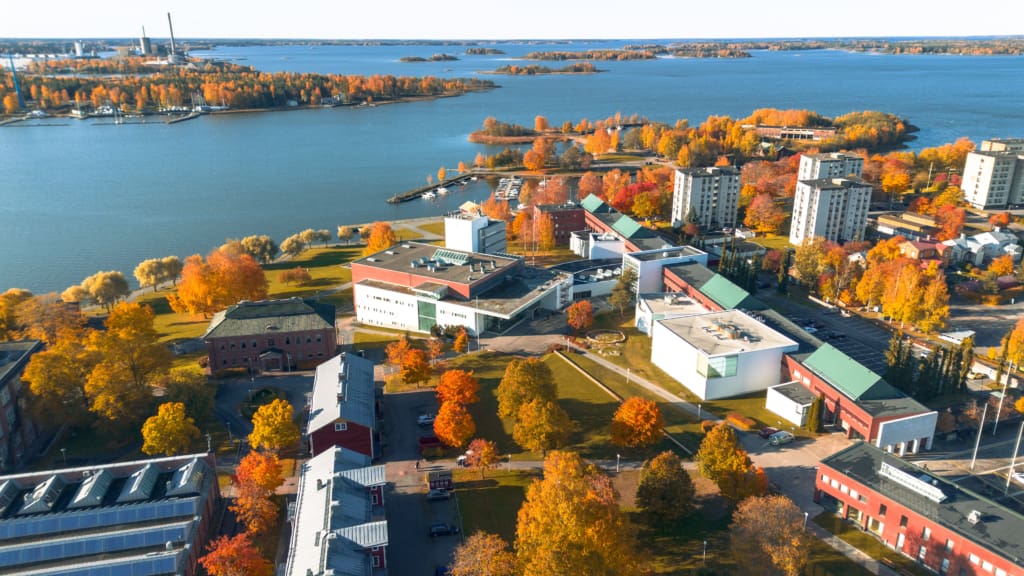
The University of Vaasa campus sits along Finland’s western “export coast,” where the school has built its strategy around sustainable business, energy, and society, closely linking business education with the region’s energy industry and climate transition goals.
Finns often describe their country’s outline as a dancing maiden. Finland’s westward reach into the Gulf of Bothnia is the lady’s skirt caught in the wind, the narrow midsection her slim waist, Lapland’s northern bulge her head. The long sweep of Lapland forms her raised arm, lifted as if waving or spinning.
Vaasa sits at the knee. The city of about 75,000 people anchors the Ostrobothnia region on the western “export coast,” home to a dense cluster of global energy companies as well as small and medium-sized enterprises.
It is here that the University of Vaasa is carving out a niche in business education for the energy transition.
“We describe ourselves as a university centered on making and supporting the energy transition toward carbon neutrality,” says Minna Martikainen, Vaasa rector since 2023, and a professor of financial accounting.
“This transition especially requires business renewal–new business models, clean financing, and financial mechanisms that can support very large, long-term investments.”
WHERE BUSINESS, ENERGY, AND SOCIETY INTERSECT
University of Vaasa has four academic schools, three of them focused on business disciplines: School of Management, School of Accounting and Finance, School of Marketing and Communication. Its fourth – School of Technology and Innovations – links engineering, digital systems, and applied innovation to Vaasa’s business roots.
It enrolls about 7,000 students across its bachelor’s, master’s, and doctoral programs.
In her three years as Rector, Martikainen is leading a strategy centered on three central pillars – sustainable business, energy, and society. The aim is not to layer sustainability onto existing programs, but to integrate business, technology, and social systems into a single model that reflects how the energy transition actually happens.
The university’s business education reflects that thinking. Finance students study investment behavior, valuation, and risk alongside the growing impact of AI on markets. Management students focus on strategy and business renewal. Marketing and communication students examine truth, knowledge, and media in a social environment shaped by digital platforms. Layered across all of it are cross-disciplinary modules in energy transition, digital economy and AI, innovation, and resilience.
That platform is increasingly resonating beyond Finland. International student enrollment has shot up nearly 400 percent last year alone, Martikainen tells P&Q. The university now enrolls around 450 international students and expects the number to reach around 3,000 in six years.
Part of the interest stems from the changing prospects for international business students in the U.S., part of it from the university’s commitment to a cleaner, kinder society.
Q&A WITH MINNA MARTIKAINEN
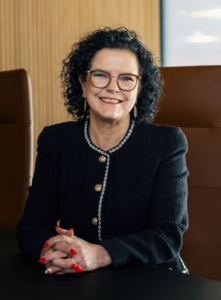
Minna Martikainen, Vaasa rector
Finland is a logical base for a university with Vaasa’s stated strategy. The country is a world leader in environmental policy, including a national goal of carbon neutrality by 2035 and an aggressive shift to a circular economy.
Martikainen previously served as vice rector for research at the University of Vaasa. Her academic career spans leadership and faculty roles across Finland’s top business schools, including professor of financial accounting and dean for education at Hanken School of Economics, and professor at Aalto University School of Business. She has also held senior posts at Lappeenranta University of Technology, where she was vice rector for international affairs and professor of business finance and accounting.
Poets&Quants spoke with Martikainen about values-driven strategy, its growing international footprint, and what the energy transition demands from business education. Our conversation has been edited for length and clarity.
To set some context, briefly explain what the city or region is known for and how that shapes the university’s identity.
First of all, the western side of Finland is known as an export area. If we compare the share of exports relative to gross national product, this is the most export-dense area in the country. We even call Western Finland the “export coast” of Finland, which includes Ostrobothnia.
In Finland, we sometimes describe the country as resembling a dancing female figure, and Vaasa is located at the knee. Ostrobothnia as a region is very well known not only for exports, but also for its high density of SMEs (small and medium-sized enterprises).
In Vaasa specifically, we have a very strong and growing energy sector. We are known as the Nordic energy capital. There are four globally listed energy sector companies located in the city—Wärtsilä, Danfoss, ABB, and Hitachi–in a city with about 75,000 inhabitants and around 15,000 students.
So this is very much an area of knowledge. That is how I would put it.
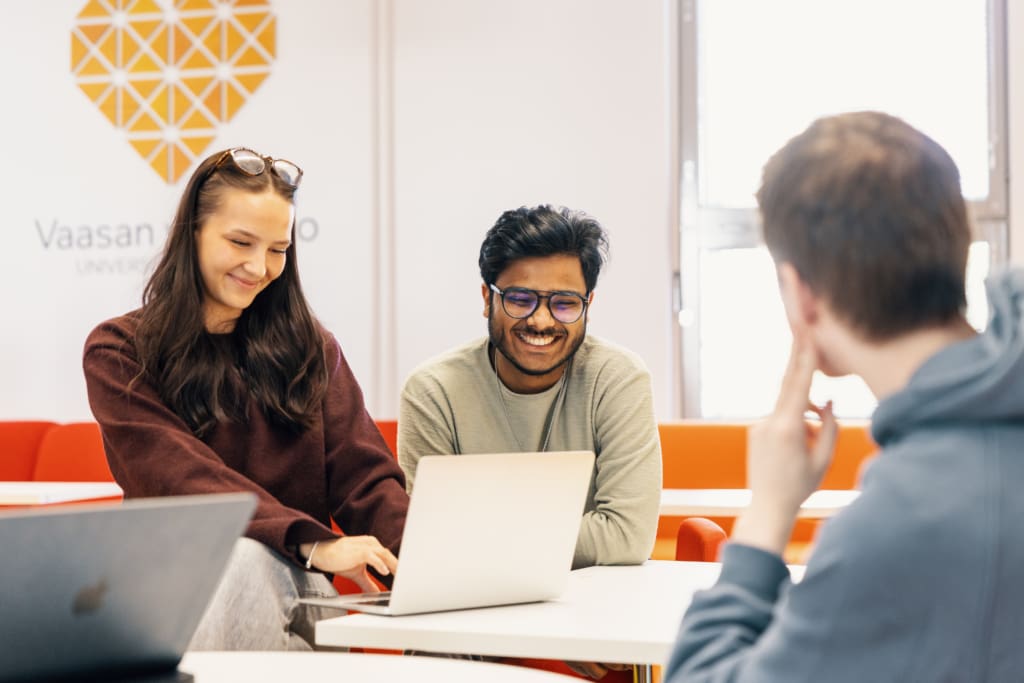
Students collaborate on campus at the University of Vaasa, where cross-disciplinary learning in business, technology, and energy transition is built directly into everyday coursework.
How does the university, and the business school in particular, define its identity within that context?
At the university, we actually have three business units. We call them schools, covering accounting and finance, management, marketing and communication, along with one technical unit focused on technology and innovation. So we are a university that combines business with technology, particularly around business renewal linked to the energy transition, and we also include elements of the social sciences.
We describe ourselves as a university centered on making and supporting the energy transition toward carbon neutrality. This transition especially requires business renewal—new business models, clean financing, and financial mechanisms that can support very large, long-term investments. This is something financial markets are not typically designed for. The time horizon of financial markets is usually up to five years at most, even when considered long term.
By contrast, investments required to support carbon neutrality and prevent climate change often have investment periods of 15 to 30 years. These are exactly the areas where we focus our expertise. We see ourselves as being at the forefront of what is needed to enable this transition and, ultimately, to help address climate change.
Have Vaasa’s strategic pillars – sustainable business, energy, and society – always been core to the university?
No, actually, this is our new strategy; We started working on it during my first year as rector.
Of course, a strategy needs to be based on something strong. As a leader, I felt that this university has many “jewelry stores” inside it—strong capabilities that were not very visible or shining if they were not clearly brought forward and placed on a platform through strategy. That is what we have been doing.
The university has very strong areas in research and education, and the goal has been to articulate more precisely what we are doing and to communicate clearly what kinds of professionals we are educating and what our strengths truly are.
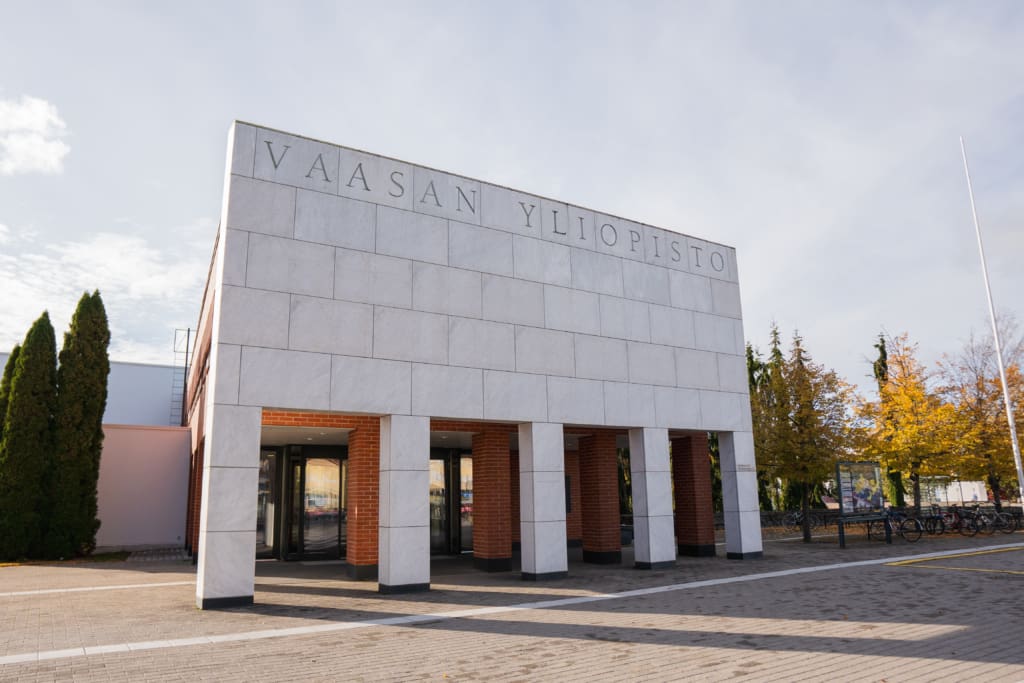
The University of Vaasa’s entrance anchors a campus that blends historic industrial architecture with a future-focused mission centered on sustainable business, energy, and society.
How do those three pillars show up in practice through courses, research, or experiential learning?
In the business school, for example, in the School of Accounting and Finance, we have Finland’s largest finance program. It is highly specialized in understanding investment strategies—the behavior of finance, the behavior of investments, and the behavior of capital in financial markets. It also focuses strongly on company valuation.
A core part of this work is examining how the behavior of money and capital changes over time, how risk is priced and rewarded, and how developments such as AI and digital systems are influencing financial markets and investor behavior.
In our management school, strategic development and strategy are very strong focus areas. In the marketing and communication unit, there is deep expertise in understanding the value of communication tools—how communication works, how meaning is created, and how to assess what is true in real time in the age of social media. That area has been growing very fast.
Across the business school more broadly, we also focus on sustainable economies, international growth, innovation, and public value. Coming from Finland as a welfare state, there is a strong understanding of the role of public institutions and public finances. We pay relatively high taxes, and while taxes are debated during political elections, there is broad support for the idea that we need a strong welfare economy so the country can do well.
The thinking is that people are willing to contribute so that others—our neighbors and their children—can afford access to education and public services. In that sense, Finland offers strong possibilities. Education is free all the way through the master’s level, and at the doctoral level, students are employed and receive a salary.
How does your strategy translate into the way programs are structured, particularly when it comes to multidisciplinary learning?
We offer cross-disciplinary studies that students can choose alongside their main program. We call these multidisciplinary modules.
For example, there is a module focused on the digital economy and AI, typically a 20 ECTS package (European Credit Transfer and Accumulation System), which students can choose as part of their degree. There is also a module on energy and the energy transition from a business perspective, as well as a module focused on innovation.
The newest multidisciplinary module we offer focuses on resilience and preparedness from a comprehensive security perspective. We see this as hugely important for the future.
These modules are available at both the bachelor’s and master’s levels, but students are especially interested in them during their master’s studies. Students can choose anywhere from 20 ECTS up to 34 ECTS of cross-disciplinary studies within any master’s program. This structure is something we see as quite unique.
Many European business schools talk about sustainability and their commitment to it. What do you think truly differentiates Vaasa’s business education?
In my opinion, what makes us unique is that we approach sustainability from a systems point of view. That perspective is central to our work, and it connects directly to the carbon neutrality transition.
Our technical offering is what makes this strong. The same applies to digital economy and sustainability—creating sustainability through real change factors, not just talking about sustainable business models or sustainability as a concept. This is about true cross-disciplinary work that enables businesses to become more sustainable in practice.
We focus on deeply understanding the energy transition from a business perspective and on how business models need to change in order to address climate change. You cannot teach this properly without cross-disciplinary research.
It is also about educating business students to understand the technical side—to see and grasp the technicalities involved in these transitions.
Do you think this emphasis on climate transition has become a recruiting tool for Vaasa?
Absolutely. This is the change we need to make globally—to prevent climate change. Technical researchers are largely saying that the tools already exist. The science is almost there. But if businesses do not change, if the mindset of people does not change, and if the mindset of financial markets does not change, the transition will not happen at the scale or speed required.
We still talk about green money and black money, and there is still much more black money in the market seeking fast wins, rather than waiting for green, transitional returns that require patience. At the same time, AI trends are booming and reshaping markets, but AI is also dramatically increasing global electricity demand. If this trend continues as it is, there will not be enough capacity to support all of these data centers.
If we do not change how we approach this, there will eventually be a hard stop.
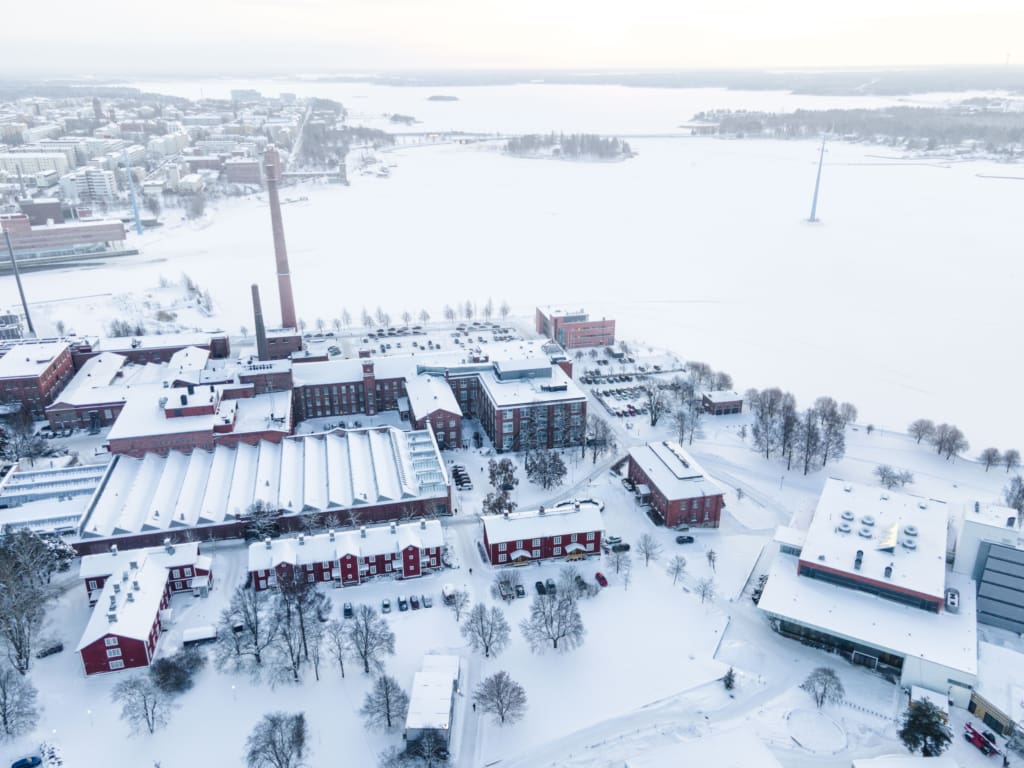
Snow blankets the University of Vaasa campus in winter, where the school’s close ties to Finland’s energy sector and its focus on sustainable business and long-term climate transition shape both research and teaching year-round.
I also understand that you’ve seen a sharp rise in international students. Can you put that into context and explain what you think is driving that growth?
We have seen a strong increase in international students. Of course, the percentage growth looks high partly because we did not previously have a large international student population in our overall mix. By 2030, our goal is that roughly one-third of our students will come from international markets.
The reason for this increase is very clear. Finland simply needs more workforce and more specialists. Our national population is declining significantly toward 2030, and there is ongoing debate about how the country should respond to that challenge. We want to be an example of a university that actively supports the country in this way.
At the same time, it is not only about attracting international students, but about educating them in a way that supports integration into society. We focus on educating specialists in areas that are highly valuable—not only globally, but specifically for Finland. We work to help them feel comfortable staying in the country, including teaching national languages.
In parallel, we also need to educate companies and the broader culture in Finland. Organizations need to become more experienced with international HR practices and more familiar with international ways of working, so that social and working environments are genuinely welcoming. It is a continuous learning process on both sides.
The growth has been very strong. Last year alone, the increase was close to 400%. We currently have around 400 to 500 international students, and by 2032, we expect that number to grow to approximately 3,000.
Given the turmoil in U.S. higher education, are you in a position to recruit students who might previously have considered a U.S. education?
We do see that interest in us has been increasing because of changes in the U.S. market, and we do welcome talent. We see constant movement and shifts in the international recruitment landscape.
I would say that Finland is becoming very attractive, especially at a time when hard values and facts seem to matter more than ever. As I mentioned earlier, Finland is a welfare country where people are willing to support one another and ensure that everyone can have a good life.
These values, in what is currently quite a cold world, resonate strongly. When people hear about them, they matter. One of the symbols of our university is a heart, and I keep that with me as a reminder. We genuinely care.
What about from the faculty side? Are you seeing increased interest from scientists and researchers who want to work with you?
Yes, absolutely. We do see growing interest from faculty and researchers, and for many of the same reasons.
We genuinely believe this is the right way to approach education and also to take care of economies. What is really striking—and you probably know this—is that only a very small percentage of the global population, something like two to three percent, controls almost 95% of global capital. At the same time, there is widespread poverty, hunger, and war.
If you think about it from the Finnish perspective, the mindset is very different. People are willing to pay more than 50% of their income in taxes so that their neighbor’s children can have the same quality of education as their own. That value system matters, and it resonates strongly with many academics.
How are you engaging with business and industry around Vaasa in the climate transition space?
We work very actively with the regional ecosystem. For example, we have joint research laboratories with Wärtsilä, which is a game changer in the marine industry’s transition toward carbon neutrality. One current project looks at engine technologies using argon and hydrogen, exploring whether that combination could be implemented in real applications so that diesel engines would ultimately produce water as the output.
That is just one example. Business students are also involved in these kinds of research projects, because they are directly connected to business model renewal. On the business side, we work very closely with corporations, financial institutions, and banks.
We also educate doctoral students together with our partners through what we call CoDoc models, where research problems come directly from industry and focus on what is most urgently needed by businesses. In addition, we have a pre-doctoral model in which students complete their graduate thesis work within companies, embedded in R&D projects.
We are very active in this kind of collaboration. We believe this is how universities should approach both education and research—through integrated cooperation—because it allows the impact of the work to be almost immediate.
What milestones or metrics are you watching over the next few years, especially following the revamp of the strategic plan? How are you measuring success across sustainability and climate transition?
I see the university, across all of our fields, becoming an internationally known and impactful institution. That means impact in education as well. Success would mean that people actively choose to come and study with us because they want to see and experience how change can be made toward a more stable society—how the energy transition happens alongside integrated business model renewal.
In terms of concrete measures, growth is one indicator. At the moment, we are growing at about 30% per year. Looking ahead, doubling the size of the university within 10 years would not be unrealistic.
Another key measure is research funding. Currently, a little under 20% of our funding comes from external research financing. By around 2032, I would like to see that figure closer to 50%. This is not about money itself, but about the value of knowledge. It reflects how attractive our science is, how strong our cooperation with partners and corporations is, and how relevant our research is to external funders.
That, in turn, signals the value of our scientists and the knowledge they produce. It also directly benefits students, because they are learning the most up-to-date knowledge—knowledge that has already demonstrated value to external partners and funders. This is how we see meaningful change taking place.
Do you offer an MBA, or do you focus more on master’s programs?
We do offer an MBA, but in Finland the MBA market is quite small. MBAs are not part of the official degree system in the same way as master’s degrees. Typically, if companies want to send someone to pursue an additional degree, they might choose an MBA, but overall the market is limited.
The reason is that we already educate at the master’s level in a way that is accessible to working professionals. People who are already employed can take our courses and participate in some of our programs, which are often scheduled on Thursdays, Fridays, and Saturdays. This allows them to continuously update and build on their education.
At the moment, this education is still completely free. Because of that, there is not really room for a large, paid MBA market in Finland. So while we do offer an MBA, it is on a relatively small scale.
Anything else you’d like to add?
I have tried to give a clear picture of why this type of university matters. We are small to medium-sized—rather small by Finnish standards, and medium-sized in Europe—but we strongly believe that universities like ours have a very important role to play.
These are the kinds of universities that seriously think about how education and research should be closely connected to companies and industry. Research and education should be oriented toward future solutions—solutions that no one fully knows yet, but where the answers exist if you combine disciplines and work hard together.
That is something I believe in very strongly.
The post The P&Q Interview: University Of Vaasa’s Minna Martikainen On Building A Business School For The Energy Transition appeared first on Poets&Quants.