
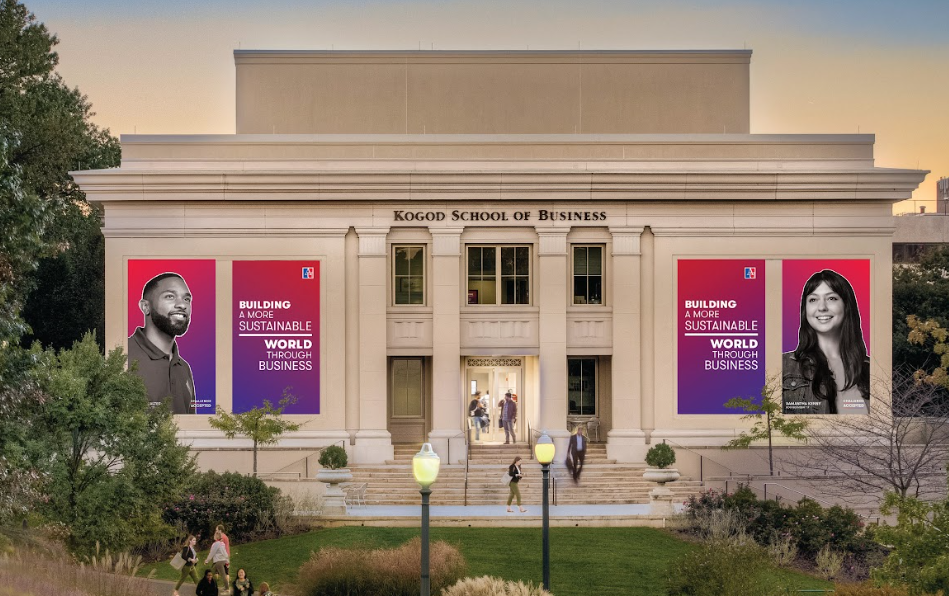
American University’s Kogod Business School rose 70 spots in Corporate Knights’ 2024 sustainability MBA ranking.
American University, Kogod School of Business
It was a wake-up call, a flashing red light, a bombshell. It was a simple observation. And it left an impression that changed everything for David Marchick, Dean of American University’s Kogod School of Business.
In 2023, the university had landed Alphabet CEO Sundar Pinchai and Google President Kent Walker as speakers. During a conversation about AI, it was Brett Wilson, a venture capitalist, who made a game-changing statement. He didn’t view AI itself as a threat to jobs. Instead, it was simply a means to separate the forward thinkers from the complacent.
“AI won’t replace your job, but another person who knows AI might replace you if you don’t know how to use AI in whatever you do – accounting, investing, marketing, or management,” Wilson told the audience.
This epiphany jolted Marchick into action. Rather than taking an academic slow-walk, he operated at a startup’s full-on sprint to “get in front of the parade.”
AI ALREADY DOING THE WORK OF A 22-YEAR-OLD ANALYST
Forget the half-measures and pilots that other schools were pursuing. Kogod went all-in on AI. To Marchick, AI wasn’t just a tool, but a “revolution” in how business would be conducted in the future. No longer would AI be relegated to a few courses, a concentration, or even a degree. At Kogod, AI has become the centerpiece of the program, a shift considering it had staked its claim as the MBA program for sustainability.
In less than a year, Kogod weaved artificial intelligence into every course, be it cases, exercises, or projects. Students used AI tools to handle everything from reading balance sheets to managing project details. All the while, the school had contracted with a private sector partner to train faculty and staff on items like prompt engineering. The program now offers four dozen AI-related electives, with an experiential bent towards using AI problem solving in real-world scenarios. As part of the MBA program, students use AI platforms to code, build presentations, and break down data sets. At the undergraduate level, students must complete a core technology course that covers AI and machine learning concepts.
Even more, Kogod has eschewed a one-size-fits all approach in favor of a more personalized pathway where students use tools that better align with their career goals. “This goes way beyond ChatGPT because in every field there are specialized AI tools,” Marchick told P&Q in a 2024 interview. “So any student, whether an undergraduate or a master’s student, who graduates will have fluency in AI in whatever field they want to pursue. This is not about someone being the best programmer. It’s about someone going into consulting or finance or accounting or HR.”
And if Marchick had any doubts about the wisdom of his AI commitment, he only needed to turn to one of his former partners at Carlyle. She laid out just how far AI had come in just a few short years. “She says AI allows us to underwrite companies, do discounted cash flow and other kinds of analysis,” says Marchick. “If they are looking at a roofing company, they can say ask AI for the trends in sales of shingled roofs for every publicly traded company over the last 16 quarters. It can analyze all the public reports for every public company in the world. She told me that, ‘This program does what I did when I was 22 and an analyst.’”
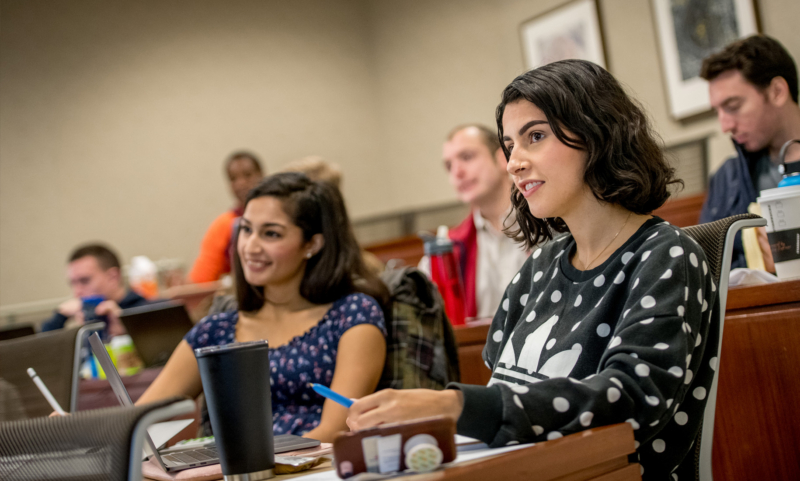
Kogod students
A MOMENT OF CLARITY…AND HUMILITY
In a 2025 essay for Poets&Quants, Marchick laid out exactly how far Kogod had come in less than a year. “By academic standards, our school has been moving on AI at light-speed. Since last fall, we have integrated AI into undergraduate and graduate programs, launched faculty training and created an AI speaker series. Our faculty now offer more than 40 AI-infused courses, teaching students to use AI for investments, research, presentations, data analysis, decision-making, and business innovation. Faculty are also leveraging AI in research and exploring its impact on business challenges. Poets&Quants called our initiative “the most consequential AI transformation in business education.”
If Marchick hoped to slow down and celebrate the school’s accomplishments, he was in for a rude awakening. In a trip to Silicon Valley, he witnessed first-hand what he called the “accelerating gap between academia and the future.” Amid a world of driverless cars, Marchick described the tech and academic worlds as “two species evolving in parallel, at different speeds, with little overlap.” It was a humbling realization that left Marchick wondering what value academia could have in an increasingly mercurial business landscape.
“AI has already become a companion for Gen Z; soon, it will function as their agent,” Marchick wrote. Universities are run by leaders in their 60s and 70s; we met with twenty-something senior tech executives, many with less than six months’ tenure in their roles… we departed San Francisco aware that universities are too stuck in their ways, unable to change quickly even when the world around them is darting ahead. That slow pace raises questions about higher education’s role and relevance.”
BACK TO THE BASICS
To that end, Marchick observes that institutions can enrich the conversation by studying AI’s “shortcomings” and providing a platform to offer solutions. This past year, Kogod has already opened an Institute for Applied Artificial Intelligence and starting a seed fund for AI and sustainability ventures. This year, the school also signed an AI deal with Perplexity, providing Kogod students with access to the latest versions of the largest language models. More than that, Perplexity empowers students and faculty to create their own tutors, study guides, and collaborators for their classes.
In the end, to truly navigate a world where AI is front-and-center, Marchick harkens back to Wilson’s point that galvanized Kogod’s revamp of its business school curriculum. It is the user – not the technology – that ultimately differentiates success from stagnation. In the end, Marchick emphasizes, that means taking education back to its roots to focus on the who over the what.
“As AI becomes even more powerful, core human skills like collaboration, oral communication, and teamwork will become even more critical. Many academics dismiss these skills as not sufficiently rigorous to merit faculty instruction. In a world increasingly shaped by AI, however, strong communication and effective collaboration will define the leaders who can navigate complex human interactions and drive innovation.”
DON’T MISS:
10 BUSINESS SCHOOLS TO WATCH IN 2025
10 BUSINESS SCHOOLS TO WATCH IN 2024
10 BUSINESS SCHOOLS TO WATCH IN 2023
10 BUSINESS SCHOOLS TO WATCH IN 2022
10 BUSINESS SCHOOLS TO WATCH IN 2021
10 BUSINESS SCHOOLS TO WATCH IN 2020
10 BUSINESS SCHOOLS TO WATCH IN 2019
BUSINESS SCHOOLS TO WATCH IN 2018
BUSINESS SCHOOLS TO WATCH IN 2017
BUSINESS SCHOOLS TO WATCH IN 2016
The post 10 Business Schools To Watch In 2026 appeared first on Poets&Quants.