
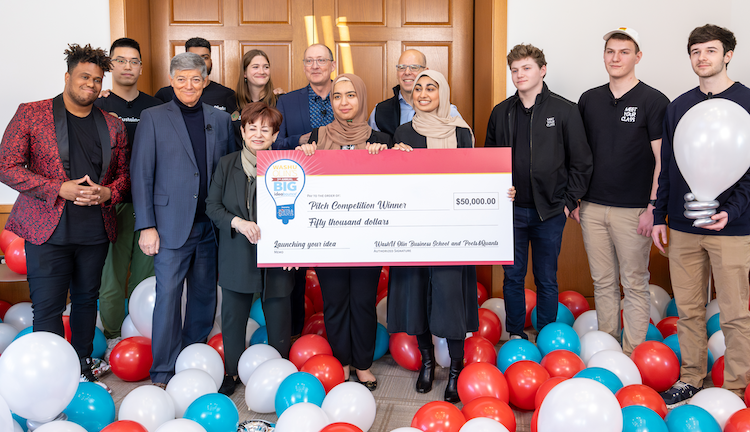
The three finalist teams in the 2024 WashU Olin BIG IdeaBounce competition with the judges and Olin Dean 2024 WashU Olin BIG IdeaBounce and Doug Villhard, academic director for entrepreneurship at Washington University
Washington University, Olin Business School
Adapting…Reinventing…Transforming.
Getting out front…Staying a step ahead…Preparing for what’s next.
That’s the heart of business: Being flexible and anticipating the future. Amazon pivoted from mailing DVDs to streaming content. Apple shifted from computers to iPhones. Even Henry Ford powered his first vehicle with steam!
Among business schools, you’ll find several institutions open to overhauling already-successful formulas. At the top of the list is Washington University’s Olin School. Originally, the MBA program staked its reputation on academic excellence and small community intimacy. Over time, it evolved into an entrepreneurship powerhouse. In 2019, it earned Poets&Quants’ MBA Program of the Year for its Global Immersion. In 2023, Olin made P&Q’s ‘Business Schools To Watch’ list for its stunning moves up the business school rankings and its establishment of its core pillars.
All of these areas remain program strengths – Olin even cracked the Top 20 in P&Q’s composite MBA Ranking for 2025-2026. This momentum has enabled the school to attract more applications than ever. And it continues to rank among the Top 10 undergraduate business schools as well. Despite its successes, Olin continues to makeover its MBA program, recognizing that complacency leads to irrelevancy.
MORE ELECTIVES, FEWER CORE COURSES
And that was particularly true in 2025. Let’s start with the curriculum revamp. To begin, the school added seven – seven – new concentrations to bring its total offerings to a dozen. These include Brand & Product Management, Business Analytics, Financial Technology, Health, Leadership & Human Capital Management, Private Capital & Strategic Ownership, and Wealth & Asset Management. On top of that, Olin reduced core courses and increased electives. As a result, students can better customize their experience and devote more time to their career interests and goals, says Evan Bouffides, senior associate dean of graduate programs at Olin.
In fact, 50% of the MBA coursework is now electives, according to Luke Bretscher, Assistant Dean and Director of Recruitment and Admissions. Even more, these changes were the result of a listening tour that included students, faculty, alumni, and employers on how market demands – much like MBA curriculum – are ever-evolving.
“The refreshed MBA curriculum reflects some of the core tenets of success outlined in Olin’s recently launched strategic plan: offering a distinctive approach to individualized business education that is highly tailored to each student’s purpose and connected to an engaged business community, preparing graduates for their next jobs as well as their long-term careers,” Bouffides tells P&Q.

Washington University Olin Business School
NEW OFFERINGS IN AI
When it comes to programming, Olin didn’t stop with launching seven new concentrations last fall. In January, the school announced it would add three specialized master’s degree programs next fall. Covering Artificial Intelligence, Wealth Management, and Sports Business, these degrees last one year (with Sports Business running three semesters). Even more, they provide professionals with an alternative to a longer and more generalized MBA degree.
The AI for Business master’s degree is grounded in employer outreach, making it quite different from offerings at other institutions, says Durai Sundaramoorthi, Professor of Practice in Data Analytics, in a 2026 interview with P&Q.
“Everyone is coming out with their version of an AI degree, and some of it is just recasting older courses,” he says. “For our program at Olin, we created net-new custom courses informed by the needs we’re hearing from employers.”
THE NEXT BIG THING: HEALTHCARE
The increased emphasis on Healthcare remains Olin’s biggest shift, however. The addition of a Health concentration stems from student demand. According to Evan Bouffides, 15% of 2025 MBA graduates came to the school with a background in healthcare (tying it with financial services). The school also maintains a Healthcare major at the undergraduate level and a similar specialization in its Online Flex MBA program. At the same time, the school is also executing a Business of Health Strategic Initiative, which focuses on boosting research, coursework, partnerships, and international events in the field. With the latter, the school hosts a monthly Health Decoded event, which has hosted guests ranging from venture capitalist John Kuelper to Kristi Hampton, former deputy director of the FDA.
Certainly, the field is lucrative. Bouffides points to health holding a 20% share of the U.S. GDP, with the school pointing to a 9% growth rate over the next decade. Already, the school has begun partnering with health systems, biotech firms, and insurers, while looking to lean into its alumni network in Minneapolis’ Medical Alley. Closer to home, the school boasts an advantage that few business schools can match: one of the premier medical schools in the Midwest.
“WashU Olin is in an ideal position to drive the business of health by leveraging strong partnerships with WashU’s renowned Schools of Medicine and Public Health to share ideas, collaborate on research, and educate students,” Bouffides tells P&Q. “St. Louis is also home to a dynamic health ecosystem with organizations ranging from biotech startups to leading health systems.”
That makes the Olin’s approach quite different, adds Patrick Aguilar, managing director of health at the Olin Business School, in a 2025 interview with P&Q. “Everyone is thinking about health, but most are not thinking with a School of Medicine and a School of Public Health.”

Patrick Aguilar, managing director of the WashU Olin Health Initiative, with winner Miles Lanham
#1 MBA ENTREPRENEURSHIP PROGRAM IN THE WORLD
While Health may further distinguish Olin in the future, it is Entrepreneurship that’s the here-and-now. For the 5th time in the last six years, Olin reigns as the World’s Top MBA Program for Entrepreneurship according to Poets&Quants. Just look at the underlying numbers. Among MBAs who graduated from 2020-2024, 27.8% launched startups within three months of graduation – highest of any business school around the globe. Looking for engagement? 91% of Olin MBAs are involved in startups as students, with 86% taking an entrepreneurship elective or more. Looking for support? Olin ranks 1st in both student-to-mentor ratio and mentorship hours per student at 5.53-to-1 and 129.10 respectively. Most of all, the school averages $19,528 per student venture in funding.
At Olin, MBAs learn entrepreneurship by experiencing entrepreneurship, be it staring their own venture or working on a startup from a classmate, school partner, or alumni member – or all of the above. In the end, the hope is that Olin students will have come far enough to create their own job by graduation, says Franklin Taylor, a ’24 MBA alum and founder of a platform offering curated offers to local shops.
“The education at Olin is like a ‘build your own adventure.’ If you bring your venture into class and apply the lessons directly, you’ll be in a strong position after graduation.”
PART OF A LARGER UNIVERSITY STARTUP ECOSYSTEM
The school boasts plenty of resources to do just that. That starts with the Skandalaris Center for Interdisciplinary and Entrepreneurship, an umbrella that brings together the eight different schools that comprise the university. Along with providing courses, the center offerings include competitions, internships, networking and speaker events, and competitions. It even operates a law clinic that covers areas like intellectual property.
“At many universities, the business school is separate from the main campus,” says II Luscri, Managing Director of the Skandalaris Center. “At WashU, Olin sits right in the middle of everything. You’re getting a lot of interactions with the entire campus community that creates ongoing ideation and support from that. Students in the MBA classrooms are sitting alongside engineers and law students.”
‘Fall in love with the problem, not the solution’ and ‘An imperfect action beats a perfect plan’ are two mantras you’ll hear at Olin. And they are part of a philosophy espoused by Doug Villhard, the Academic Director for Entrepreneurship at Olin. He also teaches the acclaimed The Hatchery, a business planning course where student teams run through the venture creating process, including interviewing potential customers, identifying financial models, prototyping solutions, preparing pitch decks, and even rolling out solutions. In Villhard’s case, it is who he is as much as what he knows that makes such a difference to his students.
“Doug’s passion for entrepreneurship and his genuine belief in his students is unmatched,” observes ’25 alum Helena Valentine. “From the very beginning, he supported me and my business with incredible enthusiasm. As a successful entrepreneur himself, he didn’t just teach theories: he shared practical, real-world insights that I could directly apply to my startup. Beyond the classroom, Doug always made himself available for advice, guidance, and encouragement. His belief in me, paired with his deep knowledge of entrepreneurship, had a profound impact on my journey.”

Image of St. Louis downtown with Gateway Arch at night.
ST. LOUIS: THE GATEWAY TO ENTREPRENEURSHIP
It doesn’t hurt that Olin operates in St. Louis, one of the country’s most underrated startup hubs. The city’s secret: It invests heavily in entrepreneurship. Long known for its Fortune 500 might, St. Louis is also home to over 30 accelerators and incubators. These include T-Rex, which houses over 200 ventures and the Cortex Innovation Center, with double that number. On top of that, you’ll find the non-profit Arch Grants. Over its 15 years, Arch Grants has doled out millions of dollars to nearly 300 companies that have raised nearly $900-million in investment and created over 4,000 jobs. In recent years, the St. Louis metro has produced several unicorns, including Varsity Tutors (Nerdy), Benson Hill, and Gainsight.
“The city offers abundant opportunities for students, with resources like Arch Grants supporting startups and the Cortex Innovation District fostering innovation and entrepreneurship,” explains Arpit Arya, a 2025 Poets&Quants Best & Brightest MBA. “St. Louis is also home to major companies such as Anheuser-Busch, Emerson, Bayer, Edward Jones, Enterprise Car Rental, and Boeing, providing plenty of career prospects…What truly sets the city apart, however, is its close-knit business community. People here are incredibly supportive, always willing to collaborate and help one another grow. It’s a place where connections are not just made—they’re nurtured.”
That’s a quality the business community has long shared with the Olin School as a whole, adds Evan Bouffides in a 2023 interview with P&Q. “At Olin, we like to say we know every student by name and story. Yes, we have a rigorous program, but we never lose sight of the individual. Faculty and staff get to know our students and support them every step of the way during their academic journeys. We pride ourselves on being a welcoming community that appreciates all for their unique talents and perspectives. And Olin students consider their classmates collaborators, not competitors.”
Next Page: University of Delaware, Lerner College of Business and Economics