

Exterior of the FinTech Building at the University of Delaware’s Lerner College
University of Delaware, Lerner College of Business and Economics
There are three things that rankings can’t measure:
- Ambition
- Grit
- Potential
In those areas, you won’t find a business school better positioned than the University of Delaware’s Lerner College.
Indeed, Lerner doesn’t stand out in conventional rankings. In Poets&Quants’ 2026 Online MBA Ranking, Lerner finished 32nd, up 9 spots from the previous year. Among Undergraduate business schools, Lerner ranks 52nd, a 13 spot improvement according to P&Q. Those numbers – however admirable – don’t reflect what’s really happening at the school.
Last March, Lerner landed the whale. It received a $71.5-million gift from alums Rob and Kathy Siegfried. It was a far cry from their first gift – $25 – in 1985. In many ways, it was a deep vote of confidence in Lerner, a move to reduce the distance between its reach and its grasp.

Interior of the FinTech Building at Lerner College
THE MAN WITH A PLAN
What does Lerner plan to do with that haul? Well, Dean Oliver Yao has big plans. While the ‘Man plans, God laughs’ idiom comes to mind with any institutional initiative, a $71.5 million-dollar check buys a lot of insurance.
The plan starts with the construction of Siegfried Hall. Picture spacious classrooms, teaching and computer labs and meeting spaces, all packed with state-of-the-art technology. Add to that a roomy auditorium and a café. Siegfried Hall will also feature a Student Success and Excellence Center for career advising, and the Siegfried Institute for Leadership and Free Enterprise, an idea lab devoted to researching and teaching the best practices of leadership and the foundational principles of the American system.
Of course, $71.5-million is only part of the equation. As a whole, Dean Yao expects to have $120-million to realize his vision. That can be summed up in Lerner’s Transformative Excellence Plan, which is based on three pillars:
- Distinctive Lerner Education
- Pioneering Scholarship
- Operational Excellence
At the same time, Lerner intends to become a national leader in three interdisciplinary frontiers:
- AI Transformation
- Innovation & Societal Change
- Leadership & Organization
THE EXPECTATION: BECOMING AN ACADEMIC LEADER IN FIVE YEARS
Ambitious? To channel Jim Collins, it is more ‘big, hairy, and audacious.’ The bar may be set high, Dean Yao admits, but the fundamentals are already in place.
“We didn’t pick those frontiers at random,” Yao told P&Q in a 2025 interview. “They’re areas where we already have faculty strength and student interest — and where we believe Lerner can become a known leader in five years.”
Beyond dollars, Lerner easily possesses the scale to enter into this leadership conversation. The school is home to over 5,200 business students according to the university, with graduate students accounting for 14% of the population. Lerner also employs 156 full-time faculty, with the school offering 11 master’s programs, 17 undergraduate majors, and 21 undergraduate minors (plus 4 Ph.D. programs). At the MBA level, the school offers specializations in a dozen fields, including Artificial Intelligence, Business Analytics, Healthcare Management, and International Business. Even more, the MBA programs are defined by its flexibility, offering on-campus, online, and hybrid options that range from 1-2 years in length. Better yet, applicants aren’t required to submit GMAT scores for admissions consideration.
Lerner boasts some additional advantages. That includes location, where Philadelphia and Baltimore are just an hour away. And you can make it from Newark, Delaware to Newark, New Jersey in two hours. The same goes for Washington, DC. The University of Delaware also ranks among the Top 50 public universities in the United States. And recruiters are quite familiar with Lerner’s level of talent. Their graduates’ top employers include titans like Bank of America, Deloitte, JPMorganChase, and PwC.

University of Delaware’s Lerner College
ALREADY A LEADER IN AI EDUCATION
Now, this positioning can be amplified by the Transformative Excellence Plan. According to Dean Yao, the school has budgeted $20-million to add faculty and expand programming in data analytics, fintech, and applied AI – areas where employers are increasingly seeking expertise. These areas also reflect Lerner’s ‘first mover’ mentality historically.
“I truly believe we were the first in the country to launch a generative AI certificate at the graduate level,” Yao adds.
While plans often lose steam in the c-suite and faculty lounge alike, Yao believes he possesses the backing, funding, and momentum to make it happen.
“This is not just an aspirational plan — it’s fully in motion,” Yao told P&Q last August. “We’re making long-term investments in students, faculty, and infrastructure to push Lerner forward in every direction.”
What progress has Lerner made over the past six months? A bunch, actually. This month, P&Q reached out to the Lerner College to learn about the progress on Siegfried Hall’s design, the execution of the Transformative Excellence Plan, and Lerner’s growth in data analytics, fintech, and AI. Here are the latest developments courtesy of Dean Oliver Yao and Andrea Everard, Associate Dean for Lerner Graduate Programs.
P&Q: You received a $71.5-million-dollar gift from the Siegfrieds last March. Could you give an update on the new building?
Yao: “Since the gift was announced last March, we’ve made steady and meaningful progress. A dedicated steering committee has worked closely with faculty, students, alumni, corporate partners, and other stakeholders to ensure the new building reflects the aspirations and needs of the entire Lerner community. We’ve completed the programming phase of the project, which moves our vision into a clear, actionable roadmap for design and development.
Siegfried Hall is envisioned as a state-of-the-art facility and a national model for innovation and excellence in business and economics education. Architecturally, it will blend classical design with sustainable elements, reflecting our commitment to environmental responsibility. Inside, the building will feature flexible, technology-enabled classrooms, advanced digital infrastructure, and collaborative spaces that support experiential learning, student success, high-impact research, and entrepreneurship. At its core, this is a student-centric building. It is designed to provide the holistic student success journey that defines a Distinctive Lerner Education.
This investment also builds on momentum already underway. In 2023, the University of Delaware opened the FinTech Innovation Hub at the STAR Campus in Newark, with Lerner as a key strategic partner shaping its academic vision and use. Today, it serves as a hub for our graduate business education and a launchpad for innovation, placing students at the center of a rapidly evolving financial and technology ecosystem.
Together, the FinTech Innovation Hub and Siegfried Hall represent an integrated vision for Lerner’s future, combining cutting-edge facilities, industry-relevant research, and a collaborative environment where students and faculty learn, innovate, and lead together.”
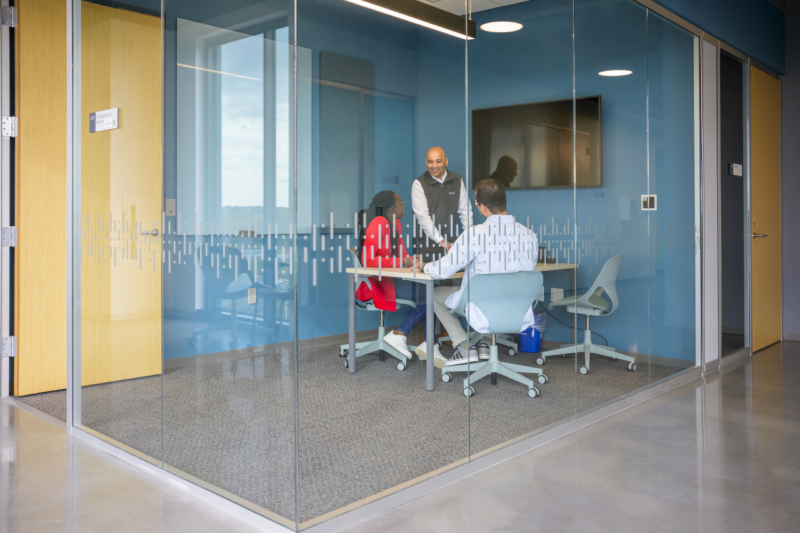
Lerner College Team working on a project
P&Q: What type of unique programming do you offer at the graduate and MBA levels?
Yao: “Lerner’s graduate and MBA programs are grounded in our vision for a Distinctive Lerner Education: rigorous, experiential, global, technology-driven, and career-ready. Our goal is to be a place where innovation meets impact, and where students and faculty work together to transform business and society.
We are fortunate to be located in one of the most important business regions in the nation. Positioned along the Northeast corridor and within a major financial services and technology landscape, Lerner attracts graduate students who are already working in industries such as finance, consulting, healthcare, technology, and analytics. That proximity allows students to stay fully engaged in their careers while applying what they learn in real time. Flexibility is a core strength of our graduate programs.
A key differentiator is our leadership in artificial intelligence education for business. Over the past year, we launched three offerings that position Lerner at the forefront of this space: the M.S. in Applied AI for Business, the MBA Concentration in AI, and a Graduate Certificate in Generative AI for Business. These programs reflect our belief that AI literacy is becoming as fundamental as digital literacy for today’s leaders.
The M.S. in Applied AI for Business is designed for the AI-driven economy, combining depth in machine learning, generative AI, deep learning, and AI strategy with real business applications. Graduates are prepared not just to use AI tools, but to lead AI-enabled transformation. For working professionals, the Graduate Certificate in Generative AI for Business offers a flexible, stackable pathway to build fluency in emerging technologies and their strategic implications. We’ve also introduced new courses—such as Responsible AI and Simulation with AI for Business Applications—to reinforce ethical, hands-on learning.
Equally important to us is access and inclusion. We created the Economic Hardship Scholarship to ensure that talented, motivated students are not sidelined by financial disruption or unexpected life circumstances. Business education should be a pathway to opportunity and resilience, especially in times of economic uncertainty, and this scholarship reflects our commitment to meeting students where they are and supporting them when they need it most.”
Everard: “What truly differentiates Lerner’s graduate programs is how intentionally we combine advanced analytics, experiential learning, and personalized student support across every degree we offer.
Over the past year, we have continued to strengthen our programs in data analytics, fintech, and artificial intelligence. Our M.S. in Business Analytics and Information Management has expanded its emphasis on advanced data modeling, machine learning, Python-based analytics, visualization, and cloud computing. The M.S. in Financial Services Analytics program focuses on fintech and financial data science. Students benefit from Lerner’s strong finance faculty and applied collaborations, engaging in projects that bridge quantitative insight with real business decision-making.
We also take our role in advancing financial literacy and economic education beyond the university seriously. Our M.A. in Economic Education and Entrepreneurship is a distinctive program designed to equip high school economics teachers with the content knowledge, pedagogical tools, and entrepreneurial mindset needed to teach financial education effectively. By strengthening how economics and personal finance are taught at the secondary level, we are helping to build a more economically informed and financially capable future workforce.
Experiential learning is embedded throughout our graduate programs. Through consulting practicums, capstone projects, and partnerships with organizations across Delaware and the Mid-Atlantic region, students apply analytics and AI tools to real-world challenges, from customer analytics and marketing automation to financial modeling and strategy.
Our Online MBA reflects this same future-ready approach. Students gain practical knowledge they can apply immediately, choose from flexible, career-focused specializations, and learn from the same distinguished faculty who teach on campus. Every student also receives personalized support from dedicated program advisors and Lerner Career Services, which provides one-on-one coaching, mentoring programs, job shadowing opportunities, and hands-on Forage simulations modeled after real employer recruitment challenges.
Together, AI leadership, STEM-infused curricula, experiential learning, access-focused support, and personalized career development define what makes Lerner’s graduate and MBA programs distinctive. We prepare students not only to succeed in today’s economy, but to shape the future of business and financial education itself.”
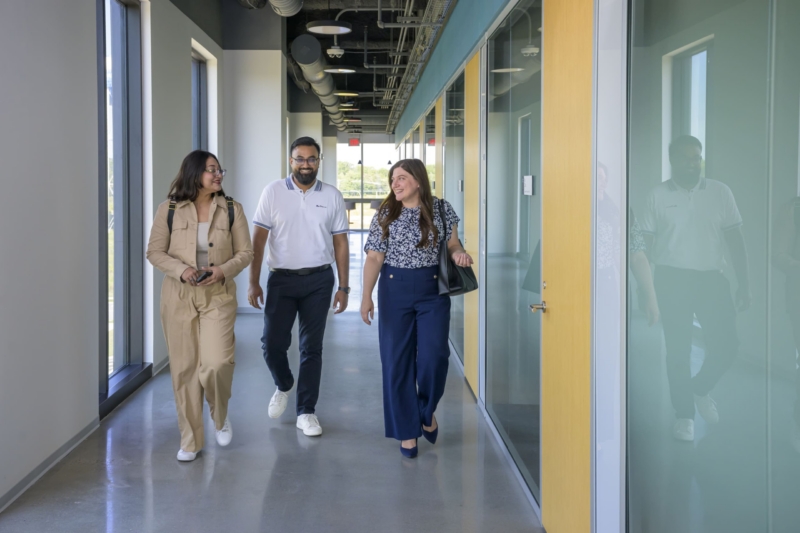
MBA students Tahseef Reza and Nabila Briste spent their summer gaining real-world experience through UD Lerner’s Graduate Internship Program. Tahseef is interning with JPMorgan Chase, while Nabila is working at Sallie Mae—both applying their business analytics skills in high-stakes environments.
P&Q: What types of definable progress have you made since last March in executing the Transformative Excellence Plan?
Yao: “Since last March, we have made clear and measurable progress in executing Lerner’s Transformative Excellence Plan by moving decisively from strategy to action across academics, research, operations, and societal impact.
From the outset, we approached the plan as a shared commitment rather than a static roadmap. Faculty, staff, students, alumni, and external partners were actively engaged in shaping priorities and advancing implementation, creating strong alignment across the college. As a result, Transformational Excellence now guides both our strategic decisions and our day-to-day operations.
Academically, we have strengthened our graduate and MBA programs through ongoing portfolio review and targeted innovation. We expanded industry-connected offerings such as the JPMorganChase Certificate and the Incyte Pocket MBA, deepening experiential learning and employer engagement. Signature experiences like the Ammon Case Competition and the forthcoming Experiential Leadership Challenge give graduate students hands-on opportunities to solve real business and leadership challenges, scaling from local companies to national corporations.
Student support has been another area of definable progress. We enhanced graduate-level advising to provide more proactive, personalized guidance and significantly expanded mentoring opportunities, now supporting more than 600 mentor-mentee pairs across the college, including a strong graduate student presence. Our accelerated 4+1 programs have continued to grow, enabling high-performing undergraduates to earn graduate credentials efficiently and enter the workforce with advanced skills.
We have also strengthened Lerner’s research culture and scholarly impact. Initiatives such as the Faculty Research Showcase and the Distinguished Speaker Series have elevated faculty research visibility and collaboration, while continued support for high-impact scholarship reinforces Lerner’s role as a thought leader in business and economics education.
Operationally, we have focused on building capacity for long-term excellence. We advanced planning for the new Siegfried Hall, expanded modern learning environments such as the Financial Planning Center, and streamlined internal processes to improve efficiency and collaboration.
Finally, we have accelerated progress in key frontier areas central to the plan. AI and digital knowledge and tools are now being embedded across curricula and supported by hands-on workshops that build digital fluency. Entrepreneurship programming continues to grow, highlighted by the launch of Blue Hen Innovation Fest.
Ultimately, we measure progress by impact: on students, scholarship, and society. Since last March, that impact has become increasingly visible.”
P&Q: Last March, you were looking to strengthen Lerner’s capacities in data analytics, fintech, and AI. What types of progress have you made in those areas in the graduate business programs?
Yao: “One of the most important shifts in strengthening Lerner’s capabilities in data analytics, fintech, and artificial intelligence has been our intentional work across the University of Delaware—particularly with the College of Engineering and the First State AI Institute. Launched in June 2025 and housed within the FinTech Innovation Hub, the Institute connects AI research directly to business applications and plays a key role in reimagining the graduate business experience
AI is transforming every industry, and business education must lead that transformation. At Lerner, we are embedding AI not as a standalone specialty, but as a core competency [that] every graduate needs, alongside leadership, ethics, and strategic thinking. That approach requires deep collaboration with technical experts, and our partnerships across UD allow us to integrate cutting-edge engineering and computer science expertise directly into business education.
A strong example is our work in fintech and AI research. A new partnership between Lerner College and Warwick’s Gillmore Centre expands collaborative research, faculty exchange, and global engagement in fintech with real-world industry and policy impact. At the same time, our close collaboration with UD Engineering ensures that this scholarship translates into applied learning for graduate students, bridging technical innovation with business strategy.”
Everard: “At the program level, this approach has allowed us to move quickly from planning to execution. Many of our newest graduate offerings are intentionally designed and delivered across UD, particularly with the College of Engineering, creating a more interdisciplinary and future-ready learning experience.
The FinTech Innovation Hub at UD’s STAR Campus, co-located with Engineering, serves as the physical home for fintech education and research and brings business, engineering, and computing faculty together in a shared innovation environment. A new co-directorship model—led jointly by Lerner’s Gang Wang and Engineering’s Nektarios Tsoutsos—provides sustained, cross-disciplinary leadership for UD’s fintech ecosystem.
This interdisciplinary design is embedded directly into our graduate programs. The M.S. in Applied AI for Business blends technical AI foundations with applied business strategy, while the MBA specialization in AI and the Graduate Certificate in Generative AI for Business integrate technical insight with managerial decision-making. In fintech, our M.S. and Ph.D. programs in financial services analytics combine finance, data science, and advanced analytics.
We have also strengthened partnerships beyond the classroom. Lerner is playing an active leadership role in the First State AI Institute through representation on its Education Working Group. Industry partnerships, including Discover Bank’s investment in the Hub, further expand hands-on learning opportunities for graduate students.
Together, these efforts deliver an interdisciplinary graduate experience that reflects how innovation actually happens, preparing Lerner students to lead at the intersection of technology, analytics, and business.”

Lerner AI student
P&Q: Looking ahead 5 years at the graduate and MBA levels, what would success look like at Lerner?
Yao: “Five years from now, success at the graduate and MBA levels will be defined by impact. At Lerner, we measure progress by student outcomes, scholarly influence, and contributions to industry and society. This standard will continue to guide our decisions.
For students, success means Lerner is recognized as a powerhouse in graduate business education, preparing leaders who can apply technology, analytics, and AI responsibly to drive real organizational and societal value. Our graduates’ career trajectories, leadership roles, and long-term professional impact will be the clearest indicators of our effectiveness.
From a scholarly perspective, Lerner will be nationally known for research that matters: work that shapes business practice, informs policy, and advances innovation in areas including fintech, AI, and leadership. Beyond rankings or reputation, our success will be reflected in how our ideas are used and adopted.
Equally important is our regional and national impact. Lerner will be recognized as a catalyst for economic growth and innovation, contributing to a more resilient and inclusive economy through strong industry partnerships and applied solutions. Ultimately, success means being known not only for what we teach, but for the difference we make.”
Everard: “That focus on impact is carried forward intentionally in how we design, deliver, and evaluate graduate business education. Success in five years means every graduate program is measured not just by enrollment, but by outcomes—career advancement, skill relevance, employer engagement, and real-world application.
We will continue to assess programs through metrics such as salary growth, placement rates, employer partnerships, experiential learning participation, and alumni leadership outcomes. Curricula will evolve continuously to reflect emerging technologies and industry needs, ensuring students gain skills they can apply immediately and over the long term.
Experiential learning will remain central, with students working on real problems through industry partnerships, interdisciplinary collaborations, and innovation hubs. Personalized advising and career coaching will be aligned to each student’s goals, reinforcing accountability for outcomes from enrollment through graduation and beyond.
Together, this approach ensures that Lerner’s graduate and MBA programs remain focused on what matters most: delivering measurable, lasting impact for students, employers, and society.”
Next Page: IE Business School