

IE University’s New York City campus in SoHO
IE Business School
Several American business schools have made overseas expansion a central tenet of their mission. You’ll find the Booth School in London and Hong Kong. The Kellogg School operates a campus in Qatar, while NYU Stern just cut the ribbon on a Abu Dhabi campus last year. European business schools have been equally ambitious in opening far-flung campuses. That includes competing on the United States’ home turf.
INSEAD maintains a San Francisco campus to help students tap into the Silicon Valley ecosystem. And IESE Business School includes a New York City location. Now, IE Business School is making a huge investment in the Big Apple as well.
Two years ago, IE Business School acquired Soho’s Glasgow Caledonian New York College. And the school moved quickly from there, investing a total of $18-million in the venture. And the results are already rolling in. Last February, IE enrolled 31 students in its Master in Business for Social Impact & Sustainability in February. Six months later, the school brought in another 30 students for its Master of Management program. While the programs are based in the United States, 91% of IE’s students have hailed from outside the United States.
ACCESS TO EVERYTHING & EVERYONE
“Our value add is not to become a campus with a lot of U.S. students,” says Manuel Muñiz, provost of IE University, in a 2025 interview with P&Q. “Our value add is as a global institution with international students. By being here, we are opening a huge door. If you come here you are going to study in a highly rigorous program but with connections to the real world.”
It has been a risky bet for IE, particularly after the Trump administration assumed power in 2025 and instituted policy changes targeting visas and international students. Despite this, the school obtained student visas for all students across both intakes. At the same time, the campus is a work-in-progress, occupying 4 classrooms and employing 2 full-time faculty and 30 adjuncts. By September, however, IE plans to add three programs for its New York City base: a Master in Business Analytics & AI, a Master in Finance, and a Master in Strategic & Creative Marketing, Communications & Media. These programs will triple the number of students on its campus, with the number expected to swell to 350 students by 2029.
That said, New York City fits perfectly with the spirit of IE. A truly international program – where over 90% of the school hails from outside Spain – IE is immersing itself in a metro where there are over 800 languages spoken. By the same token, nearly 40% of NYC residents were born outside the United States, further aligning with IE’s cosmopolitan vibe. More than that, the city is the center of business, be it Wall Street, Madison Avenue, or Seventh Street – a hub for finance, advertising, fashion, and entertainment. Overall, the city is home to 49 Fortune 500 companies. At the same time, it ranks as the second-largest startup ecosystem, a leader in Life Sciences, AI, and ClimateTech ventures that has spun out 150 unicorns. In other words, as the saying goes, IE students will literally be a cab ride away from most top companies, industries, or experts. That bring endless opportunities for IE students to find internships, jobs, or business partnerships.
“New York City is part of the school,” says Lee Norman, dean of IE’s business school and a board member for the new campus. “I envision a new type of education that is about the guts of business. Our students will work with local companies to boost their profits or help make more efficient the operations of an importer of chorizo.”
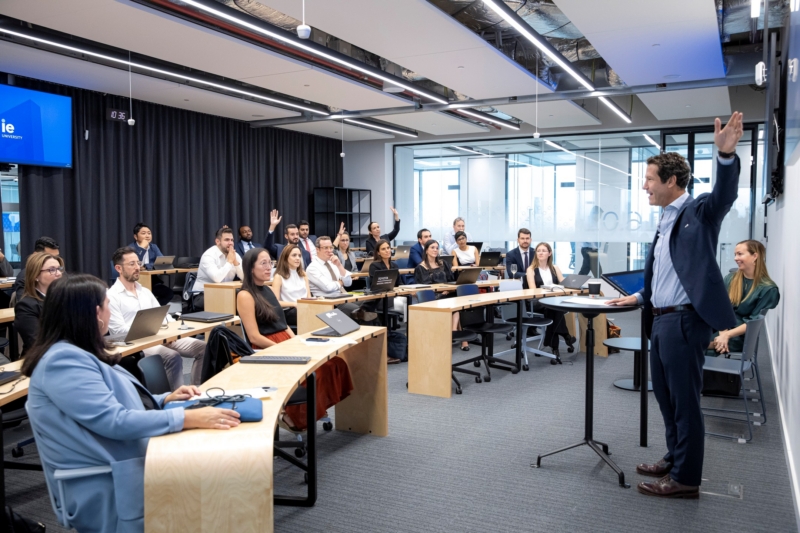
Lee Newman, Dean of IE Business School, with students at IE Tower, the tech and sustainable campus of IE University in Madrid.
AI ACROSS THE BOARD
To some, the New York campus would be an unconventional move for IE Business School, particularly with international student enrollment down in the United States. Then again, IE is the same school that built a 35-story campus in Madrid during COVID, a time when online education was projected to eclipse the brick-and-mortar model for business schools. Sure enough, IE continues to support over 10,000 students across over 100 undergraduate and graduate business programs. That includes an online MBA program, which has ranked as the top program in its space for the past three years according to The Financial Times.
Indeed, IE Business School is the proverbial first mover in graduate business education. After all, it is a program that rolled out a Digital Toolkit that MBAs must master to receive their diplomas – a toolkit whose requirements span from selling to data fluency to project management. In recent years, IE has also centered on three areas that offer the biggest return to students and employers alike: artificial intelligence, sustainability, and entrepreneurship.
Three years ago, the school issued what it called its “AI Manifesto.” At its core, the manifesto was a commitment to integrate AI across every subject in every class across the university. This included creating degree programs that incorporated both AI’s technical fundamentals and its impact and ethical implications. Six years ago, IE began offering a Bachelor of Computer Science and Artificial Intelligence – which was quickly followed up by an Executive Management Program for Data Analytics and Artificial Intelligence. Even more, the school’s masters degrees in Business Analytics & Business Data and Computer Science & Business Technology heavily infuse AI concepts. More than that, AI has become a requirement in other programs. For example, Master in Applied Economics students must take a course in machine learning and data management.
Last year, the school signed a partnership with OpenAI, making ChatGPT available to all of its students. And faculty too – who have received AI training to enable them deepen its usage in their courses. For Vivek Yadav, a 2025 P&Q Best & Brightest MBA, these AI tools have been a Godsend.
“I use ChatGPT to break down complex concepts, especially when I’m encountering them for the first time. Whether it’s simplifying financial models, brainstorming strategies, or summarizing case studies, AI has been a valuable learning companion.”
AI’s impact has become so profound that IE professors are considering replacing traditional exams with real-time bots that require students to deploy a wider range of resources to spur more holistic problem-solving.
“If everyone is going to be using AI in the workplace, then what sense does it make to stop people from using it in school,” asks Ikhlaq Sidhu, Dean of IE School of Science and Technology, in a 2025 interview with Poets&Quants. “We cannot take the position that we leave teaching the way it is, and we ignore this big change happening in the world.”

IE University will welcome students to its new IE Tower campus in September, one of the few vertical college campuses in the world.
A LEADER IN SUSTAINABILITY
The same could be said for Sustainability. In 2025, IE Business School ranked as the #1 program for ESG and Net Zero Teaching by The Financial Times. This ranking is not only based on alumni evaluation scores, but also “portion of teaching hours from core courses dedicated to environmental, social and governance issues and climate solutions addressing how organizations can reach net zero.” IE also placed 3rd globally in the same ranking for its carbon footprint, hardly a surprise considering IE was among the earliest carbon neutral universities in Europe.
Translation: There is little disconnect between what IE teaches and how it acts.
IE’s commitment to sustainability starts at the faculty level, explains Isabela del Alcázar, the school’s chief purpose and sustainability officer, in a 2023 interview with P&Q.
“We decided that sustainability had to be everyone’s ownership. So the chairs push sustainability throughout the different programs. For example, in strategy, initially we only had a couple of champions. Right now, there’s a transition and more and more professors are willing to introduce this content. They see that as something that is required by the job market that students need to know. And really, they’re pushing it really hard, and that’s how it permeates into every program.”
And it isn’t just employers demanding an understanding of sustainability-related concepts, adds Dean Lee Newman in a 2023 P&Q interview.
“One of our fantastic professors, Mikko Ketokivi, teaches operations which, traditionally, is very hardcore analytical. In the business school, we work in teams; a huge percentage of the MBA, and all of our programs, work in teams. So, for their final team project, Mikko told me that eight out of eight teams in his section showed sustainability related or social impact projects. In an operations class. We’re talking about sustainable supply, sustainable materials, circular economy, etc. That says a lot.”
THE PLACE TO BE AN ENTREPRENEUR
Beyond AI and Sustainability, IE Business School is heavily associated with Entrepreneurship. After all, the school was founded by entrepreneurs over 50 years ago. True to form, IE ranked 3rd in P&Q’s 2026 Entrepreneurship Ranking. How popular is Entrepreneurship at the school? 100% of IE MBA students have taken an Entrepreneurship course and join an Entrepreneurship club. In fact, 14% of IE graduates from 2020-2024 launched their own venture. More than that, 63% of students are involved with a startup during school – higher than any other business school in the world. In terms of coursework, 38% of IE electives are focused on entrepreneurship and innovation.
For Sarah Good, a 2022 grad who joined two classmates in starting a Healthtech venture, the school’s startup ecosystem provided a wealth of resources for her startup.
“This includes communication skills, legal support, metrics and data analytics, funding advice, and intensive pitch practice each week. As mentioned previously, we were fortunate enough to be selected as one of the teams to continue formally working on the project through IE’s Venture Lab incubator this fall. This has given us invaluable access to mentors from across the healthcare industry, investors, and useful workshops. These focused on, for example, how to build the best MVP, where to access tech support, and how to fairly divide equity and build shareholder agreements. Furthermore, our coursework and electives such as Technology, Innovation, and Sustainability, has pushed our thinking in terms of where we fit into the healthcare industry at large, and how we can make the biggest impact.”
Such distinctive offerings – be it AI, Sustainability, or Entrepreneurship – are rooted in IE’s status as a private university, whose mission is to pair an entrepreneurial mindset with an embrace of technology and multidisciplinary learning. That status frees IE to take risks – like opening a business school in New York City – that other business school’s can’t.
“Education is a sector that’s ripe for disruption,” adds Dean Lee Newman. “A lot of universities are very traditional and slow to adapt. Between either public funding or endowments, there hasn’t been a giant incentive to innovate business schools. One of the things we at IE University can take advantage of is our governance structure. We are agile; we can move fast.”
Next Page: University of Illinois, Gies College of Business