
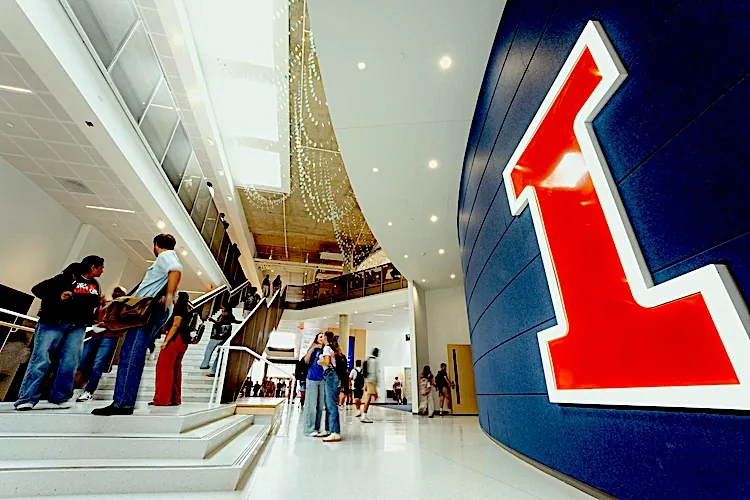
The newly-opened Wymer Hall
University Of Illinois, Gies College of Business
“The revolution will not be televised.”
No, it’ll be put online instead.
That’s particularly true with the iMBA program from the University of Illinois’ Gies College of Business. Celebrating its 10-year anniversary in January, the iMBA was truly revolutionary. Cost? $22,000 back then…and just $26,136 now. While business schools often relegated online MBAs to recorded sessions taught by adjuncts, the iMBA incorporated live, interactive, weekly courses taught by top faculty members. At the same time, it operated on a pay-as-you-go model, where students could stack courses into certificates or master’s degrees as they pursued their MBAs. The program even offered an optional global immersion or on-campus gatherings to bring classmates together in-person.
Cheaper and faster. More flexible and interactive. A program that elevated online students from low-labor revenue sources to learners on par with their brick-and-mortar counterparts. It was risky. It was groundbreaking. It was a revolution that still reverberates today.
RIVAL SCHOOLS STILL TRYING TO CATCH UP TO THE iMBA
“The secret sauce for us has always been, really, a combination of three things; a relentless focus on access, looking for all kinds of ways that we can lower barriers for people to earn their business education, combined with a low price point and extremely high quality,” explains former Gies Dean Jeffrey Brown in a 2023 interview with P&Q. “And I think those three things together really explain it. The market has taken off because I believe that prospective students know an incredible value when they see it.”
Even more, Gies reimagined everything from content to delivery to produce the iMBA, says W. Brooke Elliott, who succeed Brown as dean in 2024. “We didn’t simply take the model for our residential MBA and put it online. We thought very differently about how to serve learners at scale. And that started with thinking about a stackable model, but also, we’ve wholly changed how we deliver a course. The course model is very distinct. At our maximum, we served almost 1,500 individuals in a single course, but we did that because we innovated early where we have a tiered course structure. We have a lead or a co-lead set of faculty members who are our very top-tenured faculty. A lot of times, we have an associate instructor and we have anywhere from 30 to 50 course assistants, and we heavily utilize technology.”
The results of the iMBA’s market disruption speak for themselves. According to school stats, 62% of iMBA grads earned a promotion, new position, or job offer during the program, with another 25% reporting a pay raise. In a 2023 survey of 4,898 students, according to Dean Elliott, there was a 96% satisfaction rate to coincide with a 92% retention rate. These successes, however, were rooted in calculated risks taken by Jeffrey Brown, Gies’ dean from 2015-2024 and P&Q’s Dean of the Year in 2021.
To make room for the iMBA, Brown shuttered five programs, including marquee Full-Time and Executive MBA programs. Controversial decisions at the time, they turned out to be the right moves in the final analysis. Over top of that, Brown raised over $350-million over his tenure, along with hiring over 60 faculty members – a 40% increase. In between, he spearheaded the revamp of the undergraduate curriculum and broke ground on a new building.
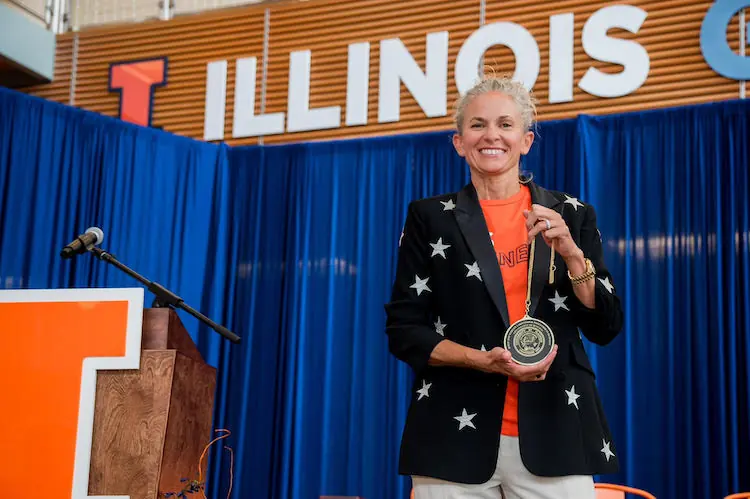
New Gies College of Business Dean W. Brooke Elliott at her investiture ceremony
AN UNEXPECTED DOWNTURN
Such feats made big shoes to fill with Brown’s move back to faculty. Still, the school has hardly skipped a beat since Dean Elliott moved into the big office.
Forget a second act…Elliott has promised a “second revolution.” And she has been delivering on the promise. Not only did she raise $30-million in her first year, but boosted scholarship support from $900,000 to $1.6-million. That should come as no surprise. After all, she pushed iMBA enrollment from 2,792 to 5,435 students during her two years as the Associate Dean for Online Programs.
While 2025 could be described as the best of times at Gies, there were low points too. Just ask Nerissa Brown, the executive associate dean of academic programs.
“Our on-campus programs are primarily supported by international enrollments,” Brown told P&Q in a 2025 interview. “We’re down a good clip this year — pretty much down by like 25%. Some campus-based programs are down by 30 to 50 percent. That’s a big hit across the college.”
According to Brown, political uncertainty, coupled with visa delays and denials, helped produce these conditions. In real numbers, Brown told P&Q that the school lost roughly $7-million during the first semester due to losing 200 international students in its master’s programs for Finance and Business Analytics alone. At many business schools, deans would retrench until the atmosphere changed.
Not Elliott…
“I have never been more optimistic about higher education in Illinois,” she says. “Much of what we do here flies in the face of the critics of higher education.”

Gies College of Business online programs feature world-renowned faculty and industry experts, combined with the strength of the program and the engagement with fellow students who bring insights from a variety industries and cultures in real time.
INNOVATION IS IN THE GIES DNA
As every business student learn, leading companies are often created during lean times. Think Microsoft and Apple during 1970s malaise or Airbnb and Uber during the Great Recession. While revolutionaries often swallow themselves, Gies has achieved the wisdom that comes with becoming an incumbent. That’s because there is a story behind the numbers. The Cliff Notes can sum it this way: online enrollment is up, while residential tuition was down. Hence, Gies technically suffered a $600,000 loss in reality. More to the point, Gies’ online programs have acted as a “strategic safeguard” against disruptions elsewhere, Brown says.
“Online versus residential education tend to move opposite to each other when you think about enrollment and tuition revenue — it’s contrarian…If you’re a business school and you have not diversified your portfolio where there’s at least some online options, then in this current environment I would say you’re very late to the game.”
Indeed, only optimists launch new programs amid rough waters. In Gies’ case, the school is developing an AI-driven online Master’s in Business Analytics to be launched in the coming fall. At the same time, Brown’s team is putting together a hybrid MD-MBA program, where the MD is taught on campus and the MBA happens online. That doesn’t count a new specialization, produced in partnership with the College of Agricultural and Consumer Economic Sciences, that weaves together business, agribusiness, and food sustainability fundamentals.
“We are innovators — it’s in our DNA,” says Dean Elliott. “But to be innovative, you have to be in a strong financial position because you have to be willing and able to take risks that others can’t.”
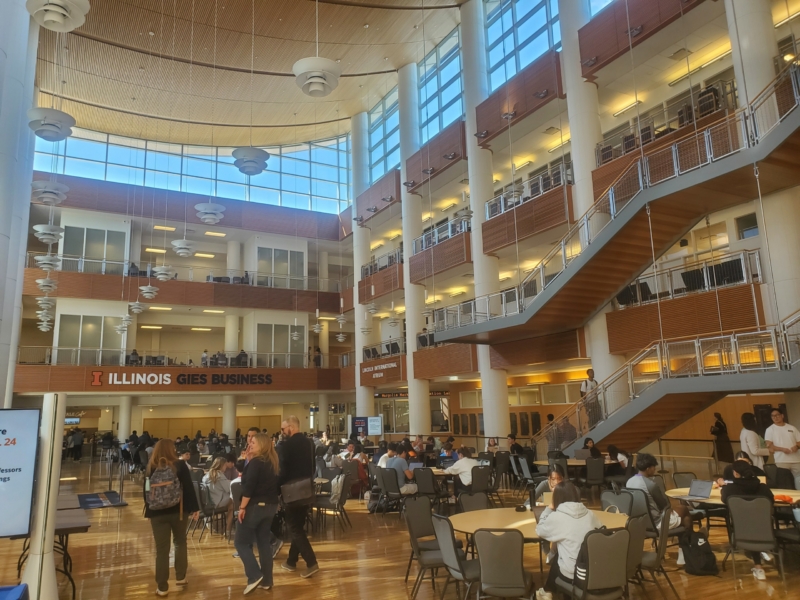
Wymer Hall. Photo Credit: Jeff Schmitt
A NEW BUILDING USHERS IN A NEW ERA
That extends to Gies doubling down on its AI capabilities. For example, Gies has partnered with Coursera on a tool where student prompts can lead them to access videos, lecture summaries, and sample quizzes. The school is also piloting the use of faculty avatars, or “digital twins.” Not only do these avatars enable faculty to quickly update course material, but personalize the experience for students as well.
“My avatar can speak Mandarin with a southern accent,” Elliott jokes. “I’m a 24/7 teaching assistant.”
Gies’ contrarian instinct and optimist spirit was further cemented in October. A program closely tethered to the online space, Gies unveiled Wymer Hall in October. Think of it as a space that brings together two different worlds. Picture a 200-seat auditorium and 18 customizable meeting rooms for students, along with two television sound stages and five studios devoted to online learning initiatives. What’s more, it operates off a sustainable geothermal heating and cooling system for net-zero status. Covering 100,000 square feet and costing $105-million to build, Wymer Hall has become the heart of the business school. More than that, it is a testament to Gies’ commitment to a future that values both the online and campus experiences.
“Everything about this building was designed with learners in mind,” Elliott told donors, students, faculty and guests at the ribbon cutting. “It offers flexible classrooms, collaboration areas, content production studios, team workspaces, and welcoming lounges. Every detail reflects our intentionality – spaces that foster collaboration, spark innovation, and build connection.”
“It’s an investment in the success of the College. It’s an investment in the success of the campus. And it’s an investment in innovation, because it is not your traditional teaching and learning environment,” added University of Illinois Provost John Coleman at the opening.
All in all, the Gies approach is an embrace of the Kaizen concept of “continuous innovation,” with an emphasis on acting fast. And it is a strategy that other business schools may want to study closely.
“If we stop innovating, we stop leading,” Dean Elliott tells P&Q.
Next Page: HEC Paris