
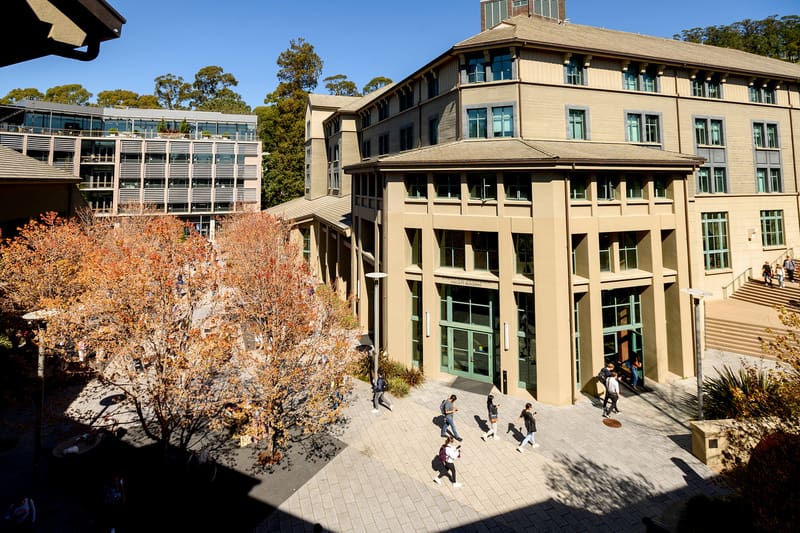
Haas Campus. Credit: Noah Berger
University of California Berkeley, Haas School of Business
Do you go with an insider or an outsider?
That’s always a lingering question for organizations making a change at the top.
Choose someone from the outside? They can introduce best practices from outside the building and shake things up. And they’re not beholden to anyone, either. Elevate a current leader? Chances are, they’ve seen what works and what doesn’t. More than that, they possess a deep grasp of the people, history, industry, and clients – not to mention the intricacies of the entire operation.
When it came time to pick a dean at U.C. Berkeley’s Haas School, the decision turned out to be a no-brainer. In June, Haas removed the “Interim” tag and made Jennifer Chatman the dean. Now entering her 33rd year at Haas – which included stints at associate dean of both academic affairs and learning strategies – Chatman is affectionately known as the school’s “culture queen.” That’s because values are currency at Haas – and Chatman was the driving force behind codifying them 15 years ago.
A FAST & PROMISING START
Here, the community follows the Defining Leadership Principles: Question the Status Quo, Confidence Without Attitude, Students Always, and Beyond Yourself. These principles reflect the school’s values of Curiosity, humility, continuous learning, and teamwork, establishing expectations and behaviors as much as identity. And they guide every facet of the Haas experience, says Jenn Bridge, Executive Director of the Haas Full-time MBA Program, in a 2025 interview with P&Q.
“[The Defining Leadership Principles] aren’t just slogans. They’re operational principles embedded in over 180 processes that guide everything from admissions to curriculum to career development. This creates what we call “path-bending leaders,” who challenge assumptions, reframe problems, and create entirely new possibilities. We teach students to be bold, entrepreneurial AND ethical, driving both business success and positive impact simultaneously.”
Don’t think Haas is entering a period of slumber with Chatman. A “Double Bear” who earned her BA and PhD at UC Berkeley – brings an ambitious agenda. Even more, she has played a major part in Haas’ biggest recent successes.
That includes the launch of the Flex MBA. It ranks as the world’s top Evening and Weekend MBA program, with an innovative mix of live interactive online courses and on-site immersions. She has also worked to move the Spieker Undergraduate Business Program from a two-year to a four-year model. In the process, the program is projected to double in size to 1,100 students by 2027. At the same time, Haas has rocked the rankings since Chatman’s elevation. Last year, Bloomberg Businessweek ranked Haas as the #3 MBA program in the United States. In fact, Haas was the only program to rank among the Top 10 across all five dimensions measured by Businessweek: Compensation, Learning, Entrepreneurship, Networking, and Inclusion. When U.S. News surveyed business school deans and MBA directors in 2025, Haas posted Top 10 scores across six disciplines: Finance, Analytics, Management, Marketing, Nonprofits, and Entrepreneurship.

Students in an AI elective course at Haas. The school has launched a new certificate program in AI, and plans a flagship course for the program in 2026.
EXPANDING AI RESOURCES
At the same time, Chatman (and her team) have boosted the Haas School’s profile in AI. In 2025, the school launched an AI concentration in the Full-Time program, with plans to further roll it out to the Flex MBA. It was a natural step for a program already offering 40 AI-related courses, including ones focused on AI’s influence on areas like climate change and finance. In addition, Haas is adding an AI for Business Certificate. Less focused on coding and data modeling, the program is designed to show students where “[AI] adds value and where it falls short,” in the words of Dean Chatman. The certificate is based on four pillars: technology, management, strategy, and impact. All in all, Haas’ AI options tap into the local ecosystem, with leading AI-related firms ranging from OpenAI to Nvidia being within a hour drive of the Haas campus.
“In designing this certificate, we wanted students to explore what it means to build their own capabilities using AI, to work in teams alongside AI agents, and to rethink how business partners and stakeholders interact in an economy transformed by this technology,” Chatman told P&Q. “And we want to prepare Haas students to collaborate with their peers in engineering, data science, and AI-focused programs to bring new ideas to market.”
And it isn’t just AI-related degrees or courses where Haas is expanding its AI footprint, adds Jenn Bridge. “We are also pilot(ing) LearningClues in the core curriculum this year. LearningClues automates quizzes so that students can test their knowledge in core classes. The quizzes will give faculty a sense of which topics students are struggling with so they can review that content. The faculty is also using Rumi Docs, a platform that helps instructors manage and assess generative AI use in student writing…The Rumi platform includes customizable AI policies that enable faculty to set the level of AI assistance permitted for each assignment.”
STARTUP CENTRAL
Entrepreneurship, a traditional Haas strength, continues to receive plenty of attention. In 2025, Haas ranked as the 2nd-best MBA program in the United States according to Bloomberg Businessweek. From 2019-2023, Haas MBA alumni produced ventures with the 3rd and 7th-highest-funded startups – Kyte and AtoB – whose outside investment totaled nearly $780-million over that period. Dean Chatman framed the Haas entrepreneurial difference more starkly in a 2025 interview with P&Q.
“UC Berkeley is the #1 university in the world for alumni founders, venture-backed startups, female founders, and female-founded companies (according to Pitchbook).”
One reason: the university offers a wide-range of resources to prospective founders. That includes incubators like LAUNCH, Sutardja Center for Entrepreneurship, and CITRIS Foundry – not to mention the acclaimed Berkely SKYDECK accelerator. In fact, Saikat Chaudhuri, eHub faculty director, estimates that the university itself houses 80-100 innovation and entrepreneurship units, if you count competitions and hackathons. That number rises even higher when you factor in another 20 or more campus clubs devoted to entrepreneurship.
Last year, Haas added the aforementioned eHub to the list.
Why build another entrepreneurship community at Haas – one of the first schools to offer courses in the field? Simply put, there was a gap: an untapped market big enough to rally around this new offering. You could say the eHub targets the “entrepre-curious” creating a micro-community where prospective founders – graduate students and undergraduates alike – can receive guidance and support with their ideas (however unformed).

Haas School of Business. Photo Copyright Noah Berger / 2023.
A PLACE TO LEARN, EXPERIMENT, AND NETWORK
Covering three floors, eHub originated from student surveys, which showed students were looking for a space to learn about entrepreneurship and meet peers who could potentially serve as co-founders and alumni who could mentor them. In other words, they wanted something that would demystify entrepreneurship and make it “easier and more accessible for everyone,” in the words of Saikat Chaudhuri.
“We want to just be a gateway to make the rest of campus’s life easier,” Chaudhur continues in a 2025 interview with P&Q. “Send people there and if you have an idea, where’s the first place you go? You come to this hub and you get inspired, you meet people. There’s a lot of cross-pollination and new ideas that load serendipity at work, and you can get your guidance on, ‘OK, what do I do first? OK, first go here and take this class that’ll teach you how to get from point A to point B. Then go get a $5,000 Trione grant, for example, and get a little bit of money to work on your startup and then go and do this hackathon and then apply for SkyDeck once you’re ready.’ That was really the goal.”
Among students, Sara Lucia Lizarazo López appreciates how eHub has enabled her to build a network across the university…and beyond. For Anthony Magno, the physical space has been invaluable.
“I’m there daily — taking calls, meeting my team, and networking with mentors,” Magno says. “Through eHub, I’ve connected with VC partners, successful entrepreneurs, and industry leaders who’ve built and exited ventures…Zoom is great for execution, brainstorming in person fosters deeper collaboration and creativity. Building real relationships is key in the early stages of a startup. Startups need professionalism. eHub provides a boardroom-like setting to meet with investors and mentors, elevating student ventures.”
WHERE THE ACTION IS
That can come in handy at Haas. After all, the school sits right at the doorstep of the Bay Area-Silicon Valley ecosystem. Think 73 Fortune 500 companies with all the big names – Google, Salesforce, Visa, Oracle – maintaining a presence there. Along Sand Hill Road, you’ll find all the big names in venture capital: Sequoia Capital, Greylock Partners, ACCEL, and Andreessen Horowitz. Here, there is a can-do spirit that anything is possible – a “constant energy” that feeds “innovation, creativity, and reinvention,” in the words of ’25 alum Ann C. Ukadike. It is that same energy that Haas will continue to harness and spread through its 46,000 alumni across 20,000 companies and 81 countries.
“Being immersed in the environment of UC Berkeley and Silicon Valley – in close proximity to the labs, incubators, and VCs shaping the future – is an incredible opportunity to enhance my learning and my career,” says first-year MBA Justin Keller.
Next Page: American University, Kogod School of Business