
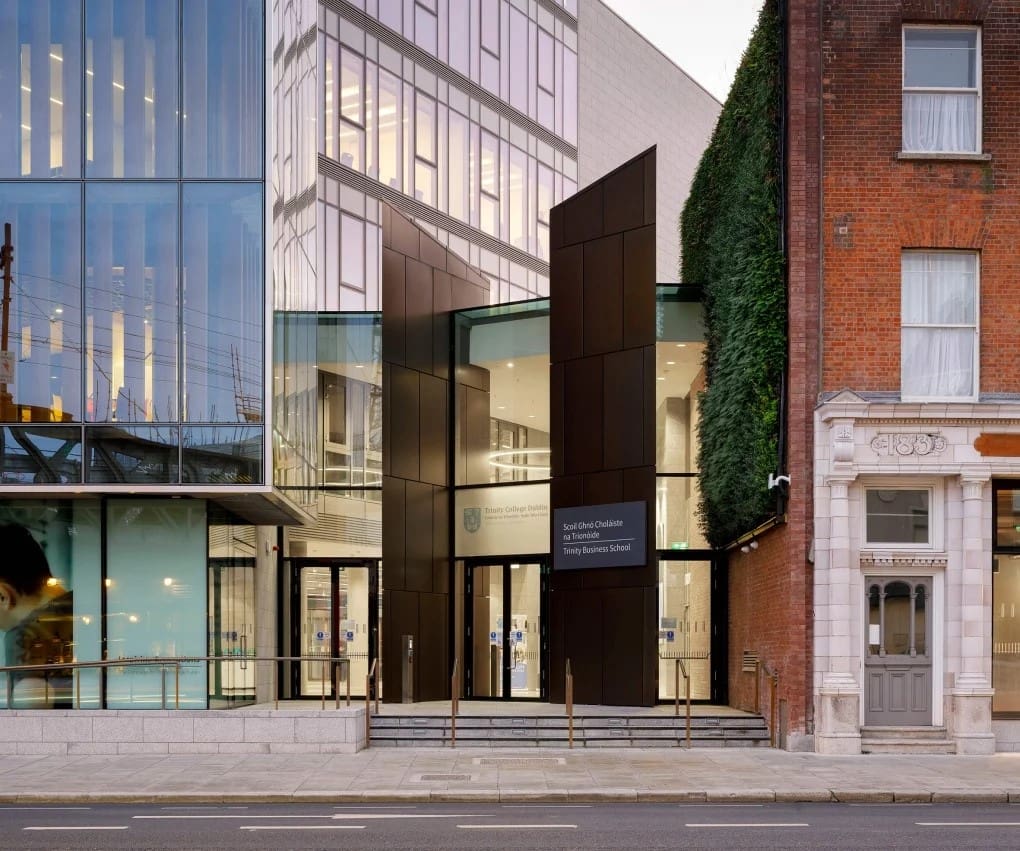
Trinity Business School in Dublin has seen a surge in international interest, including a 25% increase in applications from U.S. students, amid political threats to American higher education.
The big enrollment trend of 2025, at least for U.S. based business schools, is the off-the-cliff decline of arriving international students. According to Department of Commerce data, 19% fewer international students arrived in the U.S. this August compared to the year before.
America’s loss may be Europe’s gain. Several of the region’s business schools have told Poets&Quants they are seeing a surge in international interest, both from students who had already been admitted to U.S. programs or would traditionally have looked there first.
Trinity Business School in Dublin is among them. And, beyond increased international interest overall, the school has seen a 25% jump in applications from U.S. students this fall.
“There has been a slight drop in students from India and China, but it has been more than compensated for by a significant increase in students from North America, other parts of the world, and EU countries,” Dean Laurent Muzellec tells Poets&Quants.
“Ireland remains a very open and welcoming economy, with many multinationals based here and a visa policy that is still very supportive of international students. That continues to make us attractive.”
WHY AMERICAN STUDENTS ARE LOOKING TO DUBLIN
For North American students, the appeal of Trinity makes good sense. Ireland is a five-hour flight from New York City, shorter than a flight to Los Angeles. Many Americans have family ties to the country. And Dublin is widely regarded as Europe’s digital capital, home to the European headquarters of tech firms such as Salesforce, Microsoft, and Meta.
Interest in Ireland seems to have ticked up even more after Donald Trump’s return to office.
“This increase has been visible at both the undergraduate level, which is relatively new for us, and at the MBA level,” Muzellec says. “Students who do not align with the political direction of the current U.S. administration, or who care deeply about issues like climate change or diversity, equity, and inclusion, may be looking to leave what they perceive as a difficult environment. Ireland can be appealing in that context, and Trinity in particular.”
Q&A WITH LAURENT MUZELLEC
Founded in 1592, Trinity College Dublin is Ireland’s oldest university. Its business school marked its 100th anniversary last year. Since becoming dean in 2023, Muzellec has sharpened the school’s “Transforming Business for Good” strategy, embedding sustainability, responsible technology, and social inclusion more deeply across teaching, research, and strategy. The university has committed to becoming carbon net zero by 2040, a pledge that includes phasing out carbon-intensive EMBA study trips. That focus has earned Trinity College Dublin a rise to 29th globally and first in Ireland in the QS Sustainability Rankings.
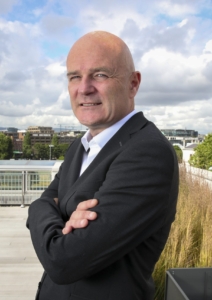
Laurent Muzellec, dean of Trinity Business School
At the same time, the school has leaned into AI, not as a cure-all, but as a tool that must be governed responsibly and taught with an awareness of its environmental cost.
Muzellec, a French citizen who joined Trinity in 2015 as a marketing scholar focused on digital business models, has been central to that shift. He launched the MSc in Digital Marketing Strategy, founded the Centre for Digital Business and Analytics, and helped push the school to balance digital transformation with long-term social and environmental responsibility.
In this interview, Muzellec talks about why Trinity is attracting students who once defaulted to U.S. programs, how sustainability and AI are reshaping European business education, and why he believes leaders need to think in centuries, not election cycles. Our conversation has been edited for length and clarity.
What is Trinity Business School most known for, and what are its key differentiators?
One of the things we are certainly known for is being an institution created in 1592. We have more than 400 years of history. Historically, we would have been associated with the likes of Cambridge or Oxford, except that Trinity is in Ireland. At that time, Ireland was part of the United Kingdom. So it is a long, well-established institution.
Within that institution, the Business School itself is 100 years old. We were founded in 1925, and we celebrated our centenary this year. We just closed out our anniversary year.
In terms of what we are known for today, there are two things worth highlighting. Since I took over, we have pursued a strategy called Transforming Business for Good. I do not know the extent to which we are known externally for it, but we have put a lot of effort into integrating ESG across our curriculum, monitoring all modules across programs that address these issues. I think that is one of the benefits of being a 400-year-old institution. We know very well that we want to be here in another 400 years, and pretty much the only thing that could prevent that is climate change. That puts things in perspective.
The other area we are known for is closely tied to the evolution of Ireland over the last 20 years. Ireland has become what you could describe as the digital capital of Europe, with companies like Salesforce, Meta, and Microsoft establishing themselves in Dublin in particular. We try to benefit from that dual positioning.
That said, whether this truly differentiates us is an open question. To be honest, I am not entirely sure, because it seems that everyone is aspiring to integrate AI and address climate change.
There has been a well-documented backlash against DEI and sustainability in the U.S., alongside growing scrutiny of the rigor and credibility of ESG reporting. How do you interpret this moment? Do you see real backpedaling, or a shift toward more rigorous accountability?
I think there are two distinct topics here: DEI on one hand, and ESG on the other. Even though it is often the same people who either defend or attack both, they are actually very different issues and should be treated separately.
On DEI, what is concerning from a European perspective is that the goal of equity, or at least the goal of equality achieved through equity policies, seems to be getting dropped or even becoming antagonistic. I feel that should not be the case. DEI is an important concept. It is an American concept, rooted in the history of minority movements and the civil rights movement in the U.S. Some of those elements do not translate perfectly to European history, but my personal view is that we need to move away from this confrontational framing.
Right now, you have people who defend DEI as if there is nothing wrong with it, and others who want to discard it entirely. For DEI to be truly inclusive, it needs to be accepted by everyone, including the majority of people who, as we see in the U.S., may otherwise become strongly opposed to it. I think there is an opportunity in Europe to reframe DEI in a more consistent and consensual way. That is my personal opinion, and it is something I am actively working on. It would be a real pity if this either-or attitude led to dropping all the elements of DEI or to cycles of removing and then reimposing them. I do not think that would be very productive.
On ESG, I see two phenomena at play. One is political backlash or regulatory fatigue. The other is the rise of artificial intelligence, which has created a sense of urgency that tends to push the climate emergency into the background. We are fortunate to be a public university rather than a private company, and we are also a very old institution. That allows us to focus on long-term trends. AI is extremely important, and we integrate it into what we do. But in the medium to long run, ESG remains critical, and we continue to focus on it regardless of political movements.
Frankly, it does not take much to remind people why this matters. A very warm summer or a couple of heat waves can quickly bring climate issues back to the forefront.
On reporting, you are right that there has been some backlash. The challenge for companies is ensuring that regulations do not impede their ability to compete globally. One major frustration in the business world has been that regulations were imposed on production in the Western world, particularly in Europe, while borders remained open to goods produced elsewhere that were not subject to the same standards. These are very complex issues, and that is where much of the backlash has come from.
We are seeing a period of readjustment. For example, the European Union committed to 100 percent electric cars by a certain date, I believe 2035, and has since begun to roll that back. Policymakers realized that imposing this without proper trade barriers could mean that the market would be dominated by imports, particularly from China. I am exaggerating slightly, but that was the underlying risk.
That complexity is real. Still, I firmly believe that climate action can give companies a competitive advantage in the long run. This is what is needed, and it is a trend that will continue. It simply needs to be managed at a pace that allows incumbent companies to transform themselves.

A view of Trinity Business School, where sustainability, responsible technology, and social inclusion anchor the school’s “Transforming Business for Good” strategy under Dean Laurent Muzellec.
Trinity has enjoyed increased interest from international students, including from the U.S. When did it become noticeable?
Historically, we have always had a fairly strong cohort of students coming from the United States. Ireland occupies a unique position. It is a mid-Atlantic island, part of the European Union, English-speaking, and it has a very large diaspora around the world, including in the United States. When many American multinationals were looking to establish their European headquarters, they chose Ireland for tax reasons, but also because we have one of the most educated workforces in the OECD, along with the advantage of the English language.
That naturally attracted North American students over time, often because they had some affinity with Ireland. Their grandparents may have been Irish, or sometimes, quite simply, they met an Irish partner and wanted to come back and join them.
That said, we started to see a noticeable acceleration around 2020, with further acceleration more recently. This increase has been visible at both the undergraduate level, which is relatively new for us, and at the MBA level. I think part of the reason this trend began even before the second Trump administration is the cost of higher education in the United States. We are about a five-hour flight from New York City, and for students on the East Coast, the distance is extremely manageable. In fact, for someone from Boston or New York, studying in California involves a time difference that is almost comparable to coming to Ireland.
That makes Ireland quite attractive. In addition, students who do not align with the political direction of the current U.S. administration, or who care deeply about issues like climate change or diversity, equity, and inclusion, may be looking to leave what they perceive as a difficult environment. Ireland can be appealing in that context, and Trinity in particular. Once students are drawn to Ireland, Trinity often stands out because it is the country’s oldest university and widely regarded as its leading institution.
Do you have any numbers you can share to help quantify that interest?
I do not have the full historical numbers in front of me, but I can say that applications from the United States are up by more than 25 percent this academic year across all of our programs.
At the postgraduate level in particular, our programs are extremely international. In some cases, up to 80 percent of the cohort is made up of international students. That said, this is not concentrated in one or two countries. Sometimes when people hear “80 percent international,” they assume it means a large proportion from a single country, such as India or China, but that is not the case for us.
We have very broad representation. In that context, North American students, including those from the United States, typically make up between 10 and 20 percent of a cohort. Irish students form another segment. European Union students who are non-Irish represent a significant portion, perhaps around 40 percent. Then you might see another 10 percent from China, another 10 to 15 percent from India, and a smaller number from South America as well.
Overall, our classes tend to be extremely international and genuinely diverse.
Are you seeing a similar increase in interest from students in China and India who may have previously considered U.S. programs and are now looking elsewhere?
That is something that has actually surprised us. We are seeing some level of decline from China and India, particularly in the last year. For China, this is likely linked to broader national policies focused on strengthening domestic industries and encouraging students to remain at home.
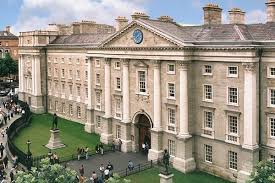
Trinity College Dublin, founded in 1592, Ireland’s oldest university.
India is a slightly different case, and the drop there has been less sharp, but it is still noticeable. Beyond geopolitics, I sometimes wonder whether there is a broader shift happening. There may be a growing aspiration for something more local and more authentic. Across many parts of the world, there seems to be a renewed emphasis on localization and authenticity.
It feels as though the era of what you might call happy globalization is fading, for a variety of reasons. These include the rise of more conservative politics in many Western countries, the stance taken by China, and environmental concerns. Taken together, there may simply be less appetite for that fully globalized model. That is one possible explanation.
What do you see as the pros and cons of a potentially less globalized world, given that business schools have long promoted globalization?
In this context, Ireland is something of an outlier, and I think we are benefiting from that. As I mentioned, there has been a slight drop in students from India and China, but it has been more than compensated for by a significant increase from North America, other parts of the world, and EU countries. Ireland remains a very open and welcoming economy, with many multinationals based here and a visa policy that is still very supportive of international students. That continues to make us attractive.
What we are trying to do is localize the student experience in Dublin. At the same time, Dublin has become such a global city that this localization does not prevent us from remaining international. There is an opportunity there. Ireland can offer a sense of authenticity while still benefiting from a multicultural environment and the presence of global companies, which makes the experience appealing.
More broadly, I do think there is a need for business schools to differentiate themselves by giving their degrees a local texture. When someone earns an MBA in Ireland or in Dublin, it should not feel exactly the same as earning one anywhere else in the world. My sense is that many business schools will move in this direction, trying to localize aspects of their programs while continuing to attract international students.

Located in the heart of Dublin, Trinity Business School is attracting students who once defaulted to U.S. programs, drawn by Ireland’s visa policies, global tech ecosystem, and lower cost of business education.
Was Transforming Business for Good a strategy you introduced as dean, or was it already underway?
My predecessor, Andrew Burke, formulated the strategy with the team through a series of workshops. At that point, I was already part of the Business School. After becoming dean, I made further adjustments and then led the full implementation of the strategy.
We refined it around three pillars: sustainability; transformation through the responsible use of technology; and social inclusion. We felt that social inclusion cuts across many of the debates around DEI, particularly when you focus on where people come from from a socioeconomic perspective. In some countries, including Ireland, this captures criteria that have traditionally been addressed through DEI, so that framing made sense for us.
In practice, this means several things. We have a program called the Trinity Access Programme, and we are increasing the number of students who come through that pathway. Admission there is based on socioeconomic criteria. Under the transformation-through-technology pillar, we have embedded AI across most of our programs, changed how we teach to make it more flexible, introduced new topics such as business analytics with AI and management, and launched a new master’s program in that field.
The third pillar, and arguably the most important, is sustainability. That means integrating climate action into every program. More than that, it means assessing the extent to which each individual module addresses climate-related and sustainability issues. One of the first things I did as dean was conduct a full review of all modules delivered across the Business School to evaluate how much they engaged with climate action topics.
What we found was quite revealing. In areas like entrepreneurship and innovation, climate and sustainability were already embedded in 100 percent of modules, which was good news. In other areas, such as finance, only about 10 percent of modules even mentioned these issues. As a result, we introduced new modules in areas like sustainable finance and impact investing. We also looked closely at existing content. For example, in a reporting module, we asked whether ESG reporting was included in a lecture or several hours of instruction. That is the approach we have taken.
Do you think students are choosing Trinity Business School because of its focus on sustainability and climate?
I wish I could say yes, but I am not entirely sure. Many business schools claim to be doing this now, so it is difficult to differentiate purely on that basis. At the undergraduate level, we focus strongly on sustainability because we see it as part of our mission. When students are with us for three or four years, we are helping to shape how they see the world and equipping them with tools that will matter over the course of their careers.
At the postgraduate level, it depends on the type of program students choose. If someone enrolls in an MSc in Business Analytics and AI for Management, they are probably not expecting sustainability to be the dominant theme. We do cover it, but it is not the primary focus. By contrast, we have an MSc in Responsible Leadership and Sustainability, and in that case, students are clearly choosing the program for that reason.
For the MBA, I think students genuinely appreciate the emphasis we place on climate action, but they also want us to address other critical topics. That is why we have introduced content around business analytics, AI, and AI governance in the MBA as well. Those topics are very popular.
Students are also attracted by the opportunities in the Irish market. Unemployment in Dublin is around 5 percent, and adult unemployment is closer to 3.8 percent. It is a very vibrant economy and remains an open one.
Trinity has committed to becoming carbon net zero by 2040, and one of the steps has been phasing out international study trips for the EMBA because of their environmental impact. Are you considering similar changes in other MBA programs? And do students lose something by not having those trips?
As I mentioned, around 80 percent of our students come from abroad. For them, the opportunity to travel internationally may not carry the same appeal. They come to Ireland and to Dublin specifically to have that Irish and international experience, and that is what we provide.
When you consider the carbon footprint of traveling elsewhere, combined with our desire to be more closely connected to the local Irish ecosystem and industry, it led us to rethink the value of international trips. Our students are already international. They are coming here rather than traveling back out again. So instead of adding another layer of travel, we decided to immerse them more deeply in the ecosystem we have in Ireland.
From a pedagogical perspective, a work integration perspective, and an ESG perspective, it made sense. In many ways, it was an easy choice for us because of Ireland’s position, Trinity’s location, and the makeup of our student body.
For other programs, what we are developing is a more flexible offering. We have a flexible MBA, which is often mistakenly viewed as an online MBA, and sometimes online MBAs are seen as a cheaper version of the degree. That is not the case for us. Our flexible MBA includes two weeks of residency in Ireland at the beginning of the first year and again at the beginning of the second year, similar to an executive MBA.
The academic content is delivered in short, digestible segments of about 10 minutes, accessible on any device. Students have a defined period to engage with the material and complete assignments, often working in groups that are geographically distributed. That means students do not need to relocate to Ireland for a full year, but the international experience is still there and is replicated through technology.
We also have an exchange arrangement with Berkeley, where students based in the United States can take modules online with us, and our students can do the same in return. That allows us to create an international learning environment without requiring constant travel.
We are realistic about the impact. The carbon emissions from a single international trip will not, on their own, change the trajectory of climate change. But if we claim to prioritize sustainability while continuing to promote extensive global travel, there is a clear mismatch. For us, this was about aligning what we do with what we say.
How is Trinity approaching AI through a sustainability lens? What does that engagement look like in practice?
That is a tricky question. The first step is integrating AI into a broader reflection on ethical governance. That does not cost anything financially, but it is still very important. It also means being explicit about the environmental cost of AI and ensuring students are aware of it.
The underlying assumption, or perhaps the bet, with AI is that the efficiency gains it delivers will eventually outweigh the environmental costs associated with its use. That is still unfolding. Beyond emphasizing responsible use and ethical guidance, there are also projects where AI can be applied to improve reporting or strengthen the sustainability dimensions of certain initiatives.
It is a difficult balance, and we do not have a magical answer to that dilemma. In that sense, we are in the same position as many others. The question becomes whether you ignore it or treat it as something negative. But AI is already here. It is being imposed on all of us, and it is essential to understand how to use it, particularly from a pedagogical perspective.
There are also the implications AI has across disciplines, whether in finance, marketing, or operations. You cannot simply ignore it. So this is the space we are actively trying to navigate.
As business education faces major shifts driven by AI, geopolitics, and sustainability, what do you see as the biggest challenges in the coming years? And what opportunities does that create for Trinity Business School?
In many ways, we have already touched on the main challenges. They will continue to center on artificial intelligence, sustainability, and geopolitical change. For us, there is an opportunity to become more local while still attracting students from all over the world. I do not foresee major geopolitical disruption in Ireland, but we are not complacent. What has happened elsewhere could happen here, so we need to remain attentive.
One of Ireland’s strengths, and Trinity’s in particular, is our international profile. Our student body is genuinely diverse. We have students from North America, India, China, across the European Union, and beyond. Some schools elsewhere have become overly reliant on a single market, often China or India. That concentration can create vulnerability. Our diversity gives us resilience and allows us to continue navigating uncertainty.
On the dual transformation front, both digital and sustainable, we are well positioned. Many of our graduates go on to work at companies like Salesforce, KPMG, Meta, and Microsoft. Those industries remain firmly rooted in Ireland. If we remain true to our ESG commitments, our students can benefit from that environment while also developing an ethical perspective that allows them to drive change from within those organizations.
We are also relatively small, which gives us agility. Another important factor, particularly for students from North America, is value for money. Our MBA costs around €35,000 for the year. It would be very difficult to find an MBA in the U.S. for less than double that price, and in some cases four times as much. Graduates also receive a two-year post-study visa in Ireland, which allows them to work. Ireland remains open in that sense.
Looking ahead five or ten years, I believe Ireland and Trinity are well placed to manage these challenges over the long term. Ultimately, the one issue that underpins everything is climate change. That is where we need to remain focused and continue our efforts.
DON’T MISS: WHARTON’S JERRY WIND ON CREATIVITY, LEADERSHIP, AND THE AGE OF AI AND BUSINESS SCHOOL THOUGHT LEADERS ON WHAT LIES AHEAD IN 2026
The post The P&Q Interview: Trinity Dean Laurent Muzellec On Why Even American Business Students Are Looking To Dublin appeared first on Poets&Quants.