

The Terry College of Business campus in Athens, Georgia blends historic architecture with modern academic space – home to one of the nation’s top-ranked public MBA programs
In his office at the University of Georgia Terry College of Business, interim Dean Santanu Chatterjee does not hesitate when asked what feels most urgent about this moment for the college.
“The elephant in the room,” he says, “is academic honesty.”
For Chatterjee – an economist, distinguished professor, and one of the longest-serving leaders on Terry’s campus – that urgency is not abstract. It is born of two decades of experience shaping graduate programs, advising faculty, and steering long-term strategy at a business school navigating rapid change.
AI AS TOOL, NOT SUBSTITUTE
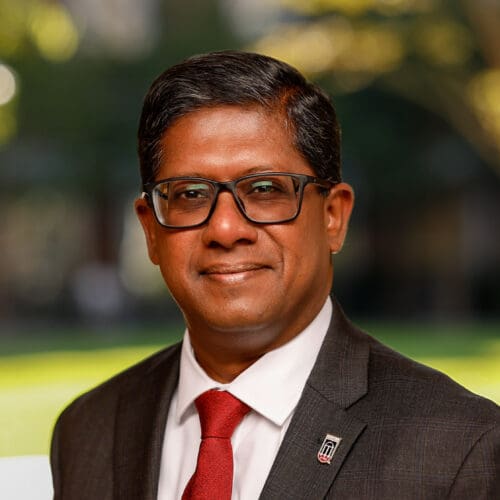
Georgia Terry Interim Dean Santanu Chatterjee: “I’m going to focus on the things I can control – our students, their experience, their preparation, their ability to sit in front of an employer and tell a compelling story about what they bring to the table”
Chatterjee came to UGA in 2001 and has spent virtually his entire academic career at Terry. A Dr. Harold A. Black Distinguished Professor of Economics and a Josiah Meigs Distinguished Teaching Professor, he has taught across undergraduate and graduate programs and earned multiple honors for teaching and research. Over the past decade, he directed the full-time MBA and MS in Business Analytics programs, helping elevate the MBA’s national and international profile for value and placement. In 2025, he was named interim dean after his predecessor became the university’s provost.
If he has to name one defining issue facing Terry, it is how AI is woven into the school’s academic mission.
“It’s a multifaceted priority,” Chatterjee says, describing both horizontal integration – across majors and disciplines – and vertical integration – from undergraduate to master’s to PhD programs.
But beyond curriculum design sits a more fundamental question: What does a grade mean anymore?
When students have access to generative AI tools – tools many have been using since high school, and soon since middle school – the signal value of an exam changes. Recruiters are asking the same thing. In a recent campus visit, the head of data science at EY posed a blunt question: What does an A represent in the AI era?
Chatterjee does not see AI as an existential threat. He sees it as a test of discipline.
“AI is just another tool,” he says, placing it alongside statistics, econometrics, coding in Python, and machine learning. “It will help them add value to the organization. But it is not a substitute for learning. That is a disaster waiting to happen.”

The Terry College of Business Learning Community
The solution, he believes, lies not only in teaching AI tools but in changing how business schools teach. Less reliance on traditional lectures and high-stakes exams. More active learning. More project-based work. More teamwork and presentations. The soft skills – communication, storytelling, critical thinking – remain among the top attributes employers seek, as documented for years in GMAC recruiter surveys.
“Coding has been replaced with AI,” he says. “But soft skills are still in that top five. We cannot take our eye off that ball.”
Two task forces are now at work: one faculty-led, focused on curriculum and industry engagement; the other staff-led, exploring operational integration of AI across advising, scheduling, and career coaching.
The goal is not to replace advisors with algorithms. It is to give advisors leverage.
“If I’m advising 600 students and can only give you 15 or 20 minutes,” he says, “and I have your résumé and transcript, I can feed it into an AI model and get a prediction about what jobs you should look for or what class you should take. Then I can focus our time on you – not on starting from scratch.”
Efficiency, in this framing, creates space for humanity.

Students at the Terry College of Business gather between classes in Athens, part of what school leadership describes as a tight-knit MBA community that emphasizes hands-on learning, global exposure & close faculty engagement
HEALTHCARE: A NEW PLATFORM
AI is not the only front.
With a new medical school and nursing school arriving in fall 2026 at UGA, Chatterjee is working to build what he calls a “business-healthcare platform,” rooted in Terry’s strengths in analytics, cybersecurity, and economics.
Healthcare represents the largest share of U.S. spending. It is also increasingly intertwined with private equity, technology, and operational complexity. Doctors, pharmacists, and nurse leaders must navigate strategy, finance, and organizational design as much as clinical care. Terry already offers an MD/MBA and PharmD/MBA, and additional dual degrees are in development. An undergraduate healthcare administration minor, in collaboration with the public health school, further expands the pipeline.
The aim is preparation for a sector where business leadership is as critical as technical expertise.
RANKINGS AS OUTCOMES, NOT OBJECTIVES
As with most B-schools, rankings are a frequent topic of conversation. Terry’s trajectory – landing at No. 29 in the 2025 U.S. News MBA ranking, rising to No. 23 in Bloomberg Businessweek, placing No. 60 worldwide in the 2026 Financial Times Global MBA Ranking (and No. 1 in the world for Value for Money), and checking in at No. 29 in the most recent Poets&Quants composite ranking – is hard to ignore.
“Rankings are outcomes,” Chatterjee says. “They reflect what you are putting in.”
He resists tailoring strategy to a single metric. Instead, he watches for broad-based movement across multiple lists – a sign of underlying health rather than short-term gaming.
“Don’t stress about small variations,” he tells his team. “Going from 28 to 30 is fine. But avoid volatility.”
His organizing framework draws from Terry’s four strategic pillars – leadership, innovation, sustainability, and analytics. Every new program or course proposal is filtered through that lens.
He is not a fan of sweeping curriculum overhauls every five years. “I’m more of a continuous evolution person,” he says. Surgical, targeted change over wholesale redesign.

MBA students collaborate between classes at Terry College, where applied learning and industry-driven projects are central to the curriculum
DISTINGUISHING TERRY – ROLL UP YOUR SLEEVES
Operating in a state that also boasts Emory University Goizueta Business School and Georgia Tech Scheller College of Business, Terry has made a deliberate choice to remain smaller and flexible.
The MBA program enrolls roughly 300 students per class – intimate enough, he believes, to prevent students from becoming numbers.
Experiential learning is central to that identity shift. Each full-time MBA completes two required projects – one in each year – sourced through structured corporate outreach. Practitioner instructors, drawn from companies across sectors, anchor fields from consulting to sustainability.
Students select projects aligned with their interests. International residencies are project-based. Technology mitigates Athens’ geographic distance from Atlanta, enabling hybrid and weekend engagements.
The cultural shift, he says, is clear: “Roll up your sleeves and get to work.”
ATHENS: NOT A DISADVANTAGE
Chatterjee argues Athens is not a liability but an asset. A classic college town with deep musical roots, it offers a research university ecosystem of 19 schools and colleges. Dual degrees abound – MFA/MBA in film production, MBA paired with social work or nonprofit leadership, collaborations across engineering and environmental sciences.
Study abroad participation has surged. Last year, 1,500 students engaged in 27 international programs, supported by more than half a million dollars in scholarships – much of it need-based. The long-term goal: ensure that every Terry student has at least one meaningful global experience, with cost minimized as a barrier.

The Terry Business Learning Center in Athens, Georgia
UNCERTAINTY & FOCUS
As an economist, Chatterjee is careful about predictions.
Technology evolves rapidly. Federal policy introduces uncertainty around tariffs, immigration, and DOJ guidance. International students watch H-1B rules closely.
His response is pragmatic.
“I’m aware of the things I cannot control,” he says. “But I’m going to focus on the things I can control – our students, their experience, their preparation, their ability to sit in front of an employer and tell a compelling story about what they bring to the table.”
In a year defined by transition – for the college and for business education writ large – Terry’s interim dean is doubling down on preparation, integration, and relevance.
“The headwinds are there,” he says. “But if we do our job right – if we prepare our students well and create real value – that’s within our control.”
DON’T MISS ‘MY VOICE IS MY SUPERPOWER’: THE BLACK MBA EXPERIENCE AT EMORY’S GOIZUETA BUSINESS SCHOOL and BLACK MBA STUDENTS AT GEORGIA TECH DESCRIBE A COMMUNITY ADJUSTING – AND ENDURING
The post At Georgia Terry, A Transitional Year Becomes A Strategic Moment appeared first on Poets&Quants.