
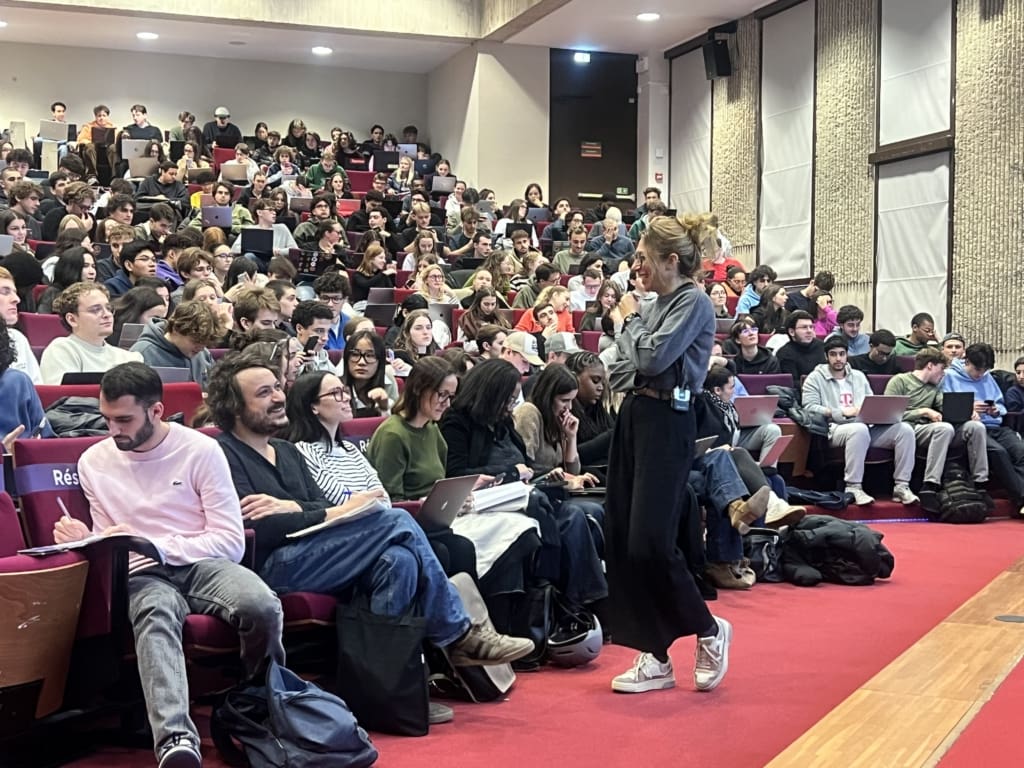
Professor Agathe Mezzadri-Guedj leads a session of NEOMA Business School’s required first-year literature course, where nearly 1,000 undergraduate students examine leadership and ethics through classic texts.
Since its publication in 1818, readers have debated a question central to Mary Shelley’s Frankenstein: Who is the monster?
Is it the created – Victor Frankenstein’s creature, shunned and alone, who murders the innocent out of rage and revenge?
Is it the creator – Victor Frankenstein himself, who abandons the life he created out of hubris and reckless ambition, running away from both the responsibility and the consequence?
Is it neither? Is it both?
It’s a debate you’d expect in any literature seminar. But, at NEOMA Business School in France, it’s now a core requirement of every first-year business student.
“Lessons from Major Literary Texts: Management, Business, and Leadership” draws on works any English major worth her salt would know well – Homer’s The Odyssey, Victor Hugo’s The Hunchback of Notre Dame, and Shelley’s Frankenstein. Taught by Agathe Mezzadri-Guedj, a professor of French literature, the course directs business students to read these classics like case studies in leadership, responsibility, power, and ethics.
It’s also a deliberate feature of NEOMA’s broader AI strategy.
“We found that having a literature course was an interesting way to provide a model of thinking about the world — where everything is uncertain and everything is changing so quickly — and to help them ask a lot of questions,” says Alain Goudey, Associate Dean for Digital at NEOMA and a professor of marketing.
“Shelley is an interesting example. When you think about artificial intelligence – and also about robotics – we are creating a lot of ‘creatures’ that are becoming more and more independent of their creators.”
NEOMA’S SYSTEMATIC AI STRATEGY
Early on, NEOMA – one of France’s leading business schools with campuses in Paris, Reims, and Rouen – positioned itself as an early mover on AI and the digital transformation. It began developing virtual-reality business cases in 2016, immersing students in simulated professional environments. In September 2020, it launched a “metaverse-like” virtual campus in the early days of the pandemic. And in 2022, it trained 8,000 students in generative AI and, in 2025, became a Design Partner of Mistral A.

Alain Goudey, Associate Dean for Digital
It partnered has partnered with AACSB to develop AI-focused conferences and learning content for business schools, launched training programs for France’s elite preparatory courses, and delivered AI training to corporations.
Take Goudey’s own role as an example of the school’s systematic approach to AI. As Associate Dean for Digital, he leads three distinct teams: the IT department, responsible for deploying digital tools across the community; an internal web design agency focused on UX and interface design; and the Learning Lab, which explores educational innovation and scales it across the institution.
Alongside the technical push, NEOMA is embedding a counterweight with distinct human capacities – critical thinking, ethics, empathy, and what Goudey calls metacognition.
“What we are trying to do, of course, is to train our students to work with artificial intelligence, but also to work without artificial intelligence,” Goudey says. “We need, as humans, to be really clear about the way we are acting or reacting in a specific situation. Being really comfortable with the way you think, the way you act, the way you behave on your own side, can augment the value you can create by working with artificial intelligence.”
A CORE COURSE, NOT AN ELECTIVE
Lessons from Major Literary Texts is a 15-core course, not an elective. It debuted in September and is mandatory for all first-year undergrad business students – nearly 1,000 of them.
Copies of The Hunchback of Notre Dame and Ourika sit on the lectern before class.
“It’s a bold move from the school to say that we are embracing technology and AI, but at the same time we need our students to be strong on both feet,” says Mezzadri-Guedj. “Stronger in the humanities at the same time as they become stronger in using AI.”
In other words, students must learn how to think before they learn what to outsource. Judgment, cultural awareness, context, interpretation come first and only then can users decide what is left for the machine. AI should sharpen human thinking, not substitute for it.
NEOMA first approached Mezzadri-Guedj about a year ago to help them design a literature course to teach AI. There was no reference manual. She would be creating a course that didn’t previously exist, and she looked at her own bookshelves for inspiration.
The challenge came in finding books, essays, and even movie clips that could speak simultaneously to leaderships and ethics while resonating with students who perhaps never imagined themselves in a literature classroom.
“What literature gives is an experience you don’t find in a case study,” she says. “In literature, you go deep into the gray zones where people are not merely good or evil.”
Take Claude Frollo, the main character from Victor Hugo’s The Hunchback of Notre Dame. He doesn’t start off as a villain. He adopts the deformed Quasimodo when Parisian society rejected him, raising him inside the cathedral walls. Frollo believes himself to be compassionate and righteous. Over time, however, students trace how Frollo’s certainty hardens into control, how jealousy and fear slowly turn him into a toxic leader.
“(Frollo) is not purely evil, but we see how he becomes more and more severe. We see him struggle,” Mezzadri-Guedj says.
“So, literature gives you context. It gives you the conscience of the bad ones too. It gives you the complexity of human behavior.”
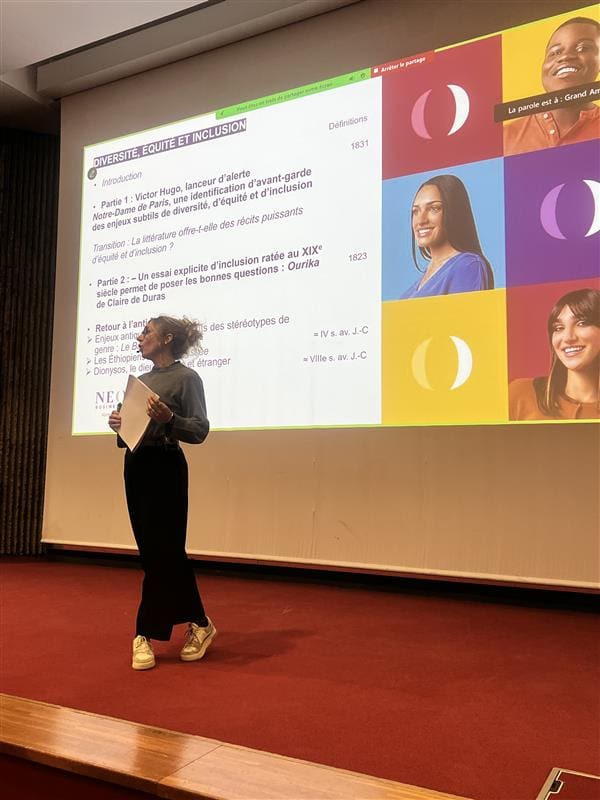
A classroom discussion on diversity and inclusion connects Victor Hugo and 19th-century literature to modern workplace and societal debates.
WAS ULYSSES A GOOD MANAGER?
First-year student William Carde had studied literature in France’s elite preparatory classes, an intensive post-secondary program feeding the country’s top business schools. He didn’t expect that he’d be revisiting Homer’s Odyssey at NEOMA.
It’s one of those classics that many think they already know. Ulysses is celebrated as a heroic strategist who designs the Trojan horse, plugs his crew’s ear with wax to escape the Sirens, and sacrifices a few men to prevent the destruction of his entire ship. But, he ultimately returns to Ithaca alone.
The question for Mezzadri-Guedj’s students: What kind of leader loses everyone but himself?
“When you just read the book, you’re apt to believe Ulysses is just a hero,” says Carde who studied mathematics and geopolitics prior to NEOMA. “Through the course discussion, you see that he actually could have saved a lot more men.”
Carde says the course has helped him apply this kind of critical thinking to his use of AI. When you write a prompt into ChatGPT, the tool has a seemingly built-in tendency to affirm your thinking, to tell you how great your ideas. Without stepping back to consider the downsides, it’s easy to feel like the Ulysses of your own story.
Carde’s generation has essentially grown up with AI, or at least AI-ajacent algorithms. Today, they work with AI, study with it, debate its pros and cons with teachers and peers.
“One of the real things this course did is it made me want to read more,” he tells Poets&Quants. “With AI, you have results instantly. Taking the time to enjoy a book, and relax, helps you create your own mindset.”
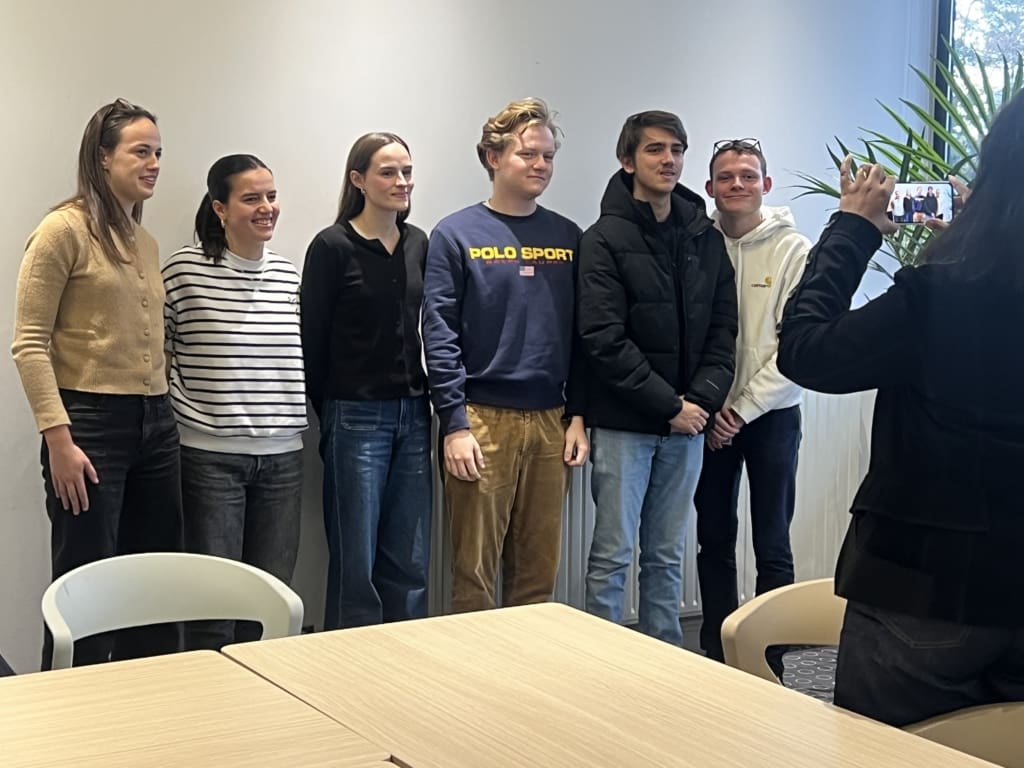
First-year NEOMA students, including William Carde, far right, gather during required humanities course embedded within the school’s broader AI curriculum.
GROK V. FRANKENSTEIN
Ellen Simon actually studied humanities in her preparatory classes, so she was used to doing deep sematic analyses of literature she studied. But, she’d never looked at the classics through a management lens.
“It’s been really fun to see that some things written in books a hundred years ago are still things we’re having to deal with today,” says Simon.
Simon wants to work in international sales, and the course reinforced skills she expects to use daily like openness, cultural awareness, and respect for diversity.
A big takeaway from the course was to view AI not as strictly “good” or “bad,” but as a useful tool that requires human guardrails. For future managers and leaders, it’s crucial to understand both its possibilities and its dangers.

Ellen Simon
Need a real-world example? Just look back a few weeks when users of Grok’s “spicy mode” directed the AI chatbot to virtually undress photos of children and women and post them on the internet.
So, who is the monster?
Is it Grok itself, the technology that facilitates the abuse? Is Grok users? Is it Elon Musk and the X engineers who created the tool, put it out in the world, and then deflected the responsibility and consequence?
To Simon, the tension is eerily similar to that in Shelley’s 200-year-old novel. AI, Grok, new technology in general is not evil by nature, but capable of great harm when driven by human desire to push further, faster, and beyond previous limits.
“The book really says: be careful with technology, be careful with hubris, be careful with trying to be better than God,” Simon says.
The lesson isn’t whether technology creates monsters. It’s whether the people leading it choose not to become them.
DON’T MISS: THIS FRENCH DEGREE PROGRAM TURNS CHAMPAGNE CELLARS INTO CLASSROOMS and HOW ONE BUSINESS SCHOOL IN MINNEAPOLIS IS NAVIGATING THE ICE SURGE
The post What ‘Frankenstein’ Is Teaching NEOMA Students About Artificial Intelligence appeared first on Poets&Quants.