
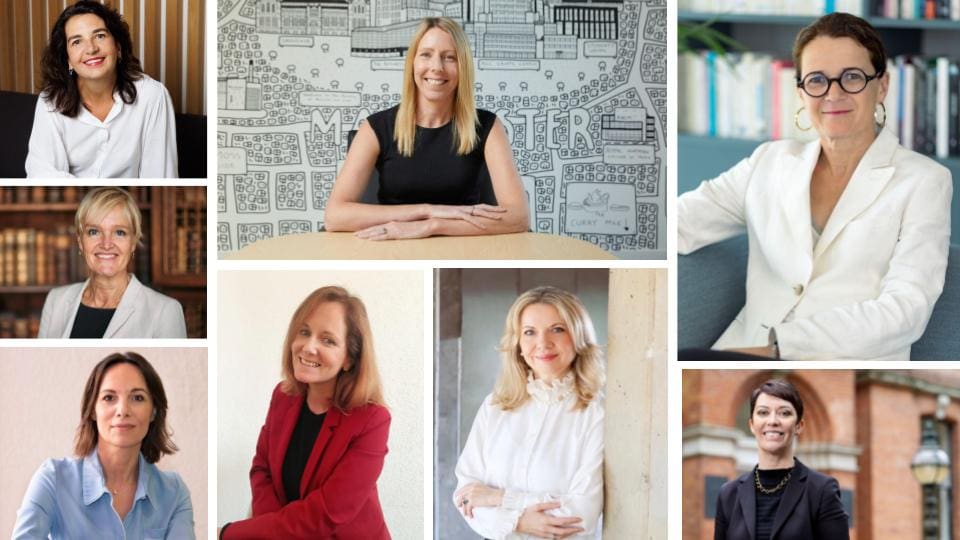
As International Women’s Day approaches, female business school leaders say progress toward gender parity in leadership is real, but far from complete.
Business schools like to portray themselves as incubators for the next generation of leaders, entrepreneurs, and innovators, the people who will tackle society’s biggest challenges and build a more equitable world. But who leads the business schools themselves?
AACSB data show the answer is still overwhelmingly men: In 2024, roughly 70% of business school deans worldwide were male.
“In schools where women make up a large share of the student body, it is not credible to claim that ‘everything is possible’ for female students while maintaining leadership teams that are almost exclusively male,” says Delphine Manceau, dean of NEOMA Business School in France.
“Parity is a matter of coherence and credibility. You cannot tell female students that they can aspire to the highest positions if they rarely see women leading business schools or flagship programs.”
DIVERSITY OF THOUGHT V. DIVERSITY OF LEADERSHIP
The numbers show meaningful progress in the pipeline. According to the Association to Advance Collegiate Schools of Business’ 2025 enrollment report, women now make up about 44% of undergraduate business students globally, a share that has remained steady over the past five years. At the graduate level, roughly 30% of MBA programs now report gender parity in their cohorts.
Leadership is changing too — though far more slowly. AACSB’s February 2024 report, Leading Today’s Business Schools: Insights From Deans, finds that women now hold about 30% of business school deanships worldwide. That’s up from 26% in 2021 and roughly double the share reported in 2008, but it still trails the gender balance seen in many classrooms.
Other data suggest the path to the top remains uneven. In its Staff Compensation and Demographics Survey, AACSB found women make up 40.3% of tenure-track faculty but just 25.7% of full professors. Women are also more likely to reach the dean’s office through interim appointments — 21% compared with 12% of male deans. Meanwhile, fewer women come through the traditional department chair pipeline, just 13% compared with 25% of men.
The imbalance shapes more than internal promotion patterns. It also influences classroom dynamics and the signals schools send to donors, employers, and prospective students about who belongs in leadership.
“If we do not redesign the structures that select and evaluate leaders, progress will remain incremental in all industries, not only in education,” says Camelia Ilie, president of INCAE Business School in Costa Rica.
INTERNATIONAL WOMEN’S DAY
The parity conversation is also unfolding in a changing, and increasingly more challenging environment. In the United States, diversity, equity, and inclusion programs have faced mounting scrutiny since President Donald Trump began his second term, with new federal directives and state-level legislation targeting both universities and corporate America. Similar skepticism has surfaced in parts of Europe and elsewhere, where critics question whether diversity programs advance fairness or impose ideological mandates.
Still, many business school leaders argue the debate misses a key point: diversity in leadership is not a political project but a practical one.
“The current backlash should not lead us to abandon our commitments. This is not an ideological matter; it is a scientific and ethical issue for businesses and for society at large. Numerous studies show that diverse management teams are better able to manage complex stakeholder demands and model inclusive cultures that students will replicate in the workplace,” says Isabelle Huault, Executive President and Dean at emlyon business school.
“The real challenge is to reach a point where a leader’s gender is no longer a topic of discussion, to render parity a non-issue, so that we are no longer invited to panels (or interviews) to address women leading schools or universities.”
In honor of International Women’s Day on Sunday, March 8, Poets&Quants asked female deans and directors of nine international business schools to answer a simple question with complicated stakes: What does it take for women to lead, and what barriers remain?

Saïd Business School, University of Oxford in England (Photo: John Cairns)
Mette Morsing
Interim Dean at Saïd Business School, University of Oxford in England
“Women at Oxford Saïd have brought tremendous strength and leadership to the School, working hard on behalf of the community and the students. But we should never forget that, for good teams, we need both genders – and diversity in many other areas. We are particularly proud of being a global school, in our staff, faculty and students. Some 96% of students come from outside the UK and this include strong representation from North and South perspectives, not just North and West! You can see this throughout the student cohort but also among faculty and staff.”
Mette Morsing was Director of the Smith School of Enterprise and the Environment and Professor of Business Sustainability at the University of Oxford. At the Smith School of Enterprise and the Environment, Mette Morsing led a team of scholars committed to achieving Net Zero and the UN SDGs through interdisciplinary, international and impactful teaching and research. She also serves on numerous councils and advisory boards worldwide.
AACSB data shows that women now make up roughly 30% of business school deans globally, up from about 26% just a few years ago. From your perspective, what has driven that increase and what still limits faster progress? Women are represented at every level in our School. They are leading departments, running programmes and carrying out amazing research and teaching. Business schools are leading the way – with 30% female Deans (AACSB) – accordingly, proportionally far more women chiefs than in major companies – where only around 10% of CEOs are women.
In terms of the future, around 50% of our MBA students are women – and the latest figures for Higher Education posts in the UK show women make up around 49% of academics, with 30% of senior posts held by women.
Despite this growth, women often reach the deanship through longer or less linear pathways. What barriers to advancement do you still see for women aiming for top leadership roles in business schools? Leadership positions often do not follow a linear pathway but it would be naïve to imagine there are not barriers to advancement in workplaces and among institutions. We need more women to step up as role models. It is important for our students, the world’s future leaders, to see they can do it themselves. I had strong women role models as a student and young academic in Denmark. It is also important for hiring committees and their leadership to be more diverse, because that, in turn, leads to more diverse recruitment.
Professor Pinar Ozcan, my colleague, is spearheading an initiative aimed at encouraging more women to become business founders. Visibility is very important and through her programme Inspiring Female Founders, she is highlighting success stories – and there are a lot of them. Earlier this month, Pinar held an AI entrepreneurship event at London’s Google HQ attended by hundreds of women. Our mission is to encourage more women to believe they can do it, whether that is running a business or leading a business school – encourage more funders to make that happen and equip them with the tools to help them.
‘Good leadership is not male or female. Once you are in a leadership position you have to be able to embody both – it doesn’t matter if you are a man or a woman, excellent leaders carry both.’
Why does parity in business leadership still matter? As debates over DEI intensify globally, how do you articulate the importance of gender parity in leadership to stakeholders who may be skeptical or focused purely on market outcomes? We know from research that more diverse teams make better decisions. So, even for the new DEI-sceptics, there is a business case in having gender diversity and other kinds of diversity in your teams and in the corporate boardroom.
There is ample research which shows the benefits of female leadership. Since 2008, European businesses led by men and women received 10 times more funding than businesses led solely by women. And BCG (Boston Consulting Group) found women deliver more than 10% additional cumulative revenue over five years than men. A recent report from the Conference Board shows organisations with at least 30% women in leadership roles are 12 times more likely to be in the top 20% for financial performance. Recent research also showed female CEOs can enhance a company’s ESG performance, primarily by elevating the level of green innovation and they boost societal benefits by engaging in more philanthropic activities.
Once women reach the deanship, what challenges tend to persist — whether related to authority, expectations, or institutional support — that are less visible from the outside? What advantages might women have in the dean’s role? Being Dean of a Business School comes with challenges – and that’s great. I am enjoying immense support from across the School and the wider Oxford University. But these days, academic researchers in this area no longer refer to men’s and women’s leadership characteristics. They talk about masculine and feminine characteristics, acknowledging that excellence in leadership entails knowing how to navigate a healthy balance of those characteristics. Good leadership is not male or female. Once you are in a leadership position you have to be able to embody both – it doesn’t matter if you are a man or a woman, excellent leaders carry both.
How does greater representation of women in business school leadership matter for students? What implications does it have for the broader business community those students will eventually lead? We believe that every leader, every individual, at the Business School has an impact on the education and the learning we deliver. All our faculty and staff are needed to deliver that world-class study experience to our students that we are known for. And I will say that selecting the best students for our programs also means that the impact they deliver in the classrooms and beyond is hugely important for us to remain excellent. Our words – Impact from Within – start with ourselves.
Seeing successful women leaders has impact. I meet a lot of female students who say how pleased they are to see the women in our leadership. We represent a good role model.
As I say above, it is shown that women lead very successful businesses. But women still face barriers in many areas and the need for opportunities to be made available and encouraged.
Describe the programs, initiatives, or institutional practices your school has put in place to advance gender parity within business education and the broader business community. Our school has a range of scholarships aimed specifically at women – giving them the opportunity to come to pursue an MBA or other course and achieve their potential. These include The Laidlaw Scholarships, The Jane Jie Sun scholarships, Forte Fellowships and the Intesa Sanpaolo scholarship.
We also offer the Oxford Women in Leadership Alliance to create an atmosphere of inclusivity, partnership, and allyship around the women of Saïd Business School. Through meaningful discussions and informative events, we work to challenge conventional conceptions of women in business, and further cultivate the next generation of thought leaders and role models. The Alliance was created to formalise and strengthen our Women’s initiative, and to stimulate action in addition to generating ideas.
Through our executive education programme, we also offer women’s leadership development programmes, which help to address many of the barriers that women must overcome in order to pursue their ambitions in leadership and management roles. The programme is guided by three overarching themes: self-acceptance, self-management, and self-development.
The learning has been designed to better equip women with the tools to navigate challenges and gender biases within the workplace, and develop the critical leadership skills to effectively guide, influence, and mentor others. We also have an excellent female scholarly community at the Business School, led by a young academic, Associate Professor Federica De Stefano, which is amazingly supportive and interesting. They arrange lunches and meetings and really provide a friendly community for all female faculty.
Looking ahead, what changes would most meaningfully move the share of female deans beyond today’s 30%? Which reforms are overdue? One reform that could have significant impact is in terms of recruitment processes. I have been on many hiring committees – which have been responsible for hiring Deans and for senior roles and, in most of those committees, there has been a man in the chair. We need to change that.
More diversity on such boards, leads to more balanced input and oftentimes different decisions, and accordingly more diversity in the faculty and among the staff. It matters that we get those committees right.
Next page: Camelia Ilie, President at INCAE Business School