
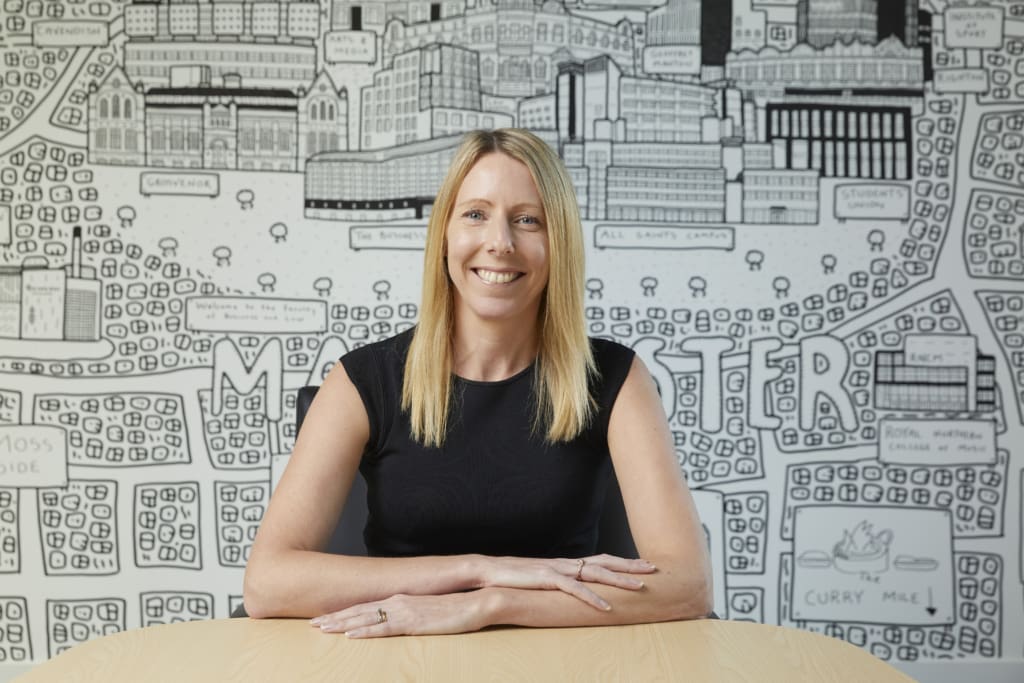
‘When stakeholders are sceptical, I focus on evidence and outcomes. Gender parity is not about optics or ideology. It is about accessing the full talent pool, strengthening performance, and sustaining credibility in a highly competitive global market for students, staff, and partners.’
Hannah Holmes
Dean of Manchester Metropolitan University Business School
“Leadership parity is an outcome of how institutions operate every day. When recruitment, workload, promotion, and culture are fair and transparent, leadership diversity follows. When they are not, progress remains slow regardless of intent.”
Hannah Holmes is Dean of Manchester Metropolitan University Business School and Deputy Faculty Pro-Vice-Chancellor in the Faculty of Business and Law. Her work focuses on strategic transformation, inclusive leadership, and the societal and economic impact of business education, and she plays an active leadership role across the UK business school sector, supporting strategic development, governance, and international collaboration.
What has driven the increase in women deans, and what still limits progress? The increase has been driven by more deliberate leadership development, clearer succession planning, and greater transparency in senior appointments. Women are now more visible in senior roles that genuinely prepare people for the deanship, rather than being confined to informal or interim leadership positions.
Progress remains slower than it should be because structural barriers persist. Sponsorship is uneven, career breaks still carry penalties, and leadership expectations often assume uninterrupted availability. Until institutions address how leadership roles are designed, valued, and supported, progress will continue to be incremental rather than transformative.
What barriers still exist? Many women reach senior leadership through non-linear routes that combine education leadership, people management, and research rather than following a single-track pathway. These routes build the breadth of capability that the modern deanship requires, including academic credibility, operational leadership, and the ability to lead complex change.
However, such experience is still not consistently recognised as preparation for the top role. Women are often asked to lead challenging portfolios such as education reform, cultural change, or organisational turnaround, yet these roles are too easily framed as service rather than leadership capital. Informal networks and opaque criteria compound this, meaning women may take longer to be seen as “ready” despite having led at scale across multiple domains.

Manchester Metropolitan University Business School and the All Saints campus. (Photo by Foblmmu)
Why parity still matters? Parity matters because leadership quality directly affects institutional performance. Business schools exist to develop future leaders and advance knowledge that improves organisations and societies. Leadership teams that reflect diverse perspectives make better decisions, manage risk more effectively, and build more resilient cultures.
When stakeholders are sceptical, I focus on evidence and outcomes. Gender parity is not about optics or ideology. It is about accessing the full talent pool, strengthening performance, and sustaining credibility in a highly competitive global market for students, staff, and partners.
Once women reach the deanship, what challenges tend to persist? Challenges do not disappear once women reach the top role. Scrutiny can intensify, expectations narrow, and women leaders are often expected to shoulder a disproportionate share of cultural and emotional labour. Institutional support is not always calibrated to the scale or complexity of the role.
At the same time, many women bring strengths that are critical in contemporary universities. Leading through influence, building alignment across diverse stakeholders, and maintaining standards while bringing people with you are decisive advantages when institutions face sustained pressure and change.
Why does representation matters for students and the wider business community? For students, leadership representation shapes expectations and aspiration. It influences confidence, belonging, and how leadership is modelled in the curriculum and wider student experience.
For the business community, business schools are leadership pipelines. Graduates who experience inclusive, high-performing leadership environments carry those expectations into the organisations they go on to lead.
Describe the programs, initiatives, or institutional practices your school has put in place to advance gender parity within business education. The most effective approaches are embedded rather than episodic. This includes leadership development opportunities for women, targeted development for underrepresented groups, inclusive recruitment and progression practices, and sustained attention to culture, workload, and promotion.
Accreditation and charter frameworks can be powerful levers when they are used for accountability and continuous improvement rather than compliance.
Do you believe women bring distinct strengths in periods of stress or change? I am cautious about essentialising gender, but leadership experiences do shape leadership behaviours. In periods of stress, I often see women leaders excel at building strong senior teams, creating clarity, and maintaining standards while keeping people engaged. That balance is essential when difficult decisions must be taken without losing trust or momentum.
What changes would most meaningfully move the share of female deans beyond today’s 30%? The most significant shift would come from moving decisively from mentoring to sponsorship. Senior leaders need to be accountable for developing diverse successors and for sharing opportunity, visibility, and influence, not just advice.
Second, the deanship must be designed as a sustainable leadership role, with realistic scope, strong operational support, and flexibility.
Third, appointment processes must be transparent, value multiple leadership pathways including education, people, and research leadership, and assess leadership capability using evidence rather than familiarity.
Next page: Marion Debruyne, Dean of Vlerick Business School