
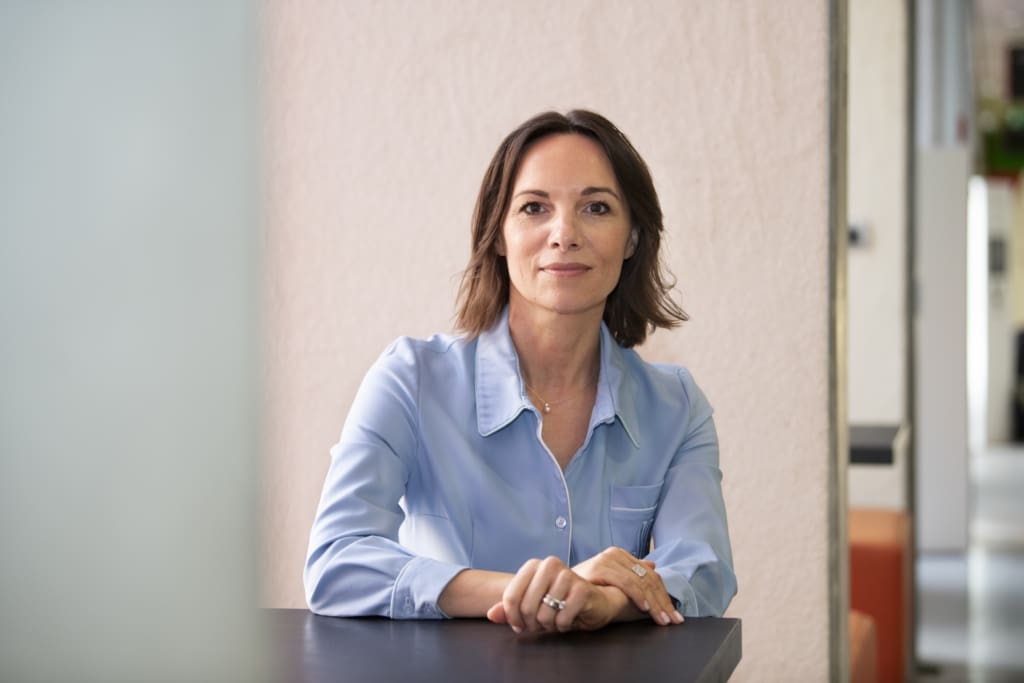
Why does parity in business leadership still matter? ‘I believe it’s a simple matter of not wasting talent and ensuring everyone can live up to their full potential, no matter their background.’
Marion Debruyne
Dean of Vlerick Business School in Belgium
“Women should not have to choose between the tenure clock and the biological clock. We desperately need to reform the standard up-or-out path to include a broader set of ways to the top.”
Marion Debruyne became Dean of Vlerick Business School in 2015, after a decade on its faculty. Before that she was a Visiting Scholar at the Wharton School (University of Pennsylvania) and the Kellogg Graduate School of Management and an Assistant Professor at the Goizueta Business School (Emory University). An engineer and a marketeer by training, Marion loves bridging the academic world and the world of business practice.
Women now make up roughly 30% of business school deans globally, up from about 26% just a few years ago. From your perspective, what has driven that increase and what still limits faster progress? My hypothesis would be that it is a natural evolution of Gen X women, who grew up being empowered in the belief that they could have it all, entering leadership roles. Additionally, search committees have paid more attention to considering a diverse set of candidates and put efforts behind finding them.
Despite this growth, women often reach the deanship through longer or less linear pathways. What barriers to advancement do you still see for women aiming for top leadership roles in business schools? I reached the deanship at 42, so I do not represent a datapoint that illustrates this longer or less linear pathway. I believe the barriers to advancing to top leadership in business schools are not unlike the well-documented barriers in the corporate world. They include perception biases about what good leadership looks like, societal expectations around motherhood and femininity and stubborn mental and structural models around what the ideal career path looks like.

Vlerick Business School’s Ghent campus
Once women reach the deanship, what challenges tend to persist? I have personally not experienced many challenges specific to being a female. I must confess that I confirm the finding that women seldom raise their hand unless prompted to do so. I was not a Dean candidate until multiple colleagues and board members encouraged me. It was their explicit support that influenced me to believe that maybe I was ready for that kind of responsibility. Similarly, I see female talents playing a crucial role behind the scenes in many business schools. They are, in fact, ready to step up into the spotlight but may need some encouragement to do so.
How do you assess whether progress on gender parity in leadership is substantive rather than symbolic? The most wonderful sign of progress would be for this no longer to be a topic of conversation, and female leadership would be as normalised and prevalent as male leadership. That, in my opinion, would really be a substantive change.
How does greater representation of women in business school leadership matter for students? This is where symbolism matters. Standard images of what leadership, quite literally, looks like persist. This includes academic leadership. When students are fed a steady diet of similar profiles in leadership positions or in front of the classroom, it only perpetuates the stereotypes. Broadening those images to include a wide range of faces can bust the stereotype. Also, it is much easier for female students to believe they, too, can reach a leadership position without having to be superwoman when they already see examples of that while studying.
Describe the programs, initiatives, or institutional practices your school has put in place to advance gender parity: Inclusion is part of our core identity. Yet it may not happen automatically. That’s why we put effort into tracking a broad set of metrics that show whether we are successful in making all talent flourish and take corrective measures where needed. For example, we thoroughly revised our admissions processes to remove potential sources of bias. We also promote diverse cohorts through targeted scholarship programmes.
Next page: Delphine Manceau, Dean at NEOMA Business School