

UCD Michael Smurfit Graduate Business School
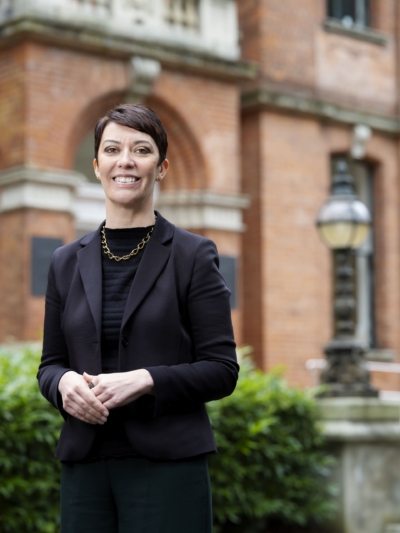
Federica Pazzaglia
Director of UCD Michael Smurfit Graduate Business School in Ireland
“Greater representation of women in business school leadership influences both our students’ imagination and expectations. Seeing women in senior leadership roles expands the mental model of who leads and how leadership can be enacted. Even when such representation appears incremental, it signals that leadership is not confined to a single archetype. As new generations come to access postgraduate studies, I am proud to notice how this feels natural to our students, and how to them leadership is more about living up to their expectations of competence, curiosity, strategic thinking, and empathy than about what an individual leader looks like.”
Professor of Management Federica Pazzaglia is Associate Dean of the UCD College of Business and Director of the UCD Michael Smurfit Graduate Business School in Ireland. She has lived and worked in Spain, Ireland, Italy and Canada and has a earned a PhD from the University of Alberta Business School in Canada. Her areas of expertise are strategic management and leadership, and her research focuses on social cognition, identity, and behavioural strategy – an interdisciplinary field that examines decision-making and strategic choices in organizations.
Women now make up roughly 30% of business school deans globally, up from about 26% just a few years ago. hat has driven that increase and what still limits faster progress? The increase in women in senior leadership positions in business school globally is evidence of a powerful shift in academia and society. While more remains to be done in terms of promoting greater representation of women in leadership positions, the impact of this shift should not be underestimated. On a structural level, we are seeing a stronger pipeline of senior female academics, more professionalised search processes, and greater international mobility. On a symbolic level, when a woman is appointed to a senior role, it reshapes the narrative of what leadership looks like, which in itself can influence future aspirations as well as institutional expectations of leadership. These shifts are often the early signals of deeper cultural change.
At the same time, progress feels gradual because social change rarely moves in a straight line. I am often reminded of Amara’s Law which states that we tend to overestimate the speed of change in the short term and underestimate the impact of change in the long-term. I suspect that gender representation in leadership positions follows a similar trajectory. The limiting factors are less about willingness and more about availability of inspiring role models and access to opportunities, with uneven access to sponsorship, expectations of uninterrupted career paths, and informal networks that still carrying significant weight in senior appointments.
‘Women leaders, like all leaders, play an important part in defining what the role means for themselves and for others, shaping expectations and policies in the process.’
What barriers to advancement do you still see for women aiming for top leadership roles in business schools? Many barriers faced by women aiming for top leadership roles in business are cumulative and largely invisible. Women frequently shoulder substantial teaching and administration responsibilities that are essential to institutional life but less visible in formal promotion criteria. Access to influential sponsorship networks can also be uneven, and leadership readiness is sometimes assessed through narrower or more traditional lenses.
Reflecting this, high performing women aiming at top leadership positions in academia are also at times hesitant to put themselves forward for high profile initiatives or are uncertain about whether these are indeed suited for them. The role of experienced sponsors and mentors in encouraging this inclination and desire to have an impact by taking on a top leadership role is essential, yet often elusive for them, thereby posing an additional challenge as they set out to navigate the next steps of their career journey.
Equally important is the emotional and cognitive labour associated with leadership progression. Women are often required to work harder to establish legitimacy, manage perceptions, and navigate expectations that may conflict with one another. These demands are often left implicit, yet they shape career trajectories in very real ways.
Why does parity in business leadership still matter? Parity matters because leadership representation is both practical and perceptual. On a practical level, diverse leadership teams tend to make more balanced decisions and engage more effectively with varied stakeholders. Leadership teams that reflect a breadth of perspectives are better positioned to anticipate complexity and risk. On a perceptual level, representation shapes how institutions are understood by students, partners, and the wider community. As business schools are increasingly engaged with a diverse and global range of stakeholders, there is a growing expectation that leadership of business schools be reflective of the diversity of their stakeholder groups.
Once women reach the deanship, what challenges tend to persist? What advantages might women have? Once women reach a top leadership position, in academia or otherwise, a significant challenge is the paradox of legitimacy. Women leaders are often expected to champion the benefits of greater diversity and inclusion, and foster institutional change more generally, while simultaneously supporting alignment with existing institutional norms. Balancing these expectations — being both change agent and system steward — can be one of the most demanding aspects of the role.
Another less visible challenge is access to resources. Representation at top levels does not automatically translate into equal authority or support. Women may still encounter invisible barriers in terms of access to informal networks and often continue to absorb a considerable amount of emotional labour that goes unrecognised. The flip side of these challenges is the opportunity to act as catalysts to create new, informal networks and to leverage support and skills through new and existing connections.
Many women bring strengths that are particularly valuable in academic leadership, including coalition-building, adaptive communication, and the ability to hold multiple stakeholder perspectives simultaneously. These capabilities are especially important in academia, where persuasion often matters more than hierarchy.
How do you assess whether progress on gender parity in leadership is substantive rather than symbolic? What indicators matter most to you beyond headline percentages? Headline representation is a useful starting point, but it is not the full picture. Substantive progress becomes visible when women hold roles with real influence —strategic portfolio leadership, research direction, budgetary control, and external partnership authority. The pipeline also matters: the proportion of women at associate dean level, programme leadership, and senior faculty ranks indicates whether progress is sustainable.
Cultural indicators are equally revealing. Are perceptions of leadership shifting over time? Empirical evidence across geographies would suggest that they are indeed shifting, and that traditional views of leadership are being reshaped making space for an approach to leadership that is increasingly skills-based more than traits-based as it has been in the past. Are policies around flexibility, parental support, and career pacing normalised rather than exceptional? Increasing representation can initiate change, but the durability of that change is measured in everyday practices and decision-making structures within organizations.
Describe the programs, initiatives, or institutional practices your school has put in place to advance gender parity within business education and the broader business community. At UCD Smurfit School, we have sought embed inclusivity into our institutional practices rather than treating it as a standalone initiative. A significant milestone in this journey has been achieving bronze status under the globally recognised Athena Swan framework. Athena Swan supports higher-education institutions in advancing gender equality by encouraging them to examine policies, culture, recruitment, promotion, and everyday practices to identify structural barriers and implement measurable, long-term improvements. The process itself is as important as the award, because it requires sustained reflection and accountability across the entire institution.
This commitment to embedding inclusivity is also evident in our efforts across taught programmes. We have placed particular emphasis on enhancing gender balance in areas where women have historically been under-represented, most notably the MBA. Targeted scholarships, outreach initiatives, and visibility campaigns are designed to reduce access barriers and broaden the applicant pool. Complementing this, initiatives such as our “Women on the MBA” webinar series highlight success stories of alumnae and current students to create relatable role models for prospective candidates.
Externally, our alumni networks and our partnerships with industry organisations extend this commitment beyond academia. Initiatives that foreground female leadership, opportunities for lifelong learning and career development, and visible engagement of female role models with our students contribute to shaping a broader ecosystem of inclusivity in a more meaningful way than a series of isolated interventions.
Do you believe women bring distinct strengths to academic leadership, particularly in periods of institutional stress or change? Leadership strengths are ultimately individual, yet lived experience can shape leadership style. Many women leaders develop strong adaptive communication skills and a capacity to navigate ambiguity — qualities that become particularly valuable during institutional stress or transformation. The ability to hold empathy and strategic clarity together can help sustain trust while advancing necessary change.
A tangible difference often emerges in how roles themselves are interpreted and communicated. Leadership positions are inherently ambiguous and contested. Women leaders, like all leaders, play an important part in defining what the role means for themselves and for others, shaping expectations and policies in the process. This interpretive work is frequently under-recognised but central to effective leadership.
Looking ahead, what changes would most meaningfully move the share of female deans beyond today’s 30%? Meaningful change will come from sustained attention to structural enablers as well as from continuing to showcase success stories and encouraging potential. Structurally, institutions need clearer mechanisms and criteria that acknowledge and sustain varied career trajectories, ensure access to sponsorship and mentorship opportunities, and broader international search practices. Culturally, there must be recognition that leadership pathways are not uniform and that excellence does not always follow a linear model.
An overdue shift is a deeper acknowledgment of the interpretive nature of leadership roles themselves. Institutions must make senior roles genuinely accessible, but individuals who step into those roles also shape what they become. When women are supported not only in attaining leadership positions but also in defining and evolving them, progress moves beyond representation toward lasting institutional transformation.
Next page: Minna Martikainen, Rector of University of Vaasa in Finland