

A new report from AACSB International, Global Minds, Local Impact: A Case for Student Mobility, published in July, finds that policy changes and visa restrictions are reshaping the movement of students around the world — a reality that could significantly affect business school enrollment.
The report draws on a poll of 97 business schools across 27 countries. More than two-thirds of respondents say policy or legislative changes have already affected demand among international students. Schools that anticipate an impact project an average enrollment drop of 16% in the coming year, with all schools predicting a 10% decline on average.
The highest reported disruption was in the Americas, where 84% of institutions say they have been affected by policy or legal changes. In Europe, the Middle East, and Africa, one-third of schools report disruption, compared with 40% in Asia Pacific.
VISA RESTRICTIONS LEAD THE LIST OF CHALLENGES
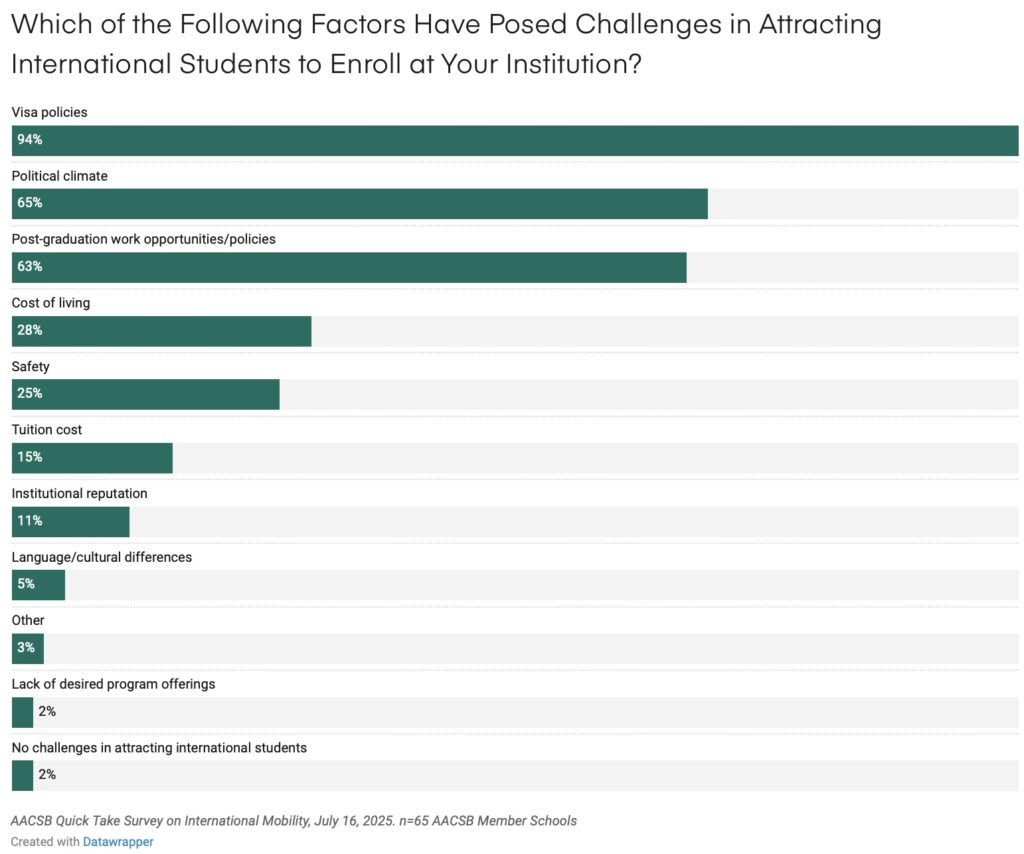
Among schools located in countries where policy has shifted, 94% cite new and more restrictive visa rules as the primary challenge in attracting international students. Other factors included the political environment in their country and concerns over post-graduation career opportunities.
More than half of these institutions say they are increasing efforts to attract domestic students. According to AACSB, this group is predominantly U.S.-based. Thirty-nine percent say they are strengthening international partnerships with peer institutions abroad as part of a diversification strategy.
AACSB’s analysis also includes economic impact data from several countries. In the United States, international students contributed $43.8 billion to the economy in 2023-24, supporting 378,000 jobs. In the United Kingdom, the contribution was £41.9 billion in 2021-22, up from £31.3 billion three years earlier.
BILLIONS IN ECONOMIC IMPACT ACROSS KEY MARKETS
Germany hosted more than 400,000 international students in 2024-25, with 45% staying after graduation. The Netherlands reported a projected €1.5 billion net gain from international students, with EEA students contributing about €17,000 each and non-EEA students nearly €100,000, and about one-third remaining in-country after graduation. In Australia, the sector generated A$51.5 billion in 2023-24.
The report also cites examples of how student mobility has influenced innovation and curriculum development. In Germany, more than 145,000 international engineering students participate in programs that include industry partnerships with companies such as Audi.
AACSB also notes research showing that international PhD students produce more patents and attract more research funding than domestic peers.
EUROPEAN INTEGRATION AS A MODEL
In Europe, the report pointed to the European Universities Initiative, which has created 65 cross-border alliances, as well as the European Student Card and the Bologna Process, which simplify credit transfers and degree recognition.
According to AACSB, these frameworks allow institutions to track not only student numbers but also skill development, innovation, and career outcomes.
AACSB states that “mobility is essential, not optional” and urged schools to integrate it into their strategies to remain competitive.
DON’T MISS AACSB REPORT HIGHLIGHTS FINANCIAL STRAINS, GLOBAL SHIFTS & RISING EMPLOYER DEMANDS IN BUSINESS EDUCATION and TRUMP’S IMPACT (SO FAR) ON B-SCHOOL APPLICATION TRENDS, EXPLAINED IN 9 CHARTS
The post Visa Rules, Politics & Billions In Play — AACSB Sounds The Alarm On Student Mobility appeared first on Poets&Quants.