
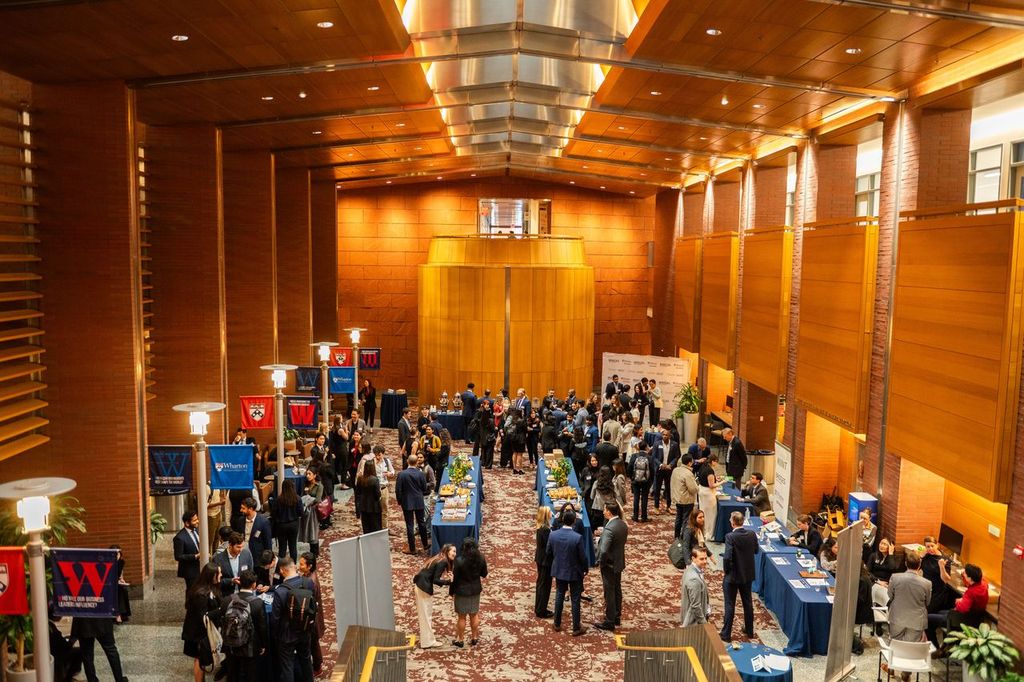
Last year, 167 students from around the world competed in the global finals of the Turner MIINT challenge at The Wharton School. Photo credit: Shira Yudkoff
Turner MIINT – one of the largest experiential impact investing competitions for MBAs – has a new co-producer.
Impact Capital Managers Institute (ICM) will join The Wharton School’s Impact, Value, and Sustainable Business Initiative as co-producer of the challenge, which attracts more than 400 students from 35 top business schools around the world.
The ICM Institute, a nonprofit affiliate of Impact Capital Managers, will work alongside Wharton Impact on the program’s curriculum, operations, and strategy, bringing along a network of more than 140 private capital funds managing more than $ 80 billion.
“We have strong preexisting synergies (with Turner MIINT),” says Marieke Spence, founding executive director of ICM and the ICM Institute. “A lot of ICM members have served as judges and mentors. A lot of (Turner MIINT) alumni land at ICM member funds.”
ICM replaces Bridges Impact Foundation – the nonprofit arm of Bridges Fund Management – which co-produced the program with Wharton for more than a decade. The move expands the partnership from a single foundation to a broader industry network with investments in over 4,000 companies.
TRAINING GROUND FOR FUTURE IMPACT INVESTORS
Now in its 15th year, Turner MBA Impact Investing Network and Training (Turner MIINT) has become a proving ground for future leaders in sustainable finance. Each year, student teams source real early-stage impact ventures, perform due diligence, and pitch their top picks to a panel of industry judges. The competition culminates in a final round at Wharton, where the winning team secures a $50,000 equity or debt investment for its chosen company.

Marieke Spence
Past winning ventures include Edovo (providing educational content and communication tools to incarcerated people) and Kumulus (a tech company that turns air into safe drinking water). LearnSprout, an education analytics platform, was later acquired by Apple. The program is named for Bobby Turner (MBA ’84), CEO of Turner Impact Capital, and his wife Lauren Golub Turner (MBA ’85), both longtime supporters of social impact initiatives at Wharton.
“It is widely considered the leading global experiential learning program, sort of a training ground for future impact investors,” Spence tells Poets&Quants. “It has an alumni network of more than 5,000 students, and participants are sourcing about 700 portfolio companies each year. It results in an actual equity or debt investment into the winning company, so there’s real skin in the game. That raises the stakes, which, of course, we all know MBAs love that.”
Students spend an academic year learning impact investing skills from global faculty and industry experts, working with mentors, and networking with professionals and peers. Each school holds its own internal competition to qualify a team for the global round at Wharton every spring.
“Impact investing is an area with substantial interest, but what you need to be successful goes beyond what we can teach in the classroom,” says Witold Henisz, vice dean and faculty director of Wharton Impact. “We need to get the students out there pitching, doing the due diligence, and having exposure to people who have been in the field. This competition gives them that opportunity.”
ESG MEASUREMENT AND A SHIFTING CLIMATE
The announcement comes at a time of increased scrutiny on environmental, social, and governance (ESG) investing. Critics point to greenwashing – when companies or funds exaggerate or misrepresent their environmental or social impact – and measurement frameworks that are vague or inconsistent.
There’s also growing political backlash. Soon after taking office in January, President Trump pulled out of the Paris Agreement for the second time. He has delayed permits for new wind and solar projects, froze tax incentives for renewable energy, and his EPA wants to rescind federal regulations on greenhouse gasses.

Witold Henisz
Even so, student interest is growing, says Henisz, Deloitte & Touche Professor of Management. The real-life effects of the climate crises are now clearly visible day to day. Just last week, Hurricane Erin became one of the fastest intensifying Atlantic storms on record. This summer, two European heatwaves were linked to as many as 2,300 deaths. Economists now predict trillions of dollars in lost global GDP from global warming.
Students arrive at Wharton with a sense of urgency, looking for ways to harness both business and capital to make a difference while also learning to scale the impact.
“We’re not having entry-level discussions of ‘what is impact investing?’” Henisz says. “These are people who have worked in the space and are asking how to scale impact investing from a few trillion dollars to tens of trillions.”
Spence agrees. On the industry side, impact funds face the same macroeconomic pressures as traditional firms — inflation, market cycles, and other external forces. But, they need talent that knows both the business fundamentals as well as the different impact frameworks.
What matters most, she says, is the “do-say ratio” — whether firms can back up their words with real outcomes. She pointed to the Rockefeller Brothers Fund, which reported this summer that its portfolio is more than 95% fossil free while still meeting benchmarks for the past decade.
IMPACT BEYOND PHILANTHROPY
There’s also a growing recognition that impact investing has moved far beyond feeling good about where your money goes. Freshfields – an international law firm specializing in corporate issues – concluded in “A Legal Framework For Impact,” that investors who ignore risks and opportunities tied to climate and other global challenges could actually be in violation of their fiduciary duties.
Instead of positioning impact investing as philanthropy or that impact investors will inevitably sacrifice returns, the report argues that considering impact is now necessary.
“That’s an incredibly powerful finding,” Henisz says. “Even if you’re not going into full-on impact investing – if you’re investing in the energy sector, if you’re investing in pharma, if you’re investing in education – you should have this lens that a program like Turner MIINT gives you to help you evaluate risks or evaluate disruptions.”
Turner MIINT, then, trains students to assess how companies affect natural, social, and human capital, and to evaluate whether those impacts can generate financial value and market-rate returns. The methodology is rigorous, designed to help future investors see where real outcomes connect to real returns. Henisz argued that such an approach could address much of the criticism leveled at ESG investing over the past five years.
A COMMUNITY THAT PAYS DIVIDENDS
For Spence, the transition from Bridges Impact Foundation to ICM is a natural next step. Brian Trelstad, who helped create Turner MIINT’s first iteration at Bridges, is also a founding board member of ICM. ICM members were already embedded in the program as judges, mentors, and employers of MIINT alumni. Spence herself judged the semifinals for three years and saw the program’s energy firsthand.
What ICM brings now is scale. Its 150 member funds consistently seek three things: fundraising connections, best practices in impact measurement, and a pipeline of skilled talent, Spence says. The ICM Institute addresses that talent need through programs like the Mosaic Fellowship, a 10-week summer placement with a 70% conversion rate into full-time roles. Having MIINT or Mosaic on a resume shows hands-on experience sourcing deals, building memos, and linking impact to financial return.
The program has also built a global alumni network of more than 5,000. MIINT winning ventures have secured over $1.14 million in seed capital through the Moelis Investment Prizes, funded by the Ron and Kerry Moelis Family Foundation.
“Competing and winning first place in the MIINT Turner Impact Investing Challenge has been one of the most rewarding experiences of my MBA so far,” said Samantha Withey, Oxford Saïd MBA ’25, and one of our Best & Brightest MBAs.
“It has provided hands-on exposure to sourcing and evaluating impact-driven ventures while refining an investment thesis for social enterprises in East Africa. It has been a perfect intersection of my past work in development and my future aspirations in impact finance.”
Graduate students and schools interested in joining the 2025–2026 Turner MIINT cohort should complete enrollment by early September. The 2026 Global Turner MIINT will be April 17-18 at Wharton.
DON’T MISS: INSIDE THE $120 MILLION PLAN TO TRANSFORM DELAWARE’S LERNER COLLEGE and 9 INTERNATIONAL BUSINESS SCHOOLS WHERE YOU CAN STUDY GEOPOLITICS
The post Wharton’s Impact Investing Powerhouse Just Got A Major Upgrade appeared first on Poets&Quants.