
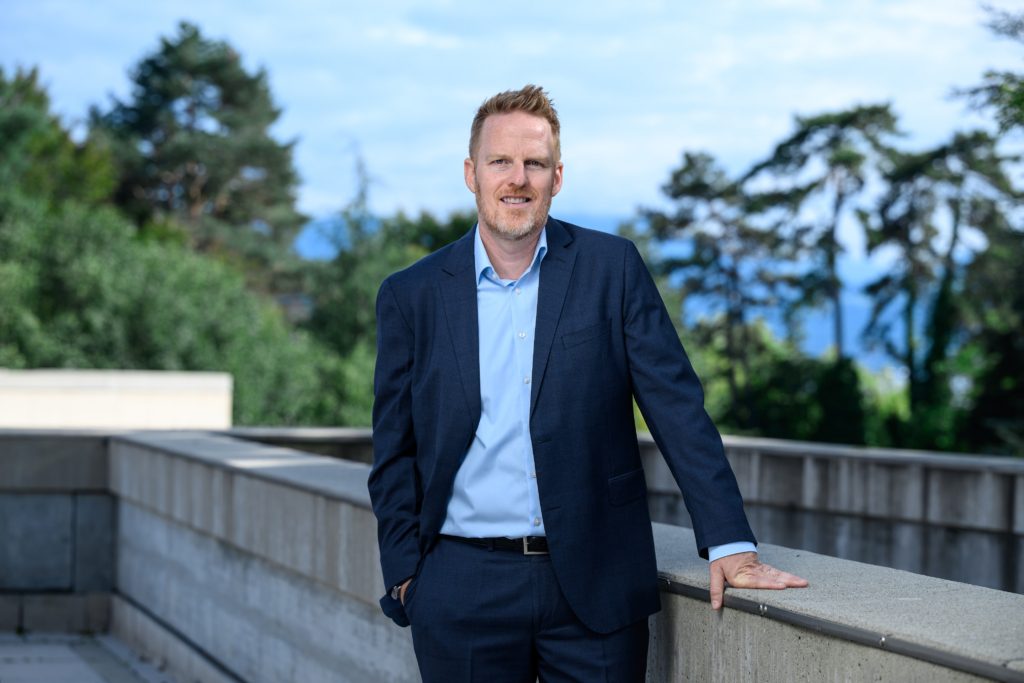
David Bach, President of IMD in Switzerland, has frequently criticized the Trump administration’s political attacks on US universities, Trump’s tarriffs, and America’s retreat from global leadership. (Photo: Mark Henley/IMD)
David Bach says he is a product of the global order America built. He grew up in Germany when the Berlin Wall still divided East and West. He remembers American troops stationed around the towns he lived and traveled through. To him, America was not only a protector, it was the ideal.
Germany and other European countries modeled their democratic institutions on America’s example. U.S. universities – built on openness, autonomy, and academic freedom – welcomed the world’s best students and faculty. That fueled innovation and prosperity while reinforcing America’s soft power.
“For anybody from our generation growing up in Europe, America was the orientation point,” says Bach, president of IMD in Lausanne, Switzerland.
“Part of why I have been speaking about the importance of U.S. research universities as a global public good – and their centrality for America’s global influence – is because I am a product of this magnetism.”
AMERICAN ACQUIESCENCE
In a moment of unprecedented political pressure on U.S. higher education – from federal crackdowns on DEI programs, partisan lawsuits over campus speech, frozen and unfrozen federal funding, and billion-dollar settlements with the Trump administration – Bach has used his considerable platform to speak both plainly and frequently.
Trump’s attacks began on the first day of his second term, when he signed several executive orders dismantling of DEI programs across the federal government. He’s since widened his scope to universities, private companies, even museums, anything he sees as “woke.”
Universities have taken the brunt. The U.S. Department of Justice last month issued formal guidance warning that even well-intentioned DEI programs may violate federal civil rights laws, and Trump’s administration has used billions in federal research grants as a lever to keep them in line.
Compared to the severity of the moment, the American response has seemed both quiet and solitary.
This summer, four of 25 member business schools pulled out of partnerships – some decades long – with The Consortium for Graduate Study in Management, a group that works to elevate Black and minority representation in business. Neither the schools nor The Consortium will explain why. Same with Forté, which was founded to lift women in business education and leadership.
When the administration paused $175 million in federal funding in a lawsuit over transgender athletes in women’s sports, the University of Pennsylvania settled and revoked their athletic titles. Penn’s Wharton School also ended its membership with the Forté Foundation, the second U.S. business school to do so this summer. Columbia University agreed to pay $221 million to settle a lawsuit over alleged campus antisemitism, while Harvard is nearing a $500 million settlement of its own.
“This isn’t just a policy shift; it’s a systematic attack on academic freedom, which has been the bedrock of excellence,” Bach says. “The longer it persists, the more damage we’ll see to America and to America’s global influence.”
It is not just universities. Several elite law firms have offered millions in pay-to-play pro bono work to protect federal contracts and stave off executive orders. Firms such as Target, Walmart, and Meta have quietly dismantled diversity, equity, and inclusion programs to avoid political scrutiny. Apple CEO Tim Cook traveled to the White House to present Trump with a gold-plated plaque, in front of cameras, in exchange for a favorable tariff exemption.
While there have been sparks of resistance, acquiescence seems to be America’s biggest export right now. The irony is hard to miss: The most vocal and persistent defenders of U.S. universities are not Ivy League presidents or B-school school deans where DEI and leadership are supposed to be core. It’s people like Bach, a German-born academic who now leads a Swiss business school.
BACH NAMED IMD PRESIDENT IN 2024
For months, Bach has frequently argued against Trump’s tariffs, warned about the politicization of federal funding, and lamented America’s retreat from global leadership on his LinkedIn, in essays, and in public forums. He’s also railed against the DEI backlash.
“At this watershed moment, business schools cannot afford to abandon their commitment to diversity and inclusion,” he writes in an April 2025 essay titled “Inclusiveness is not a trend. It’s a test of leadership.”
“Instead, we must stand with those who embrace inclusive leadership as a moral imperative and good business. If our role is to prepare leaders for complexity, adversity, and dealing with challenging political environments, this is the moment to prove it.”
‘America’s openness to talent has been one of its greatest sources of power. Undermining that is short-sighted,’ Bach says.
He acknowledges that it’s all easy for him to say as a European academic. But he insists that defending U.S. universities is a responsibility, not only because they gave him his career and platform, but because the stakes for global leadership are so high.
While Bach studied political science both as an undergrad at Yale University and as a Ph.D. at UC- Berkeley, he’s always worked in business schools. He spent eight years at Spain’s IE Business School, rising from a professor of strategy and economic environment to dean of programs. At 35, Poets&Quants named him a 40-Under-40 Best MBA Professor in 2011 for his work at the intersection of politics and business.
He spent another eight years at Yale School of Management, working under then-dean Ted Snyder who wanted to make Yale the most global business school in the world. He was a key architect of the Global Network for Advanced Management, an alliance of 33 business schools from varying regions and phases of development with a mission to drive innovation by connecting students, faculty, and resources. He also led the expansion of SOM’s degree programs and the creation of Yale Center Beijing. His course, “The End of Globalization?”, designed in the aftermath of the Brexit vote and the rise of populist leaders across Western democracies, won the 2018 Ideas Worth Teaching Award from the Aspen Institute.
In 2020, he joined IMD as dean of innovation and programs. He was named president in September 2024.
Q&A WITH DAVID BACH
In a conversation with Poets&Quants, Bach describes the predicament of U.S. universities as “a classic prisoner’s dilemma”: individuals striking deals on their own or staying quiet to avoid notice. What’s needed, he says, is a collective response, a “Three Musketeers” pledge of one for all and all for one.
He warns that America’s voluntary retreat from global leadership could very well damage U.S. competitiveness. Singapore’s former Prime Minister Lee Hsien Loong recently described a “world minus one” approach where other countries move forward collectively, even if the U.S. opts out.
“Several European business leaders have told me that even with tariff clarity, they have serious reservations about increasing their U.S. investment if policy can change so dramatically from one administration to the next,” Bach says.
In the Q&A below, Bach talks candidly about what he sees from Europe, why silence is so dangerous, and how business schools can still serve as places where hard conversations about the future are possible. Our conversation has been edited for length and clarity.
Let’s start with your interest in academics and your journey to IMD.
I grew up in Germany, went to a public school there, did a year of compulsory civil service as an ambulance driver, and assumed I’d stay in Europe. On a whim, I applied to two U.S. universities, and was admitted to Yale. It changed my life.
Part of why I have been speaking about the importance of U.S. research universities as a global public good, and their centrality for America’s global influence, is because I am a product of this magnetism. Faculty there took me — a young kid from Germany — seriously in a way that it’s fair to say most faculty at European universities wouldn’t have. I sometimes joke that I still haven’t fully recovered from the shock of being surrounded by these brilliant minds and being taken seriously.
Ultimately, this set me on the path toward a career in higher education. My Ph.D. is in political science, but I’ve always been in business schools. I straddle Europe and the U.S. I straddle politics and business. And I straddle the more traditional work of faculty as a researcher and teacher with academic leadership, which I tend to think of as educational entrepreneurship.
My career began at IE in Madrid where I directed the MBA and built a number of programs. I was then recruited to Yale, worked closely with Ted Snyder on globalizing the Yale School of Management, helped build a network of top business schools, and then came to IMD in 2020.
You and I are having this conversation right now thanks to the openness and meritocracy of U.S. higher education. Without it, I wouldn’t be here.
Since January, what has been your reaction to what’s happening at U.S. universities and business schools?
We’ve entered uncharted territory. Federal funding — once kept above politics — is now openly used to pressure universities. This isn’t just a policy shift; it’s a systematic attack on academic freedom, which has been the bedrock of excellence. Institutions are being forced to choose between defending their values, including independence and their commitment to diversity, and protecting their research funding. That’s a false choice, and the longer it persists, the more damage we’ll see to America and to America’s global influence.
What are the risks if that erosion continues?
America’s openness to talent has been one of its greatest sources of power. Undermining that is short-sighted. If today’s international students no longer see the U.S. as the ideal, the talent pipeline that fuels innovation, diplomacy, and economic growth will dry up – and once lost, it’s hard to rebuild.
As I mentioned, I am a product of this global order America built. American soft power and hard power has played a pivotal role in my life. I grew up in a divided Germany. The country was kept safe by the presence of American troops. Every little town in the area where I grew up had an American military presence. America was a protector, but it was also the ideal. The democratic institutions in Germany are modeled on America’s. For anybody from our generation growing up in Europe, America was the orientation point.
It was a dream to go and study in the U.S. That is why I say hard power and soft power. Moreover, the global success of management education is very much a result of U.S. business schools globalizing in a way the rest of higher education just hasn’t. At Yale, we constructed the Global Network of Advanced Management to connect students with one another and to open the School of Management to the world. A program I led there had the highest percentage of students from Africa across the university, something I am immensely proud of.
Undermining this, closing off U.S. higher education, endangers America’s global influence and, ultimately, its global prosperity.
As an academic leader in Europe, I can look at opportunities to hire top U.S. faculty. We are pursuing some of those opportunities, and we’d be crazy not to. But it pains me deeply that future generations of talented young people growing up outside the U.S. might not benefit in the way I and many of my peers benefited.
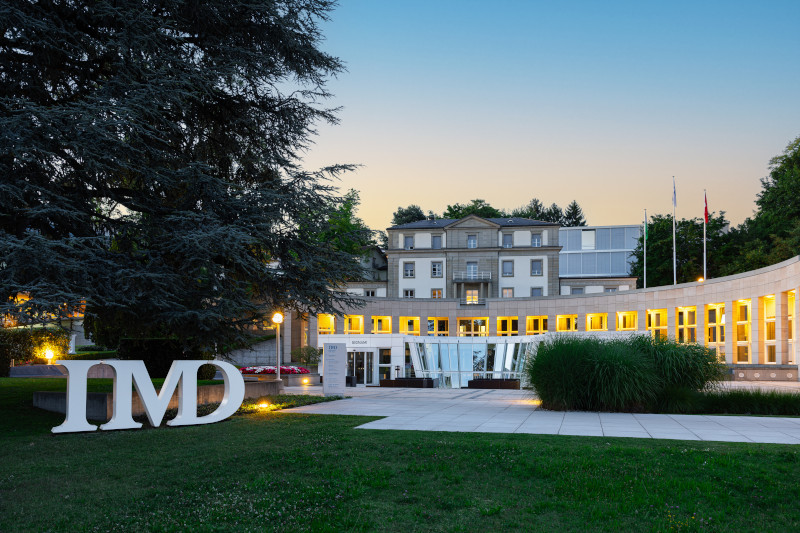
The Bignami building on IMD Campus in Lausanne, Switzerland. IMD President David Bach was born in Germany, but educated in the U.S. He attributes American universities for giving him a position and platform to defend their autonomy. (Photo: Dorian Tosca/IMD)
What is your assessment of the relative silence of universities and business schools, and the capitulation of some to presidential demands?
One of the core concepts of political economy is collective action and the challenges of organizing collective action. You need to organize and cooperate to overcome power asymmetries.
This is textbook — exhibit A. When the Trump Administration targeted the first law firm, other firms, rather than rallying to its defense, tried to poach clients. That set the tone — everyone out for themselves. And this fundamentally weakens their influence vis-à-vis the federal government. You see this with law firms, you’ve seen it with universities, you’ve seen it with countries negotiating tariffs. The Administration has been so effective in part because organizations have failed to organize and have looked out for their own short-term self-interest. It’s a classic Prisoner’s Dilemma.
There have certainly been attempts to organize. After Harvard resisted, over 150 college- and university presidents signed a letter decrying undue government intrusion. But since then, we have seen individual schools strike deals. The pressure to strike a deal quickly and have the next guy handle it will leave everyone worse off. This is not a normative statement. I’m not talking about the substance of the disagreement – just the fact that these institutions are putting themselves in a weaker position by not joining ranks.
In your conversations with American and European colleagues, what differences are you hearing?
I can really feel the anguish when I speak with higher ed leaders in the U.S. They all know that the federal government — or this Administration, I should say — is making unprecedented demands that constitute an encroachment on academic freedom, which goes against the principles that have underpinned the excellence and success of these institutions. At the same time, I appreciate the pressure these institutions are under. I want to be very clear: it’s a very different situation for a large research university than a standalone business school. The work we do in business schools is important, but we’re not developing life-saving drugs or coming up with new treatments. If you’re a university president and you know that refusing to strike a deal could mean research that could cure a debilitating disease will not happen, that’s a very difficult position to be in.
In Europe, we can still debate difficult issues openly. In the U.S., many colleagues now avoid entire topics. There is a risk-aversion that has set in. U.S.-based colleagues have shared that they are no longer comfortable working on certain topics. Some conferences are relocating overseas, not for convenience, but because of fear. That’s not the America that inspired me as a student – and it’s a loss for the whole world.
What’s startling is that when it comes to topics like sustainability or diversity and inclusion, the science hasn’t changed, the economics hasn’t changed, the research hasn’t changed. You can change the policy environment and the discourse, but the planet is still hotter, diverse teams still perform better, and renewable energy is still cheaper.
In Europe, we continue to do this research because it is important to the needs of business and society. Our U.S. colleagues completely understand that, but right now they feel hamstrung in a way that is painful for them, and painful for us to watch.
Are there red lines we’ve already crossed, or are close to crossing?
I think it’s important for your readers to appreciate that those of us outside the U.S. see something in the U.S. that eerily reminds us of other countries we’ve seen move away from pillars of democratic governance, including free speech, academic freedom, and the importance of independent scientific expertise in government.
Several European business leaders have told me that even with tariff clarity, they have serious reservations about increasing their U.S. investment if policy can change so dramatically from one administration to the next. One day, there are credits for clean energy and massive support for the energy transition; the next day, all that funding is canceled, and, in fact, the coal industry is what gets funded. One day, the U.S. is a global leader in mRNA vaccines; the next day, the government cuts all funding. If you can have such wild swings in economic policy, is this really a good business environment?
At the same time, international students are asking whether the U.S. is still the place where they want to be? In online forums, foreign students admitted to U.S. schools are exchange how best to erase their social media and thus increase their chances of getting a visa.
This is where I fear we might see lasting damage to U.S. competitiveness.
From your perspective outside the U.S., how does the world interpret America electing Donald Trump a second time? Does the meaning of a second term differ from the first?
It’s not my place to question the wisdom of American voters. What I can say is — certainly from the perspective outside the U.S — there’s such an important difference between the first and the second term. In the first term, there was a sense this was perhaps an accident — much like the Brexit vote, born out of a particular moment — and you did see the institutions generally holding. Whether it was academia, the press, civil society or even CEOs, they mobilized when it seemed the first Trump administration went too far.
Then came Biden and, whatever appropriate critique one may have of his leadership, there was a clear commitment to strengthening institutions again and bringing normalcy back to U.S. government.
‘Business is facing challenges most of these leaders have never dealt with in their careers, and for business schools to remain relevant, they need to be places where these conversations happen. That can’t happen without business school deans willing to create that space,’ Bach tells P&Q.
But the majority of American voters decided to go back, knowing that without the need to run for re-election, and with everything he had telegraphed about the kind of people he would surround himself with and what his presidency would be like, President Trump would be a more radical leader the second time around.
I want to be clear: Many of the issues that fueled President Trump’s first campaign and that propelled Brexit and populist movements here in Europe are real. Take trade. The Secretary General of the World Trade Organization, Dr. Ngozi Okonjo-Iweala, spoke at IMD in June and told a room full of business leaders that she’s the first to admit that the multilateral trade system needs reform. But let’s do that together — business, government, and civil society working together — rather than just blowing it up by replacing it with transactional bilateralism.
So that is what has rattled people. American voters didn’t just want change; they signed up for a pretty radical agenda of dismantling American and global institutions, institutions that America built and actively exported for eight decades. That’s where you hear, “Man, what happened to America?” — and that’s the sentiment I get from a lot of folks here.
What would organized resistance look like?
Go back to the textbook on collective action: you have to be willing to take some short-term pain to realize long-term gain. And you have to join forces. It’s the same whether you look at law firms, universities, or countries trying to strike trade deals.
For higher education, this could mean universities committing to one another that if the funding of one institution is cut, the others will support it. If scientists can’t continue their work in one place, you could have a mechanism to allow them to temporarily join another so the work continues. Could foundations or philanthropists commit to backing institutions that refuse to bow to undue pressure and interference, at least at a minimum level, for a few years, to keep their work going?
Call it the Musketeer principle – all for one and one for all. That kind of solidarity, that ability to avoid being picked off one by one, is really important.
But it requires trust. Even if you get university presidents in a room to agree, they all have boards — and public institutions have boards with political appointees — so university presidents don’t have unlimited freedom. But that would be the basic idea.
Is AACSB’s removal of DEI from its core values different from what universities are doing?
I have exchanged with the AACSB leadership about this. My understanding is that they felt they needed to protect U.S. members under political pressure for their DEI efforts. But in changing the language, from advancing diversity, equity and inclusion to fostering community and connectedness, they undercut the schools worldwide that had embraced DEI. And many business schools had developed formal DEI strategies because it had become an accreditation standard. The message matters — and the message felt like a retreat from principles.
Take my school, IMD, as an example. Six years ago, the AACSB re-accreditation helped us identify gaps in this important area. The peer review team’s constructive feedback led us to appoint an internal DEI champion, set up a council, and take a number of important initiatives. We made real progress and were proud when the AACSB peer review team commended us for that progress during last year’s re-accreditation visit.
A number of non-U.S. schools that had invested in these efforts felt like the rug was pulled out from under them. Part of it was communication – AACSB could have handled that better and I credit them for recognizing that — but part was just reacting very quickly to the needs of U.S. members without thinking how it would be perceived by non-U.S. members who now comprise the majority. Many of those members would have wanted AACSB to stand up more for something we all still believe is very important.
If the U.S. steps back from global leadership, does it really matter? Won’t other countries or regions just fill the vacuum?
If the U.S. steps back, others will fill the vacuum — but in ways that serve their own interests. If you listen to the MAGA movement, it’s all about how the world has taken advantage of America. In reality, America has been the biggest beneficiary of the world it built after World War II. America’s voluntary retreat from global leadership is a gift to China. It’s also an opportunity for Europe, even though the continent’s leaders are slow to embrace it.
But while this all sorts itself out, we are looking at something Ian Bremmer from Eurasia Group calls a “G-zero world.” For a long time, the G7 club of advanced democracies sought to provide global stability. With power shifting East and South, there were efforts to construct a G20 world. But G-zero means that we are entering a phase where nobody is willing or able to provide global leadership. And as we face a warming planet, accelerating biodiversity loss, rising poverty, and critical questions about how to deploy AI responsibly, the absence of principled global leadership is not good for anyone.
That’s why I’m concerned about where we’re going. Less trade as a result of tariffs will mean less economic prosperity. We’ll be fine in Switzerland, but people in Bangladesh will not be fine. The same for people in Nigeria or rural India who were just beginning to benefit from integration into the global economy. This shift in U.S. and global policy will mean more poverty, and fewer people being lifted out of it. That is a real tragedy.
Of course, in some areas other countries and regions will step up. But the economist in me thinks about opportunity cost: the value that won’t be created, the progress that will be lost.
Earlier today, I was speaking with senior executives of a large European company. They are continuing their sustainability work. Why? Because science is science, and economics is economics. But is it helpful that the U.S. policy environment has shifted so drastically, and that U.S.-based competitors may not only be held to lower standards but might even be punished for sharing sustainability progress with shareholders? No, it is not helpful at all.
Anything else you’d like to add?
We can’t control Washington’s choices, but the rest of the world can choose to keep working together. I go back to what I said earlier about collective action. Singapore’s former Prime Minister Lee Hsien Loong recently called it the “world minus one” approach, i.e. everyone tries to move forward together, even if the U.S. opts out. Think of it as the Paris Accord formula. Via the Paris Accord, 194 countries formally committed to combatting climate change. The U.S. has withdrawn – for the second time now – and yet the work of the others continues.
My hope is that leaders in business, government, and civil society will do the same — not just on climate change, but on trade, cross-border investment, poverty alleviation, fighting infectious diseases, responsible AI, and more. That’s important for two reasons: first, because the work needs to happen; and second, because it will make it easier for America to re-engage at some point in the future, when it realizes some of the recent policy turns were not in its interest.
My fear is that with America withdrawing, what will follow is entropy. Look at the 1930s — after America increased tariffs, everyone else did the same. Historians and economists disagree on exactly how much that contributed to the collapse of the global economy and ultimately to conflict, but it clearly made things worse.
Right now, the question isn’t what America will do — we know what America is doing. The question is: what will Europe do? What will India do? What will China do? What will Saudi Arabia do? Can these countries, despite political and ideological differences, find ways to keep the rules-based international order together as best they can?
Again, it’s about organizing collectively — putting aside short-term self-interest to focus on the shared long-term goal of maintaining some resemblance of global order. Business plays an important role in this, and business schools can too.
That’s the irony of the silence you’ve described at the outset of our conversation: business leaders need places to come together to have these discussions. Business is facing challenges most of these leaders have never dealt with in their careers, and for business schools to remain relevant, they need to be places where these conversations happen. That can’t happen without business school deans willing to create that space.
At IMD, we’re trying to make our small contribution to opening up and holding that space.
DON’T MISS: A NEW GEOPOLITICS PUSH? HOW INTERNATIONAL B-SCHOOLS ARE RESPONDING TO GLOBAL CHAOS and AACSB FACES A SOCIAL MEDIA BACKLASH OVER DROPPING DIVERSITY GUIDELINES
The post ‘A Classic Prisoner’s Dilemma’: IMD’s David Bach On What Individual Action May Mean For U.S. Universities appeared first on Poets&Quants.