

University of Central Florida, dubbed SpaceU, at the ASCEND conference in Las Vegas in July. Courtesy photo
The next great business boom may not come from Wall Street or Silicon Valley, but from orbit 250 miles above the Earth. The University of Central Florida is positioning itself to train the executives who will run it.
UCF’s College of Business is launching an online Space MBA, welcoming the first cohort in spring 2026. While there are a handful of space related concentrations, certificates, and master’s degrees, UCF’s is the only fully online, dedicated MBA focused entirely on space commercialization from an accredited U.S. business school.
The launch comes as McKinsey & Co projects the global space economy to reach $1.8 trillion by 2035. That includes not only rockets and satellites, but also telecommunications, materials, climate technology, medicine, and tourism. The program will target entrepreneurs and managers looking to break into the sector as well as engineers, NASA scientists, Space Force Guardians, and other technical professionals who are suddenly tasked with managing large projects.

Greg Autry, UCF’s associate provost for space commercialization and strategy
“You have scientists and engineers who are put in charge of billions of dollars and 2,000 people spread across the country, with no management training whatsoever. They don’t know about accounting, or finance,” says Greg Autry, UCF’s associate provost for space commercialization and strategy as well as President Trump’s nominee for NASA’s chief financial officer.
“At the same time, there’s people in the tech industry who want to embed themselves in space. This is a perfect program for them to link into that network.”
AMERICA’S SPACE UNIVERSITY
University of Central Florida was founded in 1963 to help the U.S. land a man on the moon. It trained many of the engineers who designed the tech that got America to space, and it’s still the nation’s top talent pipeline to the aerospace and defense industries. Nearly a third of Kennedy Space Center employees are UCF alumni.
Its portfolio spans aerospace medicine, hypersonic flight, microgravity research, and planetary science. In total, the university offers more than 35 space-related degree programs across every level of study. It is home to the Exolith Lab — a space hardware testing and research facility with the world’s largest simulated lunar surface.
Today – with a private company putting up more space launches than any government while billionaires fund space flights for their friends and pop stars – the next space frontier is likely commercial.
UCF is just 35 miles from Florida’s Space Coast offering access to companies like SpaceX, Blue Origin, Lockheed Martin, Boeing and NASA’s Kennedy Space Center.
“We already have world-class researchers, direct connections to the space industry and this unique location,” says Autry. “I want students to come to UCF knowing they can participate in an industry that’s about to take off, no matter what field they’re interested in. This is the place to be.”
Cementing its SpaceU cred, UCF is hosting its annual Space Week November 3-7. Events include summits on Mars and the emerging space economy hosted by The Economist. It will also feature the UCF Space Game, an annual football match with a distinct space theme. This year, UCF Knights will take on the University of Houston Cougars – a university that also happens to be 30 miles from the Johnson Space Center, home of NASA’s Mission Control.

UCF is home to the Exolith Lab, the world’s largest simulated lunar surface. Courtesy photo
AN MBA FOR THE SPACE ECONOMY
The UCF Space MBA is a two-year, part-time program delivered entirely online and asynchronously. Students will complete 14 courses over 39 credit hours at a tuition of $37,329. Like a traditional MBA, the program includes accounting, finance, strategy and leadership. But it replaces electives with courses such as Space Law, Space Entrepreneurship and Global Space Domain.
Michelle Hanlon, executive director of Air and Space Law at the University of Mississippi, will teach space law. Steven Shinn, NASA’s deputy CFO, will teach space finance. Other courses include Space Leadership, Space Entrepreneurship, and International Business Analysis.
Students will also have weekly guest lectures from industry leaders and opportunities for optional in-person events – possibly tied to launches on the Space Coast.
The program targets working professionals already working in the industry, like people from the nearby Patrick Space Force Base, NASA, and Kennedy.

Zaheer Ali, program director for space commercialization and strategy
“You’ve got amazing engineers, people who can and will change the world, but they don’t have the skills to go talk to the venture capitalists, to go talk to the institutional funds, to understand how to manage a diverse team,” says Zaheer Ali, program director for space commercialization and strategy.
But the space economy is not only for scientists and engineers. The degree also targets managers and entrepreneurs who want to work in the emerging market.
“The space economy is a human endeavor, meaning it’s going to take all kinds,” Ali says. “That’s marketing, that’s law, that’s art, that’s design, that’s architecture, and all of that will be needed.”
GETTING THE BAND BACK TOGETHER
Autry and Ali both have deep space pedigrees.
Autry started writing on the new space movement back in 2002 as an adjunct professor at UC Irvine’s Merage School of Business. That was when companies like Blue Origin, SpaceX, and Virgin Galactic were first forming, but nobody was taking them seriously. He figures that he has been studying space entrepreneurship and strategy longer than any other management scholar.
He also hosted several space events at USC’s Marshall School of Business, was nominated by President Trump to be NASA CFO in 2020 and is his current nominee awaiting senate confirmation.
A physicist by education, Ali is a partner at Space Outcomes LLC and New Space Finance and co-founder of Positon Inc. He has also advised numerous space startups, including Pulsar Space, Magdrive, Parsimoni, ThinkOrbital, Paterson Aerospace and Space Railway.
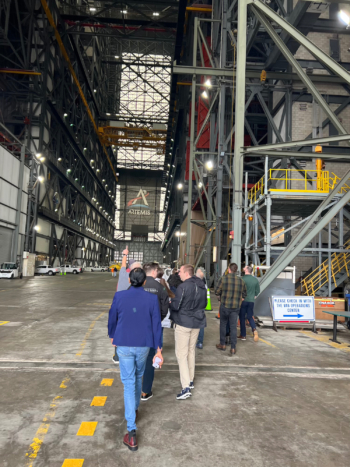
UCF business students visiting NASA’s Vertical Assembly building at Kennedy Space Center. Courtesy photo
Together, Autry and Ali launched the successful Masters in Global Management: Space at Arizona State University’s Thunderbird School of Global Management.
“It was a great success and many of my students have gone on to be very influential in the space domain,” Autry says. “However, the global space business was underserved by an in-person solution. For every student we could get into class, there were clearly dozens who would have liked an online option.”
When Autry was recruited to UCF to oversee the broader integration of space enterprise across the university, he asked Ali to join him. The Patrick Space Force Base partnered with UCF to deliver a number of graduate degree programs to their Space Force Guardians with the stipulation that they had to be able to travel the world while they took them. The online Space MBA was the logical next step.
Meanwhile, the program dives into the government policy, regulation, and geopolitics that make space such a complex sector.
“Most management programs kind of ignore that and pretend you’re living in this libertarian finance world that doesn’t exist,” Autry says. “In the space industry, (government) is the biggest customer and they’re also a heavy regulator.”
DON’T MISS: THE MBA PRICE TAG: 21 OF THE TOP 25 U.S. B-SCHOOLS NOW CHARGE $100K A YEAR OR MORE and IN THE FIELD: ESADE STUDENTS PARTNER WITH LOCALS TO RESTORE MANGROVES IN THE GAMBIA
The post Florida B-School Launches First Fully Online ‘Space MBA’ appeared first on Poets&Quants.