
Stanford sets the standard.
Known for the highest pay and lowest acceptance rates, Stanford GSB ranks atop the Bloomberg Businessweek and QS rankings. For the third consecutive year, the GSB held the #1 spot in LinkedIn’s annual MBA rankings – “Top MBA Programs 2025: The 100 Best Global Business Schools to Grow Your Career.”
Like last year, Stanford GSB ranked among the five-best in two of LinkedIn’s pillars: Career Advancement and Leadership Potential. In the process, Stanford edged out long-time rival Harvard Business School, whose runner-up position was secured by also placing among the top 5 in Career Advancement and Leadership. HBS also displaced INSEAD, which slipped to 3rd, buoyed by a top 5 score in Leadership. Wharton held the 4th spot for the third consecutive year. At the same time, the Indian School of Business moved up a spot to break into the top 5.
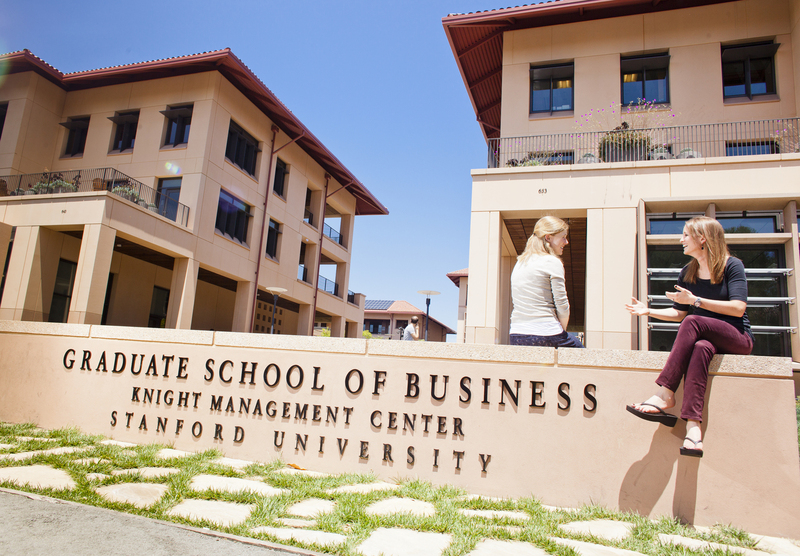
Stanford GSB Entrance
TRANSPARENCY: THE FATAL FLAW
When it comes to rankings, LinkedIn has everything going for it. Think an enviable brand name and a wealth of data. You can’t say LinkedIn went stingy with its business school ranking, either. Released on September 15, LinkedIn credits two data scientists and five editors for producing the ranking. Among the ranking’s advantages, it is international in scope, covering every country except China. It also taps into its parent’s platform, compiling data from graduate profiles that other outlets can match in scale and specificity. Better still, LinkedIn tracks career advancement and network strength to reflect wider benefits beyond readily-available pay and placement data.
There’s just one problem: LinkedIn doesn’t really understand what a ranking really is. For most, it is an instrument to compare schools side-by-side across individual metrics and categories (or “pillars” to borrow LinkedIn’s terminology). In the process, readers can identify where schools stand out, visualize how much they’re improving, and quantify gaps between programs. In LinkedIn’s case, readers receive a numerical ranking along with a capsule covering common job titles, notable skills, and top alumni locations.
In other words, the LinkedIn ranking is akin to a researcher who has little idea how to commercialize – let alone pitch – their breakthrough. In the end, LinkedIn provides a simple, sequential ranking, with little to back it up. Data tells stories. In this case, LinkedIn doesn’t even offer raw numbers for readers to come up with their own narratives. As a result, LinkedIn’s MBA ranking again falls short of the standards – however flawed – set by data-rich instruments from The Financial Times and U.S. News & World Report (or even generic, category-specific index scores supplied by Bloomberg Businessweek).
The message: Just trust us…and don’t worry about the contexts and nuances of data. As a result, the ranking’s credibility buckles under the weight of a lack of transparency.

The Indian School of Business
LINKEDIN LOVES INDIA
That’s a shame since LinkedIn’s ranking is certain to stir debate. For one, it places India near the center of the business school universe – an intriguing proposition considering the country’s rapid growth and increasing popularity of the MBA degree. Notably, there are five Indian programs among the top 26 (with IIM Indore also finishing 36th). The Indian School of Business, for example, ranks ahead of legendary American programs like Northwestern Kellogg, MIT Solan, Dartmouth Tuck, Chicago Booth, and Columbia Business School. That’s the inverse of the equally globally-minded Financial Times MBA ranking. Here, the Indian School of Business placed 27th, behind all of the aforementioned American programs. In particular, ISB produced the 4th-best survey score for its Alumni Network and 19th-best for Career Services (among 24 data points published) with The Financial Times. In LinkedIn’s case, readers only know that ISB ranked top 5 in Career Advancement.
What’s more, LinkedIn’s ranking doesn’t even align with Indian conventional wisdom, where IIM Ahmedabad is considered the country’s gold standard for graduate business education. Consistently ranked #1 in the government-produced NIRF ranking, IIM Ahmedabad finished behind ISB and IIM Calcutta (which placed 7th in NIRF). Even more, the differences between LinkedIn and The Financial Times is striking when it comes to India. For example, IIM Calcutta ranks 16th with the former and 61st with the latter. The same is true with IIM Lucknow (26th vs. 71st) and IIM Indore (36th vs. 69th).
Why? Who knows! That’s the root of LinkedIn’s ranking problem. No data and no transparency.
Aside from Indian schools, LinkedIn’s rankings are relatively free from the wild swings that doomed The Economist ranking. 9 of the top 10 programs remained the same, with London Business School knocking Chicago Booth down a spot to 11th. Among the Top 25, the biggest changes came from Indian MBA programs, with IIM Calcutta rising from 24th to 16th and IIM Bangalore improving from 27th to 20th. The only school losing any real ground was Virginia Darden, which dropped from 12th to 18th.

Oxford MBAs decked out in sub fusc
WINNERS AND LOSERS
That said, there were several noticeable differences between LinkedIn and The Financial Times beyond Indian schools. The University of Oxford’s Saïd Business School reached 12th in LinkedIn, compared to 26th in FT. The same could be said for Yale SOM (14th vs. 24th), USC Marshall (28th vs. 50th), ESSEC Business School (29th vs. 47th), Hult International Business School (31st vs. 92nd), and the Rotterdam School of Management (33rd vs. 56th). Maybe the biggest difference: IESE Business School. The #3 business school in the world according to The Financial Times, IESE ranks 22nd with LinkedIn. Readers will find a similar dynamic with SDA Bocconi (4th vs. 47th), Esade Business School (8th vs. 46th), and HEC Paris (9th vs. 24th).
Theories can abound on why. One noticeable difference between the rankings: The Financial Times ranking is driven by data points that are only 58% outcomes-based. Again, there is no hard data on LinkedIn’s end that lends itself to a head-to-head comparison.
This year’s biggest debut in LinkedIn came courtesy of the Netherlands’ TIAS School of Business and Society at 54th, with the Smith School at Queen’s University joining in at 57th. The WHU Otto Beisheim School of Management, which ranked 14th in the 2024 ranking, completely tumbled out of LinkedIn’s top 100.
THE METHODOLOGY
According to LinkedIn, the ranking methodology is based on five pillars, which were defined accordingly (with accompanying weights):
Hiring and Demand (20%): “Tracks job placement rates and labor market demand, focusing on recent graduate cohorts from 2019-2024. This assessment is based on LinkedIn hiring data and recruiter InMail outreach data.”
Top 5 (Not listed in order): Wharton, Northwestern Kellogg, Chicago Booth, Rutgers, Pace Lubin
Ability to Advance (20%): “Tracks promotions among recent cohorts. It also tracks how quickly all past alumni have reached director or VP-level leadership roles. This assessment is based on standardized job titles.”
Top 5 (Not listed in order): Stanford GSB, Harvard Business School, Indian School of Management, MIT Sloan, Northwestern Kellogg
Network Strength (30%): “Tracks network depth, or how connected alumni of the same program are to each other; network quality of the recent cohorts (2019-2024), measured by average connections alumni have with individuals in director-level positions or above; and network growth rate of the recent cohort before and after graduation. This assessment is based on member connection data.”
Top 5 (Not listed in order): IIM Calcutta, IIM Ahmedabad, IIM Lucknow, IIM Indore, Indian Institute of Foreign Trade
Leadership Potential (20%): “Tracks the percentage of alumni with post-MBA entrepreneurship or C-suite experience.”
Top 5 (Not listed in order): Stanford GSB, Harvard Business School, INSEAD, Wharton, IMD
Gender Diversity (10%): “Measures gender parity within recent graduate cohorts.”
Top 5 (Not listed in order): Baruch Zicklin, George Washington, Johns Hopkins Carey, Pepperdine Graziadio, Trinity Business School
LinkedIn notes that three of the pillars are made of two metrics, each carrying a 10% weight. However, Gender Diversity employs just one metric, while Network strength encompasses three metrics (each with a 10% weight).
LinkedIn also carefully screened alumni, removing “executive MBAs, part-time MBAs, and certificate-based MBAs from [the] analysis.” In addition, LinkedIn removed mainland China institutions, “as our data does not capture alumni based in China.” Hence, CEIBS – which ranked 41st last year – was not included in the 2025 ranking. To qualify, LinkedIn noted that business schools “must be full-time programs and accredited by AACSB or Equis. Programs must have at least 1,500 total alumni, with at least 400 of them graduating within the recent cohort (2019-2024).” At the same time, LinkedIn is careful to note that the ranking “represents the world seen through the lens of LinkedIn data, drawn from the anonymized and aggregated profile information of LinkedIn’s members around the world.”
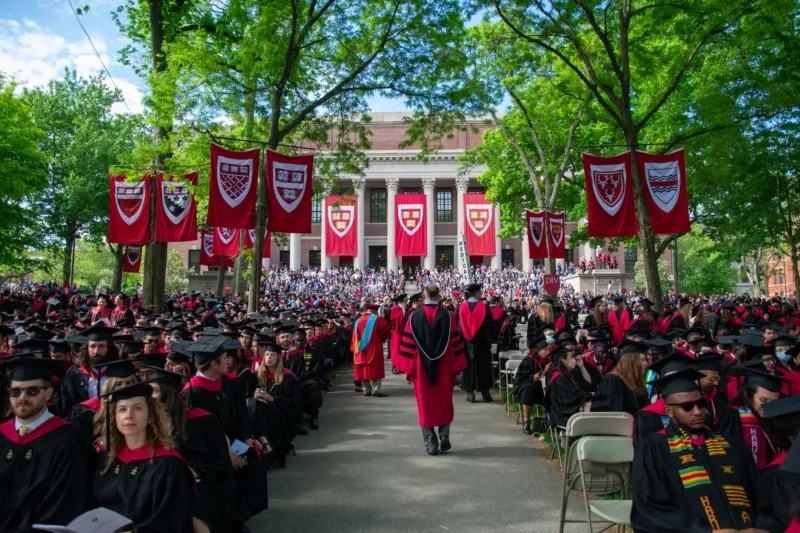
A Harvard Business School graduation. Harvard Crimson photo
THE PROMISE…AND THE PITFALLS
The approach certainly has its advantages. For one, the five-year timeframe represents a comfortable middle ground – not too long that it loses focus and not to narrow that it only reflects starting points. At the same time, it identifies schools where graduates are netting a higher proportion of promotions within five years of graduation. True to the spirit of LinkedIn, the ranking captures how connected that graduates are with fellow alumni – an indicator of potential opportunities in the future.
That’s the maddening rub with the LinkedIn MBA ranking: the data is captured, but it isn’t broken out and shared with readers who can see the degree of separation between schools. For example, Harvard Business School may rank top 5 in Leadership Potential, but how does Dartmouth Tuck compare to their Ivy League rival? Does Tuck rank 6th, 26th, or 36th? More than that, how do these schools’ executive and founder percentages compare? Right now, readers have no inkling of how close or far apart schools are in LinkedIn metrics. Let’s face it: readers who review rankings keep score. When it comes to LinkedIn, the most popular data point is missing: MBA pay.
More than that, the LinkedIn focuses mostly on outcome-driven data, which it can pull from its site. However, that doesn’t touch on a range of measurables involved in evaluating a business school. For example, the ranking lacks survey data, which it could acquire by inviting targeted LinkedIn users to assess key areas like teaching quality, curriculum student resources, facilities and technology, career services, and overall satisfaction. By focusing exclusively on hard data, LinkedIn fails to account for the overall student experience. Not only does LinkedIn ignore the student perspective, but fails to engage an audience who are the ultimate consumers of MBA talent: employers. Along with students, recruiters can tell readers exactly which schools produce the graduates who ultimately land jobs, earn respect, and make an impact in their firms. Beyond student experience and employer sentiment, LinkedIn’s ranking negates inputs like selectivity and test scores that reflect the quality of incoming classes to an extent.
A LOOK AHEAD
In other words, LinkedIn starts at Step 3 – outputs – without factoring in where the consumers really are – wanting to know who will be their classmates and what their experience will be like. Reality is, readers view rankings as a starting point. They are a confidence-building tool that enable them to see how schools compare to each other. On the surface, LinkedIn fits the bill: it provides a 30,000-foot view of where schools stand against each other, along with access to introductory level data on jobs and networks. Even more, LinkedIn saves readers from poring over sanitized data funneled through the schools. In many ways, it is the one truly independent ranking out there.
Question is, will they ever recognize the value their data has – or ever be willing to make it public to aspiring students? Let’s hope 2026 is their breakout year.
Go to the following pages to access the full 2025 LinkedIn Ranking:
PAGE 2: HISTORICAL LINKEDIN RANKING
PAGE 3: LINKEDIN VS. FINANCIAL TIMES RANKING
PAGE 4: 2025 AMERICAN LINKEDIN RANKING VS. U.S. NEWS AND BLOOMBERG BUSINESSWEEK RANKINGS
PAGE 5: 2025 VS. 2024 AMERICAN RANKINGS
Editor’s Note: The title and location data supplied in the LinkedIn ranking is based on graduates’ first job after earning their MBA. In contrast, skills involve “how frequently a skill appears within a program while balancing it against “how rare it is across all programs.” When readers click the school link, they can also access alumni LinkedIn profiles too.