
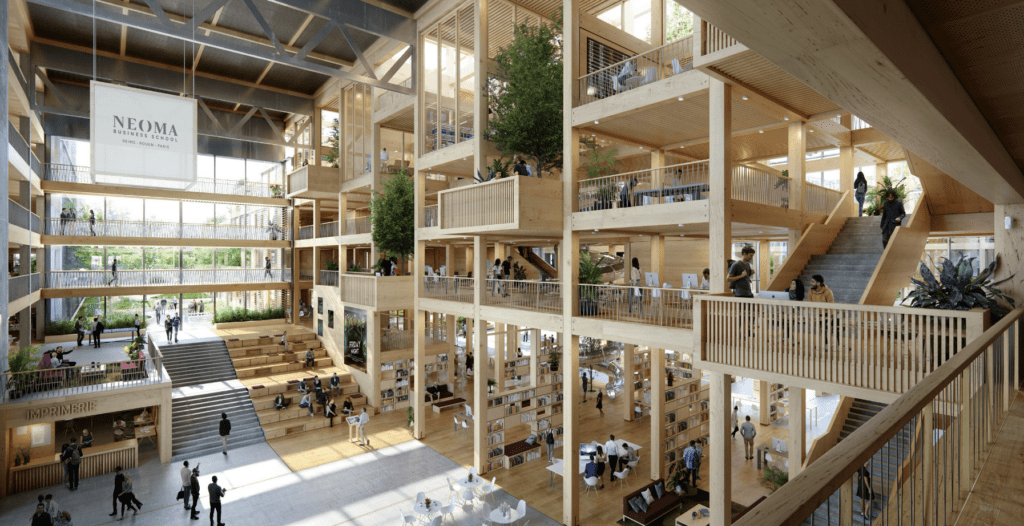
Artist rendering of NEOMA Business School’s new Reims campus, highlighting the light-filled “Hive,” a timber-framed central hub designed to foster collaboration and informal student engagement.
In February 2021, with the pandemic still raging, Poets&Quants named NEOMA Business School in France one of five European Business Schools to Watch for its flashy, new virtual campus – an immersive Minecraft-like island of lecture halls, breakout rooms, and digital hangouts where student avatars could roam at will.
The project quickly became known as NEOMA’s “fourth campus,” alongside its physical sites in Paris, Reims, and Rouen. Media outlets from Bloomberg to the Financial Times took notice. So did we.
Five years later, NEOMA is making another bold campus bet, this time designed to pull students out of the digital world and firmly back into the physical one. A new €149 million campus will open to Reims students this September, one of the most visible investments in NEOMA’s ongoing five-year Engage for the Future strategy.
“After the pandemic—and given that mental health has become a key issue for young generations—it is very important to encourage them to get together and do things in person,” dean Delphine Manceau tells P&Q. “We want to give them the space to build projects, interact with their professors, and spend time in sports and non-curricular activities. Having amazing campuses is a key element.”
A CAMPUS BUILT FOR ENGAGEMENT
In December, Poets&Quants joined a group of international journalists for a hard-hat tour of Reims’ new campus.
At the building’s heart is the Hive, a light-filled hub ringed by open rooms, balconies, and informal workspaces framed in sustainable timber. The space is designed to pull students out of classrooms and into one another’s orbit, much like a beehive draws activity toward a shared center. In an era when learning can happen anywhere, NEOMA wants its physical campus to be a place students actively choose to be.
“We wanted to design this inner heart, the place you meet, where you do not sit in classrooms,” says Søren Øllgaard, lead designer and partner at Henning Larsen, a Danish architecture firm.
“This is where you sit, hang out on balconies. There’s the library, that’s the restaurant. This is where everything happens.”

Lead designer Søren Øllgaard of Henning Larsen presents plans for NEOMA Business School’s new Reims campus during a briefing with international journalists.
Student association spaces will occupy nearly an entire wing of the building with plans for a dance studio, crafts workshop, and dedicated music rooms. The campus will be accessible by foot, car, bike, or scooter — and even by kayak via the canal that runs along the site. A €10 million sports complex will sit directly behind the main building to promote student well being and connection.
The campus will also feature a multifunctional restaurant and café, along with nearly 8,000 square meters of outdoor space, including gardens and terraces on every floor and a rooftop terrace with 360-degree views of Reims. Throughout the building, designers carved out nooks, booths, and informal gathering areas intended to encourage spontaneous interaction and small-group work.
The new building will be a focal point of Reims’ Port Colbert district, transforming the former industrial zone into a student-centered hub.
Henning Larson, founded in 1959 by a namesake known in the business as the “master of light,” beat out 41 other proposals with its design. (The firm also designed the Enterprise Research Campus at Harvard University, University of Cincinnati’s Carl H. Linder College of Business, and the Frankfurt School of Finance and Management in Germany.)
Q&A WITH DEAN DELPHINE MANCEAU
The Reims campus is phase two of a broader facilities push totaling nearly €300 million.

Delphine Manceau, Dean NEOMA Business School
When it opens, the 35,000-square-meter building will serve roughly 4,700 students across undergraduate, master’s, PhD, and continuing education programs. Plans call for 85 classrooms, two 120-seat lecture theaters, and a 750-seat auditorium designed for both school and community events.
Throughout, it is designed to align with the three pillars of NEOMA’s Engage strategy. For example, Engage for Society, is reflected in the building’s sustainability ambitions and material choices. The campus is pursuing LEED certification for environmental performance, WELL certification for occupant health and well-being, and E+C (Effinature), which focuses on biodiversity and the project’s ecological integration with the surrounding neighborhood.
The new building will also be a major feather in the cap of dean Delphine Manceau who took over the top role in 2017, just four years after the business school was formed with the merger of Reims Management School and Rouen Business School.
We recently sat down with Manceau to talk about the new Reims campus and how it fits in with NEOMA’S broader strategy. Our conversation has been edited for length and clarity.
Let’s start with an overview of NEOMA’s five-year strategic plan, Engage for the Future.
Many things are changing these days in terms of business, jobs, technology, and the international environment. When we set up this strategy two and a half years ago, I think we anticipated many of the changes that are happening now.
The plan has three pillars. The first is about continuing to improve our academic excellence in terms of teaching and learning, but also research, and adapting to new topics and new ways of teaching and learning.
AI is an important part of this pillar because it obviously changes the way we teach, the way we assess our students, and the way we do research. It is also a key topic of research. We have an Area of Excellence called Future of Work, where we analyze how jobs are impacted by AI. Of course, this leads us to reinvent and question what we teach, how we teach, and what the key skills are that our students need.
The second pillar is called Engage for Students. After the pandemic—and given that mental health has become a key issue for young generations, along with the time they spend on screens—it is very important to encourage them to get together and do things in person, build projects, interact with their professors, and spend time in sports and non-curricular activities. Having strong campuses is a key element.
As I often say, it is really important that we work at the same time on our physical campuses and on our digital strategy because it is very important to think about both together, and not to have, on one hand, a digital strategy and, on the other hand, a real estate approach.
Also in this Engage for Students pillar, we are working a lot on our international cooperations because we strongly believe that young students should spend several months abroad to understand how other cultures think so that, in the future, they are able to do business wisely.
The third pillar is called Engage for Society. It focuses a lot on the environment, climate change, biodiversity, student diversity, and faculty diversity—having a wide range of profiles among both faculty and students.
Right now, I think more than 80% of our faculty are international, coming from all over the world—Iran, Korea, Spain, the U.S., Canada, and Latin America, including Colombia and Brazil. It is usually the first time in our students’ lives that they meet people from so many different parts of the world and have professors with such cultural diversity. This is also part of their learning experience, so we continue to work a lot on diversity.
We also invest significantly in scholarships so that money is not a barrier. We select our students based on their academic level, but if we see they have difficulty paying tuition fees, we provide scholarships or jobs, or help them obtain a loan, so that finances are not an obstacle.

International journalists tour the construction site of NEOMA Business School’s new €149 million Reims campus during a December hard-hat visit.
How does the new Reims campus fit into NEOMA’s larger facilities plan?
About seven years ago, we bought our building in Paris and created a new Paris campus. We completely emptied and refurbished it. That was step one, and it was very important.
It was also a kind of test-and-learn phase, because what we tried on the Paris campus has been very useful for what we are doing right now. In Paris, the campus is 6,500 square meters across five levels and serves about 1,500 students. It also functions as a hub because Paris sits between our two other campuses. When faculty, staff, or students from both campuses want to meet, they gather in Paris.
Phase two is happening now. In Reims, we used to have two different campuses about a 15-minute walk apart, and both had become too small as the school expanded. It took us a few years to find the right location, but now we are building a large new campus of 35,000 square meters. A French journalist who visited recently said it is going to be the most beautiful campus in France. It is a very ambitious project.
Phase three will focus on our campus in Rouen in the Normandy region, where we have an amazing park with a castle. It is very beautiful, almost like a U.S. campus in the sense that it is surrounded by nature with a large park. That is quite unusual in France. We also have this small 19th-century castle that students love. We do not want to move because it is an exceptional place, but we do need to rethink how the campus is organized.
In the coming years, once we finish in Reims, we will work on improving the Rouen campus and rethinking it in terms of the student experience. For instance, from the bottom of the park you can see the Seine River. It is quite remarkable, and we want to create dedicated spaces so students can enjoy it even more.
Can you share the financial details of the new campus—how much it costs and how it’s being funded? Do you have a foundation like U.S. schools?
The project totals €149 million. That includes the campus itself as well as a major sports facility, a large sports center that will sit behind the campus.
It is funded through a mix of sources. We are borrowing about €80 million. We also have support from the region, the city of Reims, and the chambers of commerce, for about €17 million. The remainder will come from the school’s own funds and from the foundation.
We are currently running a fundraising campaign to support the project. The amounts are very different from what you see in the United States, because donations are less common in France. Still, we are very pleased with the support we are receiving from companies and alumni. Contributions range from sponsoring seats in the auditorium to funding larger parts of the facility.
It is the first time we have launched such an ambitious fundraising campaign, and I must say I am happily surprised by the very positive response.
What features of the new campus best reflect NEOMA’s strategic priorities, especially around student life and well-being?
The campus was really designed to stimulate student life. At the heart of the building, there is what we call the “beehive.” When we ran the architectural competition, one project showed this central space with open rooms and boxes arranged around it. I thought it looked like a beehive, and I could imagine students like bees—working together, having fun, and developing projects. So, this space is very emblematic of what we want the campus to be: a place where everyone gathers, collaborates, and builds things together.
We have also created a large, dedicated area for student associations where they can develop projects. Our students are very committed to activities such as helping homeless people in the region, producing musicals, dancing, and many other initiatives. Providing space for that engagement was very important.
The sports complex is another key element. They will be much larger than what we have had in the past, and our students are very committed to sports. In fact, whenever we discussed the new campus with them, one of their first questions was always about the sports facilities. For them, it is essential.
We also designed the campus to be embedded in local life rather than isolated. We want strong connections with the city, companies, and the broader community. That is why we built a major event space, including a large reception area for dinners and gatherings and an auditorium with 750 seats—likely the largest in Reims. We hope local companies will use it for their own events, and this has already helped support the fundraising campaign because companies see the value.
Finally, we have developed a mix of teaching spaces. There will be 85 classrooms overall, including several highly tech-oriented rooms—a sensory room, a studio for filming online classes, and a data visualization room. But we are also creating creativity rooms with no technology at all—spaces designed for drawing, discussion, and working with your hands. They may look a bit like kindergarten classrooms, but the idea is intentional: sometimes students need to step away from screens and technology and simply think.
As I understand it, NEOMA keeps its acclaimed virtual campus distinct from the physical classroom. Students can’t simply choose to attend remotely if they’re not coming to campus. Why maintain that separation instead of more integration between the two?
Because we don’t want our students to decide whether they come to class or not. Some classes will be online because we believe it is the better format. For instance, if we invite a guest speaker from the U.S. for a two-hour session, it is often more efficient to do it remotely. Sometimes students are working on specific software, and it is easier if everyone is behind a screen.
But we don’t want remote teaching to become a cheap substitute for what should happen in person, or for students to stay in their rooms because they don’t want to get dressed and come to campus. So, we do not do hybrid teaching. It is either remote — because there is a clear pedagogical reason — or it is face-to-face.
About 15% of our teaching hours are online. That is intentional because students need to learn how to work remotely. In their future jobs, they will collaborate with people all over the world, and they must know how to behave and work effectively behind a screen. That is part of the learning objective.
The rest of the classes are on campus, where students interact directly with professors and with each other. After the pandemic, we conducted a major research project led by our faculty, interviewing about 50 professors and 130 students to understand when remote teaching works better than face-to-face and where its limits are. We found there are specific situations where remote works well, but in many cases ,there is less emotion and less engagement. It is simply not the same.
Faculty also told us it is very difficult to teach simultaneously to students in the room and others online. So, we stopped doing that in most situations.
We also believe this supports student well-being. Part of addressing mental health challenges is encouraging students to leave their rooms, see their peers, and interact with real people — not remain behind three or four screens.
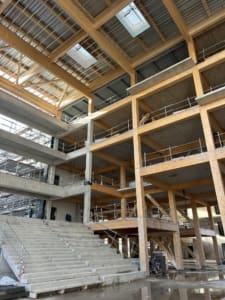
Mass timber beams and expansive open volumes define NEOMA Business School’s new Reims campus, a design intended to maximize natural light and create an airy, collaborative learning environment.
Sports culture is a major part of campus life in the U.S., but less so in France. What role will the new sports facilities play at NEOMA, and how do students use them?
We do have teams — basketball, rugby, and others — and sports are very important for our students. Just a couple of weeks ago, we held our derby competition, where teams from our different campuses compete against each other. We also have cheerleaders, dance teams, and other student groups that train regularly.
Throughout the year, these teams prepare for championships. Every Easter weekend, five schools compete in a major national tournament called the Challenge. I must say, for the past five years, our teams have been winning many of the awards, so students are very proud of that.
It’s really part of their student life. And beyond the athletic side, it’s also a learning experience. Students have to organize the teams, secure sponsors, and manage logistics. So sports at NEOMA are not just about competition — they are also a hands-on way for students to develop project management and leadership skills.
Students can also use the gym even if they are not part of a team. There will be full workout equipment and machines available for general fitness. We also plan to use the facility for staff — we already organize gym classes at lunchtime where employees can come and work out.
The idea is really to make the sports center part of everyday school life, not something reserved only for competitive teams.
How common is it for a French business school to have facilities like this?
It varies. Some schools do not have sports facilities at all, and others have relatively small ones. What is distinctive in our case is the scale and the importance students place on it.
We have invested significantly — about €10 million of the €149 million total project is dedicated to the sports facility. That reflects how central we believe well-being, student life, and physical activity are to the overall educational experience.
Tell me a bit about the environmental and social priorities in the plan, particularly sustainability, and how they are showing up in practice.
We have now integrated sustainability topics into all of our core courses because we believe they are essential in every business function. For example, finance students need to understand green investment and how it works. Marketing students must grasp the social and environmental impact of industries such as luxury, where sustainability has become a major focus. Our goal is to ensure every student develops this awareness regardless of their specialization.
In addition, we have created dedicated courses on sustainability using a transdisciplinary approach, as well as a Master of Science in Sustainability Transitions. Many of our graduates go on to work for consulting firms that help large companies manage environmental transitions.
To give a concrete example, we have a strong partnership with Ferrero — the food company behind Nutella and other chocolate products. Together, we are developing a simulation-based game that helps model how to make global supply chains more sustainable. Ferrero sources raw materials from around the world — nuts from Latin America, cocoa from Africa — and this tool allows both their staff and our students to explore greener supply chain decisions in a realistic, interactive way.
This is very representative of what we aim to do: teach students how established companies can evolve and become more environmentally responsible. We apply a similar philosophy to diversity and inclusion topics across the curriculum.
What physical features of the new building best reflect these environmental and social goals?
The building will carry top certifications in two areas. One focuses on wellness — the well-being of staff and students — and the other is LEED, which recognizes environmental performance. From the beginning, the campus was designed to be environmentally friendly in terms of heating, energy use, and materials.
The structure relies heavily on wood and glass. There is a lot of wood, and the design is very transparent, creating strong visual connections to the surrounding natural environment. The goal is to make the campus feel open, healthy, and pleasant to work and study in.
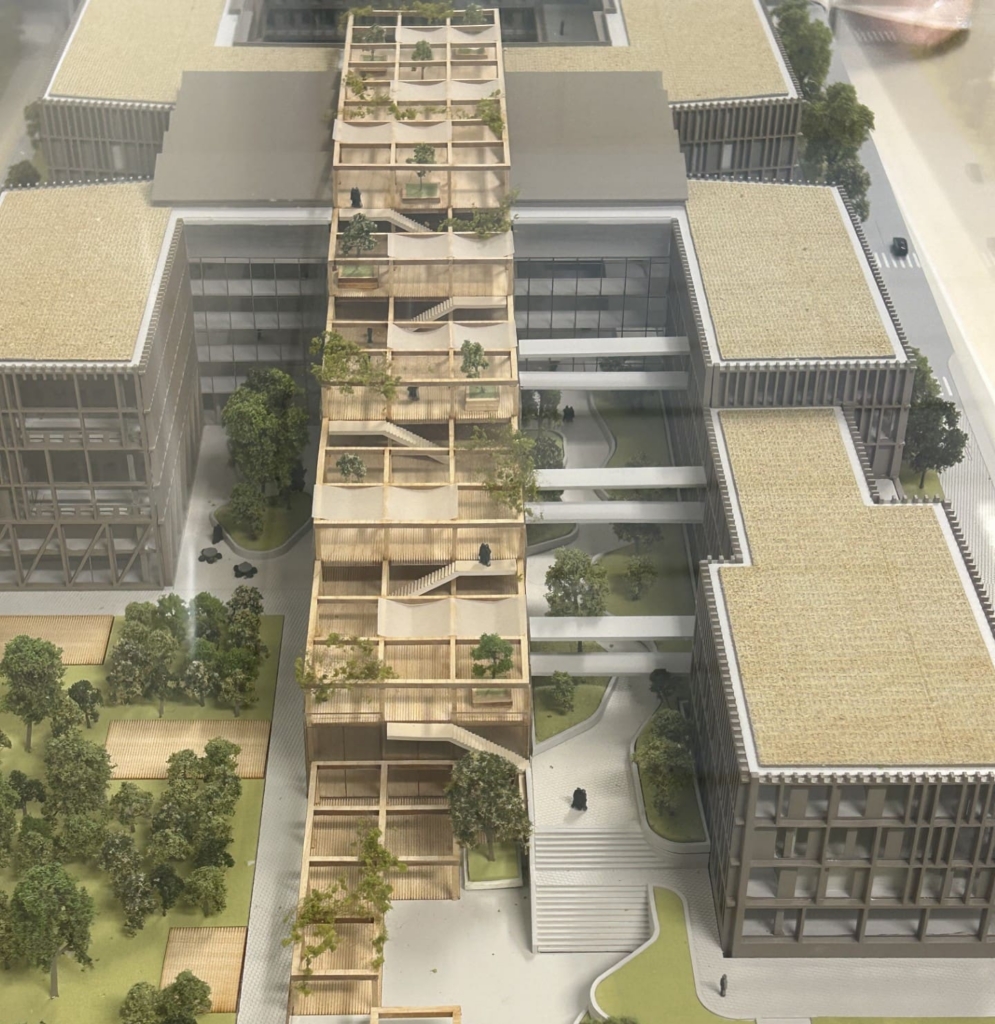
A scale model of NEOMA Business School’s new Reims campus highlights the central “Hive,” a beehive-inspired gathering space designed to draw students into shared areas for collaboration and campus life.
Anything else you’d like to add?
I think it is important to stress how internationally oriented we remain. We send about 2,000 students to U.S. schools every year, and we absolutely want to continue doing so. It is extremely valuable for our students. At the same time, we want to welcome more U.S. students to NEOMA.
We currently have 32 partner universities in the United States, in addition to many partnerships across Europe, Latin America, and Asia. Asia is especially dynamic right now — Korea in particular — and activity with China has picked up again after the slowdown during COVID.
I strongly believe these study-abroad years are essential. They teach students how to live and work with people from different cultures and to understand that others may think differently. Learning to collaborate across cultures is a critical skill for the future.
It’s important to reaffirm that we still believe in globalization and strong relationships across countries. We should encourage young generations to stay open and to help push that mindset forward.
DON’T MISS: POETS&QUANTS’ 2026 WORLD’S BEST MBA PROGRAMS FOR ENTREPRENEURSHIP AND NOMINATE YOUR FAVORITE BUSINESS SCHOOL PROFESSOR UNDER THE AGE OF 40
The post Inside NEOMA’s €149M Reims Campus, Designed To Draw Students To Physical Spaces appeared first on Poets&Quants.