
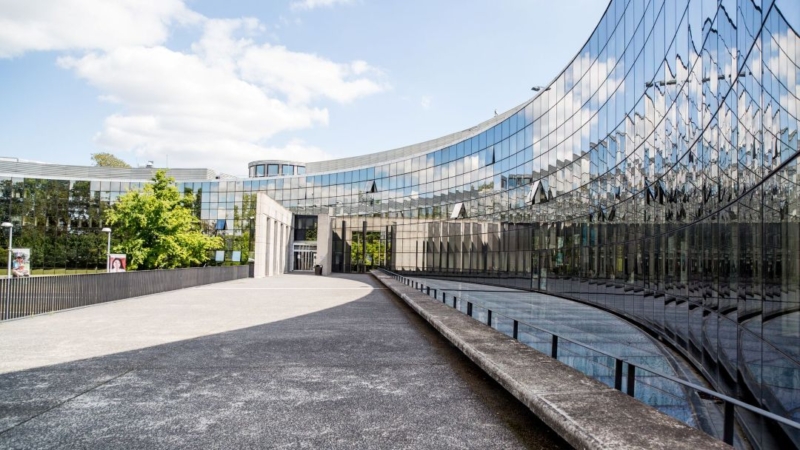
EDHEC Business School
When you walk across EDHEC’s campuses in Lille or Nice, you’re strolling through one of Europe’s business schools that has baked sustainability into its identity—not as a side project, but as a driving force. EDHEC’s own sustainability page lays out a clear horizon: net-zero by 2030, carbon neutrality by 2050, alignment with the UN Sustainable Development Goals, and a formal DD&RS (sustainable development & social responsibility) label awarded at the end of 2023.
It’s one thing to set goals; it’s another to embed them in education. EDHEC has integrated sustainability across programs and research. Their website mentions that the school started measuring its carbon footprint (scopes 1, 2 and 3) in 2020/21, and then published the second footprint for 2022-23, committing to try tracking every two years.
This kind of transparency is rare among business schools.
On the program side, EDHEC’s Global MBA is a standout. According to a Poets & Quants article, the Global MBA has been ranked 4th worldwide for ESG and net-zero teaching by the Financial Times for four consecutive years.
The school is also recognized for embedding a “Sustainable Impact Challenge,” a five-month project where students work on real-life sustainability problems with companies and NGOs.

The deeper message is that sustainability isn’t confined to one course or elective—it’s woven into research, curriculum, and student life. EDHEC’s Masters in Sustainable Finance programme highlights this by equipping students with advanced finance skills plus social justice and climate change economics. That means students are not just learning theory, they are building tools for change.
EDHEC also rachets up sustainability engagement across the student cohort. For instance, the school restructured its “Sustainable Impact Projects” (SIP) for first-year BBA students in 2024-25, focusing on the UN’s 17 Sustainable Development Goals, from health and well-being to gender equality. This shows the school is extending sustainability beyond graduate programmes into its broader educational ecosystem.
Another noteworthy point: EDHEC hosts a “Sustainability Week” across campuses (Paris, Nice and Lille) in January 2025. That campus-wide event underscores the cultural dimension of sustainability—students, faculty and staff engage in seminars, workshops and discussions rather than it just being a line on a web page.
The school’s alignment with global standards gives it extra credibility. EDHEC has been part of the Principles for Responsible Management Education (PRME) since 2015 and aligns its sustainability initiative with the UN SDGs. That kind of alignment signals the institution is committed to international best practices, not just local ideas.
From a branding and reputation standpoint, the recognition matters. The school is consistently placing in the top four for ESG teaching with a sustainability‐driven blend of academic rigor with practical relevance. That external validation helps reinforce EDHEC’s leadership claim.
When you look at the wider value chain, EDHEC’s research and practitioner links around climate finance stand out. The school has for over 20 years built expertise in finance, and now it applies that to climate risk, clean technology transitions, and sustainable business models—working to equip decision-makers with real tools. That kind of research‐to‐practice bridge is a powerful differentiator.
One result of this focus: students at EDHEC know that when they sign up, they’re joining a programme where sustainability is embedded in identity, not just optional. They undertake student challenges, live experiments in eco-friendly campuses, and emerge with not just business acumen but a sustainability mindset. The shift in mindset—toward “business with purpose”—is one of the major strategic signals for 2025.
Of course, leadership also means continuous evolution. EDHEC’s sustainability page notes a “low-carbon transition plan” is being deployed now to meet its net-zero and neutrality goals. The fact that the school is tracking Scope 3 emissions and publishing footprints positions it among the most advanced peers in this domain.
LAST YEAR’S WINNER: IE BUSINESS SCHOOL

POETS&QUANTS 2025 HONORS
DEAN OF THE YEAR: RICE BUSINESS’ PETER RODRIGUEZ
BUSINESS SCHOOL OF THE YEAR: ESCP BUSINESS SCHOOL
LIFETIME ACHIEVEMENT AWARD FOR MBA ADMISSIONS: DUKE FUQUA’S SHARI HUBERT
LIFETIME ACHIEVEMENT AWARD IN BUSINESS SCHOOL BRANDING: ILLINOIS GIES’ JAN SLATER
MBA PROFESSOR OF THE YEAR: MICHIGAN ROSS’ ANDY HOFFMAN
205 BEST IN CLASS AWARDS FOR TEACHING QUALITY, CAREER SERVICES & MORE
The post 2025 MBA Best In Class Award For Sustainability: EDHEC Business School appeared first on Poets&Quants.