
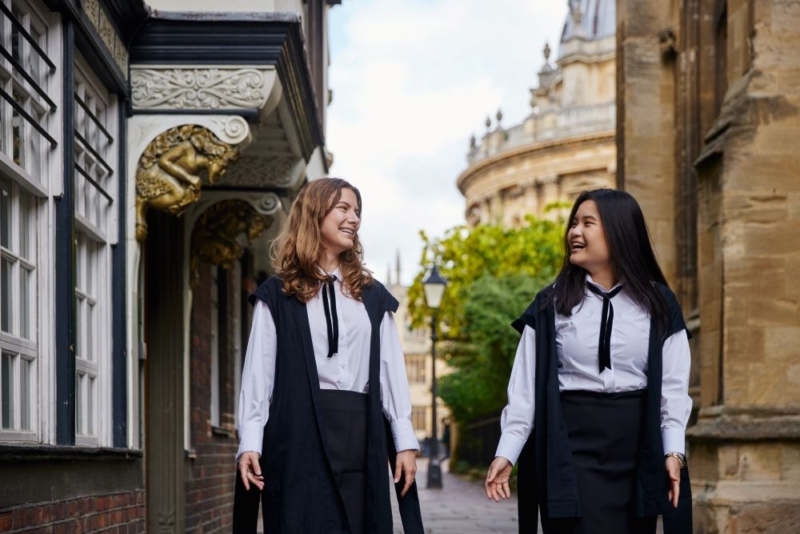
Oxford MBAs decked out in sub fusc
Oxford’s Saïd Business School didn’t stumble into its leadership in social impact. It earned that reputation the way Oxford seems to do most things these days—by mixing centuries-old intellectual curiosity with a very modern impatience for incremental change. Spend even a little time on campus and you feel it: the sense that business isn’t just a vehicle for growth, but a lever for shaping society in ways that matter. And Saïd has been leaning hard on that lever for years.
When people talk about social impact at Oxford, they almost always start with the Skoll Centre for Social Entrepreneurship. It’s been the beating heart of the school’s impact mission for more than two decades. What’s striking about the Skoll Centre is how deeply embedded it is in the school’s culture. It’s not a silo or a special-interest nook; it’s woven into the daily life of the MBA. A student once described the experience to me as “Oxford’s version of a wake-up call,” meaning that once you go through its programming, you can’t really look at business choices the same way again.
Part of that is the range of touchpoints students have with real changemakers. The Skoll World Forum—the school’s signature annual event—brings global leaders in social innovation to campus for a week of conversations, debates, and big-picture thinking. Students aren’t just passive note-takers. They network, question, challenge, and often wind up rethinking their post-MBA plans. One alum told me that attending a session on climate migration completely rerouted his career. He entered the MBA aiming for consulting and ended up launching a start-up that builds financial tools for displaced communities.
This spirit of hands-on engagement threads through the entire program. Oxford’s Impact Lab is a prime example: an extra-curricular crash course that pairs MBA students with organizations tackling everything from affordable energy to refugee integration. The dynamic is part boot camp, part laboratory. Students learn frameworks in the morning and then stress-test them with practitioners in the afternoon. It’s messy, unpredictable, and often transformative. Several students have said the Lab was the moment they realized impact work isn’t a niche—it’s a discipline.
Even the MBA curriculum leans deliberately into social outcomes. Saïd was one of the early adopters of systems thinking and purpose-driven strategy, long before every business school started sprinkling ESG-language into syllabi. Courses like “Analytics for Social Innovation” and “Global Opportunities and Threats: Oxford (GOTO)” push students to examine big systemic problems—climate, inequality, health, governance—and then develop practical, implementable solutions. It’s one thing to debate policy in an academic setting. It’s another to be asked, as one GOTO instructor often does, “What would you actually do on Monday morning?”
And Oxford students do quite a lot on those Monday mornings. The Oxford Seed Fund—student led and proudly impact focused—channels capital into early-stage ventures that prioritize social and environmental returns. It’s a rare combination of MBA-level investment experience and mission-driven venture capital exposure. Students learn what it looks like to evaluate impact not as a fuzzy moral bonus but as part of a coherent investment thesis.
Another reason Oxford stands out is its global orientation. This is a school where the average MBA cohort feels like a meeting of the U.N.—more than 60 nationalities, dozens of industries, and perspectives shaped by lived experiences in places where business problems aren’t theoretical. Bring that diversity into a classroom discussing water scarcity, food systems, or financial inclusion, and suddenly you get insights you wouldn’t find anywhere else. Faculty often tell stories of students connecting dots between policy and business in ways that surprise even the experts.
One of our favorite anecdotes comes from a team of Oxford MBAs who worked with a health-tech nonprofit in East Africa. They flew in expecting to advise on distribution strategy. By the end of the week, they had built an entirely different model after realizing the real barrier wasn’t distribution—it was trust. Their Oxford training didn’t just help them evaluate the problem; it helped them listen. And that ability, the nonprofit later said, made all the difference.
Saïd’s commitment extends to its alumni network as well. Oxford grads are everywhere in the impact world: running foundations, building B Corps, shaping ESG policy, leading sustainability teams, launching climate-tech ventures. What’s notable is that these alumni see themselves as part of a continuing conversation. They come back—to teach, mentor, partner, and often to recruit. Oxford has turned social impact into a full-circle ecosystem.
And the school’s location in Oxford is more than historic charm; it creates access. Students mingle with researchers from the Blavatnik School of Government, the Smith School of Enterprise and the Environment, and the broader university’s science and policy communities. Few business schools can match that interdisciplinary depth. When you want to understand the climate economy or the ethics of AI or the future of public health, having world-class experts one courtyard away is an advantage you feel immediately.
Oxford’s leadership also reflects a philosophical stance: the belief that business must engage directly with the world’s thorniest problems. It’s not a marketing slogan; it’s a mandate. You see it in how the school frames its mission, what it funds, who it hires, and the kinds of students it attracts. Social impact isn’t an elective identity here. It’s the starting point.
So when we talk about Oxford Saïd as a leader in social impact, we’re not just praising a program or a portfolio of initiatives. We’re acknowledging a school that has reshaped how MBAs think about their responsibilities. A school that pushes them to consider not just profit, but purpose. And most importantly, a school that has turned social impact from a side path into a central, serious, global force in business education.
In a year where many institutions are scrambling to define their role in a turbulent world, Oxford Saïd already knows what it stands for. It stands for impact—not in theory, but in action. And that’s why it belongs on our Best in Class list.

POETS&QUANTS 2025 HONORS
DEAN OF THE YEAR: RICE BUSINESS’ PETER RODRIGUEZ
BUSINESS SCHOOL OF THE YEAR: ESCP BUSINESS SCHOOL
LIFETIME ACHIEVEMENT AWARD FOR MBA ADMISSIONS: DUKE FUQUA’S SHARI HUBERT
LIFETIME ACHIEVEMENT AWARD IN BUSINESS SCHOOL BRANDING: ILLINOIS GIES’ JAN SLATER
MBA PROFESSOR OF THE YEAR: MICHIGAN ROSS’ ANDY HOFFMAN
205 BEST IN CLASS AWARDS FOR TEACHING QUALITY, CAREER SERVICES & MORE
The post 2025 MBA Best In Class Award For Social Impact: University of Oxford (Saïd) appeared first on Poets&Quants.