

At Georgia Tech Scheller, “Our goal has been to really aspire to be one of the most connected, most entrepreneurial, and most experiential business schools in the world,” says Dean Anuj Mehrotra.
Georgia Tech Scheller College of Business has never tried to win on scale. With just 72 students in the full-time MBA Class of 2027, it remains one of the smallest cohorts among highly ranked U.S. programs.
But after spending time on campus and speaking with school leaders, a clearer picture emerges of how Scheller is positioning itself in a volatile admissions market. This fall, international students made up 43% of the incoming class, up sharply from the prior year – what certainly appears to be an anomaly among top-20 U.S. B-schools. Women accounted for 44%, the highest share in the program’s history, according to the school.
Scheller’s positioning centers on business and technology integration, access to Atlanta’s corporate ecosystem, and a strong return-on-investment narrative – but school leaders argue it is the interaction of those elements, rather than any single initiative, that defines the MBA experience.
A NEW BUILDING, A STRATEGIC LOCATION
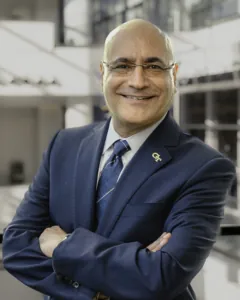
Anuj Mehrotra, dean of Georgia Tech Scheller: “Make sure you do something good today. Leave it a better place than what you had earlier”
The school is also entering a new physical chapter. Tech Square Phase 3 – a 416,500-square-foot expansion anchored by the 14-story Scheller Tower and the 18-story George Tower – is slated to finish in 2026. The two towers are connected by a shared elevator and will include a large outdoor plaza with street-level retail.
The development will house the Scheller College alongside Georgia Tech’s H. Milton Stewart School of Industrial and Systems Engineering, a configuration intended to foster collaboration across disciplines. The space is designed to place students closer to corporate innovation centers, incubators, and accelerators, creating additional opportunities for hands-on experience through capstone projects and practicums.
Scheller Dean Anuj Mehrotra describes the new tower as a significant upgrade in learning and collaboration space, designed with sustainability and energy efficiency in mind and built to support hybrid and technology-enabled instruction.
“It is one of the most modern buildings, and it has all the sustainability features. The energy efficiency of the building is extremely high,” Mehrotra says. “We have some new classrooms which will be like global classrooms, where people can attend from anywhere and feel like they are actually in the classroom.”
WHY INTERNATIONAL NUMBERS SWUNG SHARPLY
In a year in which B-schools began to see the effects of a U.S. government actively working to discourage international enrollment in higher education, Scheller’s big leap in that area is eye-catching. But admissions leaders caution against reading into it as either a sudden breakthrough or an anomaly. With a class of 72 students, small changes in headcount translate into large percentage swings.

Scheller’s Emily Sharkey: “Compared to other programs, we have significantly more options for practical classes – the hands-on experiential learning. Students are wanting that, and we can provide it for them”
“We have a small program,” says Emily Sharkey, executive director of graduate business admissions and recruiting. “Our incoming class was 72. So a few numbers make a huge difference percentage. We don’t have a crystal ball, essentially, for admissions.”
They also point to yield volatility over the last several admission cycles. International yield was unusually strong one year, dropped sharply the next, and rebounded again in the most recent cycle. In a program this small, those fluctuations can significantly reshape the class profile.
Interest remains strongest from India and West Africa, particularly Nigeria, with Ghana growing as a source country. The school has also seen increased interest from Pakistan and has made a more deliberate effort over the past three years to recruit in Latin America as part of a broader diversification strategy.
“The past three years in particular, we have really focused on diversifying our international recruitment,” says Megan Friedman, director of MBA operations and admissions. “We wanted a more broad scope globally of representation in the program because we think it adds value to the classroom when you have diversity of perspectives.”
Visa delays remain a practical constraint, especially around interview scheduling in markets such as India and Nigeria, even as applicants themselves have become more proactive in navigating the process.
ATLANTA AS AN ADMISSIONS VARIABLE
While curriculum and career outcomes dominate most MBA conversations, Scheller’s admissions team says geography plays a larger role in decision-making than candidates always articulate.
Atlanta’s mild climate, its status as a major international air hub, and the appeal of studying in the American South have surfaced repeatedly in applicant conversations, particularly among candidates from the U.K. and Latin America. Combined with Midtown’s concentration of employers, the city functions as both a lifestyle and career consideration.
Mehrotra frames Atlanta less as a backdrop than as an extension of the classroom – an environment where experiential learning and industry engagement are easier to integrate into the curriculum.“That was one of the big attractions for being here – the business school being located right at the center of this ecosystem, which is very entrepreneurial and very technologically savvy in terms of the companies and corporate environment that surround us,” he says.
“Our goal has been to really aspire to be one of the most connected, most entrepreneurial, and most experiential business schools in the world.”