

New facilities. New leadership. New degrees.
Revamped curriculum. Alternative formats. Major investments.
Every year, business schools make statements. They enter new markets, roll out spiffy tools, and sign lucrative partnerships. It’s in their nature, after all. Business is the never-ending search for new opportunities and customers, always pursuing an edge that spurs growth. No different than CEOs, business school deans want to do something special. And the best ones hope to fulfill a mission that’s bigger than simply boosting their rankings or filling their coffers.
They are the Business Schools to Watch. Since 2016, Poets&Quants has been profiling those graduate business programs whose imagination and execution have reframed what’s valuable and what’s possible. These schools are the first adopters that acted fast and decisively. They are the gold standard, the risk-takers poised to redefine business education.
ANTICIPATING THE FUTURE OF BUSINESS EDUCATION
This year’s group includes New York University’s Stern School, which successfully expanded its footprint with an Abu Dhabi campus. In contrast, IE Business School entered Stern’s backyard by socking $18-million into a New York City campus. Not only has the University of North Carolina’s Kenan-Flagler School opened a new 146,000 square foot building, but overhauling its curriculum to go along with it. American University’s Kogod School is betting heavily on becoming the go-to business school for artificial intelligence and sustainability. All the while, Washington University’s Olin School has undergone another reinvention, pairing its traditional dominance in Entrepreneurship with a growing focus on Healthcare. Let’s face it: everyone wants to see how two new leaders – NYU Stern’s ‘million-dollar dean’ and the Haas School’s ‘culture queen’ – will fare after their honeymoon periods end.
Yes, these business schools enjoy inherent advantages. Some offer a distinctive culture or experience. Others have landed impressive gifts or operate in large metros, enabling them to leverage key relationships and heavy resources. In the end, they are all hungry. Each is digging deep into the research, tapping experts and practitioners alike to learn where industries are headed and what employers are seeking. More than that, these schools are surrounded by a mystique – potential – that makes people wonder what exactly they’re going to do next.
Wayne Gretzky said it best: “I skate to where the puck is going to be, not where it has been.” For this year’s 10 Business Schools To Watch, that means anticipating what the future will require – and fully committing to preparing their students for it. And these schools are doing just that…even if it means overhauling successful formulas or defying incumbent interests. From the London Business School to the University of Delaware’s Lerner College, here are the graduate business schools that are laying out a roadmap for their peers to follow.
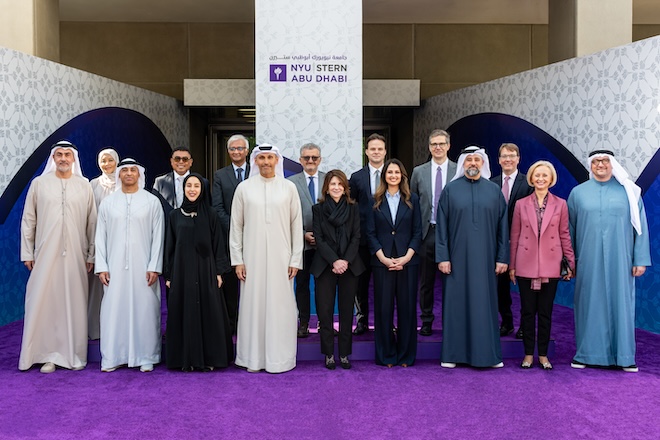
At the Grand Opening at New York University Abu Dhabi in Abu Dhabi, United Arab Emirates on February 10, 2025.
New York University, Stern School of Business
“The Million-Dollar Dean”
The pressure spiked when word leaked out that the school was planning to pay up to $950,000 for its next dean. After all, this was over $100,000 higher than the base salary collected by Harvard Business School’s dean. It signaled to the market just how valuable that leadership had become in the fiercely competitive world of business education. More than that, it reflected just how much was expected from the next dean.
…and just how vast NYU Stern had become.
Imagine a campus that houses nearly 6,300 undergraduate and graduate students. That doesn’t include nearly 500 faculty members between full-time professors and adjuncts. And the alumni base – 114,000 graduates – are sprawled across 144 countries. Picture 27 specializations in the Full-Time MBA program alone…to go along with over 200 electives. On top of that, there are a dizzying number of institutes, student clubs, conferences, and activities. Add to that, MBAs can even take 25% of their classes outside the business school!
Beyond the numbers, there are the matters of the new dean shepherding opinionated faculty, hitting up deep-pocketed alumni, and satisfying ever-demanding students – along with maintaining Stern’s edge in the marketplace. Factoring all this, maybe a million dollars is a bargain!
MAKING A BIG PLAY IN THE MIDDLE EAST
In the end, Stern offered the job to Bharat N. Arnand. A Harvard Business School strategy professor and driving force behind HarvardX, Arnand may now be cashing bigger checks than his former boss, HBS Dean Srikant M. Datar. And he has big shoes to fill. Arnand’s predecessor, Raghu Sundaram, raised over $400-million in nearly eight years on the job. Along the way, Sundaram opened Stern campuses in London, Shanghai, and Washington DC, along with rolling out initiatives like the Andre Koo Tech MBA and Endless Frontier Labs. To cap his tenure, Sundaram laid the groundwork for the NYU Stern-Abu Dhabi campus that opened last February.
A partnership between the NYU Stern School of Business and NYU Abu Dhabi, this Full-Time MBA program attracted 50 students from 25 countries in its first cohort, including professionals from JPMorgan Chase, Bain & Company, KPMG, and Intel. In September, the school announced that it would be launching a 23-month Executive MBA program in the fall of 2026. Along with layering a regional take into the programming, the program includes week-long residencies in both New York City and Shanghai.
“Our vision is to create a transformative Executive MBA experience that equips experienced professionals with the knowledge, skills, and global perspective to lead with purpose and innovate in an increasingly competitive and dynamic environment,” explains Robert Salomon, dean of Stern at NYU Abu Dhabi. “The EMBA program exemplifies this vision by fostering a connected, forward-looking community of leaders who will drive meaningful change in their organizations, industries, and economies.”
Such achievements turned Sundaram into a legend in Greenwich Village – and Arnand is looking forward to following in his footsteps.
“Stern not only has a superb reputation, it possesses a remarkable spirit – entrepreneurial, determined, energetic, resourceful, and global,” Arnand wrote in his announcement. “I’m excited to join this vibrant community and contribute to all that Stern is and aspires to be in the years ahead.”

NYU Stern event at American Museum of Natural HIstory
THE NUMBERS DON’T LIE
A leadership change always makes a business school worth watching. Ultimately, priorities are shifted and initiatives are launched, as new deans look to put their stamp on the school’s operations and culture. Out of the gate, Arnand has come out strong. In January, for example, the school launched an Artificial Intelligence specialization for MBA students, which includes new, hands-on courses on the impact of AI on finance and marketing. Students will even learn how to build AI agents. At the same time, the school has seen applications swell from 3,075 to 4,933 in just two years, a testament to its MBA program’s increasing popularity. In addition, the Class of 2025 graduates also experienced an uptick in average pay and signing bonus, with one grad even landing a $400,000 base to start.
All of this comes on the heels of Stern celebrating its 125th anniversary in 2025, which included the Stern MBA earning P&Q’s Best In Class Award for Experiential Learning.
“Just to share a few stats: six-fold growth in experiential learning over the last 10 years yielded a 500% increase in student participation,” observes Nathan Pettit, Stern’s Vice Dean for MBA and Graduate Programs, in a 2025 interview with P&Q. “There are more than 90 clients and projects on offer annually across 16 industries (five-year average). And importantly, nearly 50 alumni sponsor projects each year. For some students, this experience ultimately leads to jobs after graduation; such is the case with the Endless Frontier Labs at NYU Stern, where students provide business development support to early-stage science and tech startups, some of which become future employers.”
Those aren’t the only numbers that Stern can point to as evidence of a program being on the upswing. In P&Q’s Composite 2025-2026 MBA Ranking, Stern rose from 11th to 6th (while climbing from 9th to 5th in P&Q’s Undergraduate Business School Ranking). When business school deans and MBA directors were surveyed by U.S. News in 2025, Stern posted top ten scores across five disciplines: Finance, Analytics, International Business, Marketing, and Information Systems. When students were surveyed by The Princeton Review last year, Stern posted the survey’s highest score for its Finance curriculum, along with ranking 5th for Consulting and 6th for Campus Environment.
Not surprisingly, Stern also collected P&Q’s 2025 MBA Best In Class Award For Banking. When you compare the Class of 2024’s pay against its peers, Stern graduates generated the 4th-highest packages. That’s a lot of goodwill – from students, alumni, and employers alike – for Dean Arnand to build on.

New York City
‘NYC MEANS ACCESS’
Another building block is Stern’s New York City locale. This enables the school to attract All-Star faculty like Glenn Okun, Scott Galloway, and Amy Lynn Webb, who placed 3rd in Thinkers50’s 2025 ranking of business thought leaders. It isn’t just the full-time faculty who are distinguished, says ’25 grad Julian Sutton.
“[My Digital Media Innovation course was] taught by former Buzzfeed President, Greg Coleman. This is the type of once-in-a-lifetime experience that you won’t see anywhere else but business school. Each session is an in-person, in-depth interview with some of the country’s most incredible business leaders. We got to hear from CEOs and other chief-level executives from companies like YouTube, X, Spotify, TikTok, the NBA, and many more.”
Nathan Pettit echoes Sutton’s sentiments about Stern’s ability to wrangle business leaders to campus. “Simply put, NYC equals access. We see this repeatedly in both formal and informal ways. For example, C-suite executives regularly drop into classes as part of the learning environment. Just this past year, for example, executives from JPMorganChase, Airbus U.S. Space and Defense Inc, Pfizer, and Mark Cuban showed up, to cite a few. It’s also worth noting that more than half of Stern’s alumni network (114,000 alums worldwide) reside in the tri-state area. So students can readily connect with alums for coffee chats throughout their two years. We also have a dedicated Industry Advisor program in which alumni serve in a more official capacity to provide career guidance and real-world insights to our MBAs, working alongside our Careers Team.”
EXPOSURE TO EVERY CAREER PATH
This ‘access’ extends far beyond the campus confines. After all, New York City is the home of Wall Street, Broadway, and Madison Avenue. Every major company has an outpost and every industry maintains a footprint. And the most powerful executives and brightest business minds are bound to pass through the Big Apple at some point during a year. It is a locale, in the words of first-year Klara Lou, that “sits at the heart of almost everything.” Among the Fortune 500, 43 companies have established their headquarters there. At the same time, it boasts the world’s second-largest startup ecosystem. The upshot? Thanks to the short distance between the NYU campus and the Midtown and Financial District offices, Stern MBAs can complete mini-internships during the year. Otherwise, they can meet with company leaders to learn about their industries and potentially partner with them.
In a word, Stern makes it convenient for students to gain know-how and experience. “The ability to attend class in the morning and meet with professionals face-to-face just a subway ride away is unmatched,” says first-year Ryan Jolly. “It creates constant exposure to real-world opportunities and builds momentum in both learning and networking.”
Due to Stern’s deep connections with the city, the school can offer a benefit that few counterparts can match. “We have incredible access to our alumni because so many of them choose to work in New York after earning their MBA,” explains Nathan Pettit in a 2024 interview with P&Q. “That’s also what allows us to expose current students not only to the more traditional MBA career paths, but also to those outside of the norm, including media, retail, real estate, sustainable business, investment finance and more. For example, we built an Executive-In-Residence program in which alumni business leaders across sectors offer on-campus sessions [in both large groups and one-on-ones] during a year term to give students an insider’s perspective on their industry and function. This effort has been popular among both the alumni and students.”
So is Stern’s location, which is just down the street from Washington Square Park. “With our campus nestled in lower Manhattan, most attractions are just a short walk away, allowing me to easily enjoy my favorite activities like exploring new restaurants, attending Broadway shows, and participating in talk show tapings,” adds first-year Adrianna Tomasello.
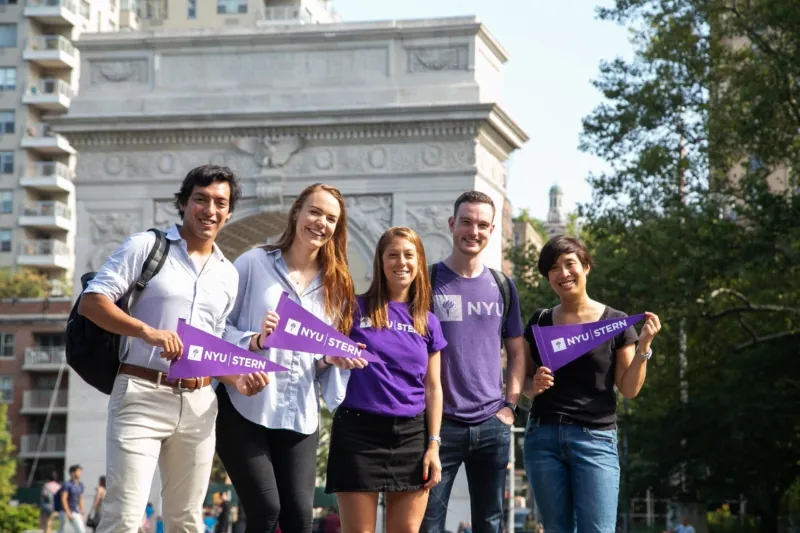
NYU Stern MBA Students
THE EQ DIFFERENCE
Still, it isn’t where Stern is or what it offers that differentiates the MBA program. That foundation is set long before students take classes in the Henry Kaufman Management Center. And it boils down to an acronym: EQ – Emotional Quotient. The school screens for it, emphasizing it more than academics and experiences in making admissions decisions. In Stern’s view, EQ – self-awareness, communication, listening, flexibility, politeness, and self-restraint – is the key to creating a learning environment that’s open and free from distractions. And this difference is noticed by the ultimate consumers of Stern talent, says J.P. Eggers, an entrepreneurship professor who was most recently the school’s interim dean.
“I can confirm that when I speak with employers (recruiters and hiring managers…this is 100% what they say – Stern MBAs are team-oriented, cooperative, fun to be around, different and unique, and possess high EQ,” Eggers told P&Q in a 2022 interview. “At the same time, Stern MBAs bring strong tech and quantitative skills to the table. Data analytics is part of Stern’s core curriculum and is built into so many classes throughout the MBA experience. In today’s global, tech-driven environment, it’s a cost of entry requirement for doing business.”
“We are serious about having a culture shaped by EQ,” adds Nathan Pettit. “Support for one another in every way is part of our DNA.”
Next Page: London Business School