
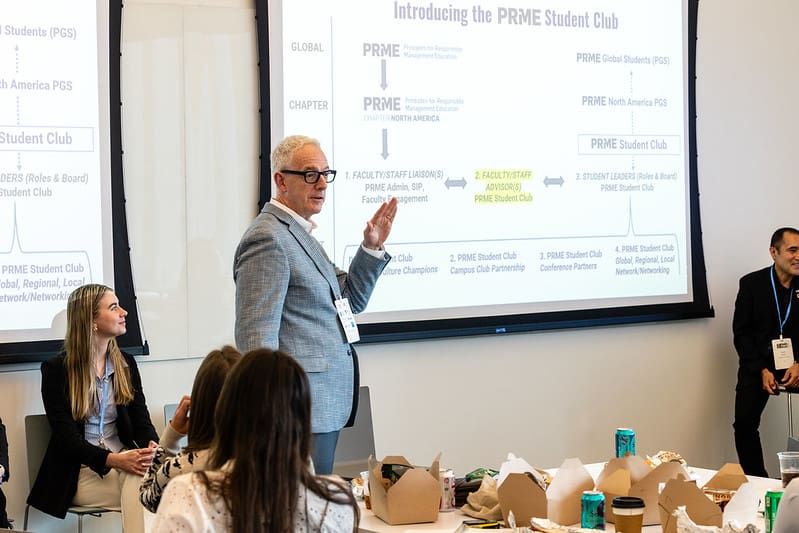
David Steingard, the newly appointed director of Principles for Responsible Management Education (PRME) presents on student engagement at the 2025 PRME Global Forum.
David Steingard steps into his new role as director of Principles for Responsible Management Education (PRME) at a moment when responsible management education is both under pressure and in demand.
Steingard, previously an associate professor of management at Saint Joseph’s University Haub School of Business, inherits a global network of nearly 900 business schools spanning close to 100 countries. He also inherits a mandate to show that sustainability, ethics, and social impact are central to how modern business must operate – and what business schools must teach.
His was appointed in January, at a time when U.S. business schools continue to navigate heightened scrutiny around ESG and DEI under the Trump administration. Nevertheless, he remains excited to continue making the case for management education as a force for good as PRME director, he tells Poets&Quants.
“There is no more ambiguity about the necessity for a responsible management education focus in a business school. The innovation, creativity, entrepreneurship around advancing social environmental causes is now largely driven by business,” Steingard says.
“If you can marshal those forces to deliver on what humanity and the planet need right now, and be profitable doing it, it is very exciting. And it’s necessary.”
US’ SUMMER OF DEI DISCONTENT
Since the start of his second term, and particularly through summer 2025, the Trump administration’s anti-DEI agenda chilled diversity and equity programs at business schools across the country.
Between July 1 and August 15, four U.S. business schools quietly left The Consortium for Graduate Study in Management, a network of top U.S. MBA programs and companies working to elevate the number of underrepresented minorities in business education and corporate leadership. Two of the schools – University of Texas at Austin (McCombs) and University of Virginia (Darden) – had been members for decades. Two others, both M7s – Northwestern Kellogg and Chicago Booth – lasted just a couple of years.
Darden and The Wharton School also left the Forté Foundation, which works to elevate women representation in business and business schools. Meanwhile, a July 2025 Justice Department memo warning DEI programs may violate federal law has pushed business schools to scale back or rebrand a variety of diversity initiatives and scholarships.
PRME hasn’t seen the same retreat from U.S. schools, Steingard tells Poets&Quants. When institutions do step away, it’s usually financial. In fact, many U.S. schools are leaning more heavily on PRME’s global UN framework as a buffer in the current climate.
A LONG HISTORY WITH PRME
David Steingard
PRME, founded in 2007 out of the United Nations Global Compact, works to integrate sustainability, ethics, and social responsibility into business schools. It provides member schools guidance on teaching the UN’s 17 Sustainable Development Goals, supports joint sustainability research, and links students and faculty through global programs and networks.
Steingard, who taught at Haub for 26 years, has worked with PRME as a community member since 2016. That year, he answered an open invitation to deans, business professors, and students to attend a UN Global Compact leadership summit at the United Nations General Assembly.
“Through that experience, I realized that PRME was really a supercharger for the agenda of business as a force for good,” he says.
He has served on PRME’s North American Chapter steering committee and earned a PRME Innovators Award. He helped develop the SDG Impact Intensity rating and as well as the SDG Dashboard which was among the first tools to map business school functions, operations, and research to the goals. He currently leads the AI and Research & Development (AIRD) Implementation Team under the Higher Education Sustainability Initiative (UN HESI) as part of the Futures of Higher Education and Artificial Intelligence Action Group.
In this interview, Steingard lays out his priorities for PRME’s next chapter and explains why he believes the business case for sustainability has never been clearer or more urgent. Our conversation has been edited for length and clarity.
What are your big goals for PRME as director, and what will you look to as a measure of success?
We have a strategic plan that is now built and moving into the execution phase for 2026, and we’re using the framework of WIGs—Wildly Important Goals. In a way, it’s very Poets & Quants: the “poets” part is the big vision of moving this cause forward, and the “quants” part is how we operationalize it.
The goals are intentionally simple. They’re designed to help PRME expand its footprint and impact while also strengthening the organization internally. The first goal is to grow PRME to 1,000 member institutions. We’re just under 900 right now, and in 2026 we want to expand further, particularly in regions like Asia and Africa. These are areas experiencing economic growth and rapid development, where new business schools are being built and where the need for SDG-related work—clean water, infrastructure, poverty alleviation—is very real. We’re seeing both a strong appetite and a clear need for PRME in these regions.
The second goal is financial. We want to raise funds to power PRME’s growth and expand what we offer. We’re working with donors, foundations, and grants, and there’s strong interest in student-focused initiatives. That includes student entrepreneurship competitions, student conferences, and funding opportunities for students to work with UN agencies. The giving community is very receptive to efforts that show direct impact, especially those that help students build careers. We’re actively working to build a bridge between responsible management education and career pathways—helping students find roles that are not only meaningful and inspiring, but also allow them to bring responsible management skills and values into companies.
The third goal, and the one I’m especially excited about, is in the area of thought leadership—specifically around the business case for sustainability. Every era frames the idea of business with purpose a bit differently. Right now, the focus is shifting toward the business case for sustainability. In a world where climate change threatens business as usual, where migration, labor shortages, and AI are reshaping workforces, companies are being forced to adapt. The question is how they adjust their strategies to continue delivering environmental and social impact while remaining financially viable.
I think of this as “return on principles.” PRME has seven principles, and we want to be very explicit about what we’re teaching students so they can advance real businesses that deliver on mission and profitability at the same time. These have never been mutually exclusive, and today they are increasingly mutually reinforcing.
We plan to launch academic initiatives such as systematic and literature reviews looking at what has happened over the past 30 years, as well as studies of companies and best practices. We also want to bring PRME’s educational strength directly to business leaders. A key part of this will involve students—for example, through a business case for sustainability student competition, judged by corporate leaders working in this space. That creates opportunities for networking, hiring, and tangible rewards.
This is a moment of real clarity. Sustainable business must be socially, environmentally, and financially sustainable. Our role is to bring those elements together and catalyze stronger collaboration between academia and business to move the entire enterprise forward.
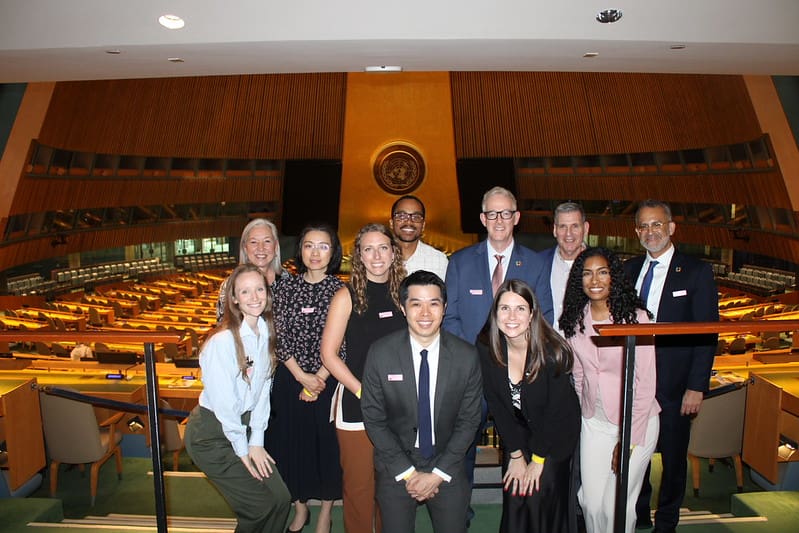
David Steingard meets with the PRME Secretariat at United Nations headquarters, where the network anchors its mission to the Sustainable Development Goals.
How does PRME navigate the growing skepticism around ESG—particularly around measurement, reporting rigor, and accountability—in the U.S. and elsewhere?
There are many forms of social auditing and reporting—ESG, carbon emissions accounting, and a wide range of tools and frameworks. As an organization, we operate in nearly 100 countries now, and even something as basic as calculating travel-related emissions illustrates the challenge: there are countless calculators available. My view is that business schools and businesses tend to measure what matters to them. The existence of many tools, and variations in their precision, is not really the core dispute. If you want to measure something meaningful and relevant to your impact, there are reliable tools available. Are some better than others? Yes. But that, in my view, is not the fundamental issue.
The bigger question is why we want to measure in the first place. Take sustainable finance as an example. You can have finance that is largely unconstrained in terms of its sustainability impact, or you can introduce criteria that account for environmental and social risks. If you genuinely care about sustainable finance, you can manage for returns that are comparable—or in some cases superior—because you are accounting for real risks related to climate change, AI, and geopolitical instability.
From a Poets & Quants perspective, we measure what matters. The tools exist. The key question for PRME schools is whether we can focus more precisely on what truly matters for business contributions to society. Measurement, accountability, and reporting then follow from that focus.
I’ll give you a concrete example. I have a colleague—an accounting professor—who was doing basic carbon accounting in financial statements back in the late 1970s. He’ll tell you, quite rightly, that this work has been around for decades. It’s easy to dismiss a tool or question a standard, but if there is genuine commitment, the infrastructure for measurement already exists.
One of the strongest examples right now is green supply chains. Companies are increasingly tracking sourcing, extraction, manufacturing, distribution, recycling, and responsible consumption. Firms that can provide this data are doing extremely well. There are also educational programs emerging around green supply chains, and the reality is that the greener and more sustainable a supply chain is, the more reliable it tends to be. In a world of tariffs, exchange-rate volatility, and geopolitical risk, companies want resilient supply chains.
The tools have also improved significantly, particularly with advances in AI. That’s simply a fact. So while skepticism exists, PRME schools are in a strong position to respond with better tools, better data, and the backing of companies that understand sustainability not as an abstract ideal, but as a core component of long-term business success.
Have you had discussions with U.S. schools about reluctance to publicly signal commitments to sustainability or DEI, such as membership in organizations like PRME?
Yes, and we have to acknowledge that the current environment is being shaped by actions from the Department of Justice and the Department of Education. There are new compliance rules around how institutions approach equity, inclusion, and diversity, and in some cases those rules extend into teaching and research on climate and related topics.
This is very real. In science and research, and frankly in business as well, activity follows funding. It has become harder, particularly in the sciences, to pursue certain kinds of research. In moments like this, institutions have to revisit their core mission and values and ask what is truly important, while also ensuring legal compliance. That balance matters.
Some institutions are managing this tension relatively well and, in some cases, are even being viewed favorably by government actors for how they navigate it. Language is a big part of this. There is now an entire cottage industry of marketing and PR firms helping universities—and other organizations—present themselves in ways that do not explicitly violate new guidelines.
PRME schools have a unique advantage in this environment. Of roughly 875 member institutions, about 155 are based in North America. Canada, too, is experiencing pressures, particularly around graduate student visas.
The strength of PRME as a United Nations initiative is that it is anchored in the UN Charter, the Sustainable Development Goals, and the Universal Declaration of Human Rights—foundational documents ratified by 193 countries. Many U.S. schools are finding support through the global PRME network, which helps them strengthen international research collaborations and remain connected to a broader platform. In that sense, it is a form of portfolio diversification. Staying globally engaged helps institutions navigate this moment.
PRME is very clear about who we are and what we stand for, and that will not change. The challenge is figuring out how to remain effective in a shifting context.
Globally, we are also seeing a different response: many non-U.S. schools are doubling down. They see this as a moment to be more explicit and intentional about their values, how they operationalize them, and how they measure impact, particularly as the U.S. cools in this area.
Has PRME seen U.S. schools pull out since early 2025?
Based on the preliminary data we have—recognizing that registrations and renewals come in on a rolling basis—we are not seeing schools moving in or out of PRME due to policy changes in North America.
I’m aware that different U.S. states are responding differently to the current policy environment, but so far we have not seen any pullback from U.S. schools.
I think part of PRME’s strength is its neutrality and broad appeal. In principle, the goals we stand for are things people across the world agree on. Everyone wants clean water. Everyone wants equality in principle. No one wants flooding, drought, extreme storms, or failing crops. When you stay focused on what truly matters to people, business schools can translate those priorities into action.
Where we do occasionally see schools step back, it is typically for financial reasons. The higher education finance landscape was already shifting before the current debates, and sometimes schools tell us that even a modest signatory fee is difficult to sustain. In those cases, we do have a fund to support institutions facing financial strain, because one of the core principles embedded in Agenda 2030 and the SDGs is “leave no one behind.” Inclusivity matters.
That said, we are also seeing broader structural changes. Faculty positions are being reduced, tenured roles are disappearing, and PRME-related work is often part of a professor’s portfolio. When faculty are under pressure to chase publications and research funding, participation can become more difficult. In response, we are experimenting with different participation models—ways to engage faculty or individuals even if institutional-level engagement is temporarily on hold.
With students, however, we have not seen any problem. Student engagement remains strong, and student-to-student connection is a powerful driver. Part of my role is to be uplifting without being pollyannish. Students are navigating not just shifting political values, but real economic pressures—jobs, wages, housing, and property ownership. It is genuinely hard for many students to secure well-paying jobs and build a stable life, particularly in the U.S. context.

David Steingard joins a delegation of Saint Joseph’s University students visiting the UN Global Compact office, reflecting PRME’s focus on linking classroom learning with real-world impact.
How do business students engage with PRME?
Student engagement, much like everything we do, tends to mirror our regional and chapter-based structure. We have student representatives and groups of students at member schools, usually supported by highly motivated PRME faculty. There are also a number of UN youth initiatives tied to entrepreneurship that students engage with.
For example, this past spring there was an event at the German Consulate focused on Youth Day and entrepreneurship. Young people presented their startups, including one woman from India who developed an app focused on neighborhood safety for women, using geolocation to help users stay safe. It was incredibly inspiring. That kind of youth entrepreneurship is a big part of what we see.
We also engage students through their professional societies—accounting, finance, and others—and we’re working to deepen those partnerships. The idea is to integrate a principled, responsible management approach into what students are already doing within their disciplines.
Another important area for us is looking at students longitudinally. Rankings tend to focus on jobs and salaries—what students earn right after graduation. We’re interested in something different: the impact they make. We’re beginning to think about students first as emerging professionals, then as mid-career leaders, and tracking how their careers evolve over time. If PRME is about leadership and responsible management, then we need to understand what that actually looks like five, 10, or 15 years down the road.
What do you see as the biggest threats and opportunities for management education generally and responsible management education specifically?
It’s both layered and complex. At the highest level, higher education is in a classic disruption phase—it’s breaking down and breaking through into something new. The electronic disruption is probably the most consequential. That includes AI delivery systems and digital platforms, and it’s changing everything.
There are really two dimensions here: education broadly, and education for responsible management. Both are affected by the same dynamics. If institutions don’t adapt to new platforms, delivery models, and economic realities, they simply won’t be able to get their message out.
PRME has been very proactive here. We’re developing new delivery mechanisms and platforms that extend beyond the traditional classroom, with offerings for both faculty and students. We offer PRME Pedagogy, which trains faculty on how to teach responsible management. It’s a global, digital program that includes electronic badging and evidence-based learning, and it uses AI alongside our reporting platform.
On the student side, we’re launching a suite of about 40 custom-designed courses in responsible management, business ethics, and sustainability. These can be facilitated by faculty or completed through self-study, and they’ll be available to students across the PRME network.
More broadly, on AI and higher education, I currently serve as the lead for the AI and Research & Development (AIRD) Implementation Team within the UN’s Higher Education Sustainability Initiative, focused on the future of higher education. We’ve been working on concepts like AI by SDGs and AI for Good, looking at how AI can act as a supercharger for students launching startups, professionals working inside companies, and anyone who needs deeper analysis and insight.
We’re fully embracing the AI revolution. In partnership with Emerald Publishing, PRME will soon launch the first of two PRME-sponsored academic journals. One will focus on AI and responsible management education, and the second—still in development—will focus more broadly on responsible management education. This gives PRME a peer-reviewed platform to advance thought leadership as the field evolves.
At the end of the day, peer-reviewed research still matters enormously in academia. By building these platforms, we’re ensuring that responsible management education continues to evolve, remain credible, and make impact as the broader educational landscape changes.
In making the case for business and management education as a force for good, what are you most optimistic or excited about in your new role?
I’m excited because there is no longer any ambiguity about the necessity of responsible management education in business schools. Innovation, creativity, and entrepreneurship around advancing social and environmental causes are now largely being driven by business itself. To borrow from Spider-Man, with great power comes great responsibility. It’s very clear that businesses—individual companies and even individual business owners—have tremendous impact and responsibility.
If we can marshal those forces and deliver what humanity and the planet need right now, while also being profitable, that is both exciting and necessary. I’ll share one data point that really reinforces this optimism. The United Nations Global Compact, in partnership with Accenture, conducted a CEO study in 2025. They surveyed CEOs globally, and the overwhelming majority said that issues of sustainability, equity, justice, inclusive policy, and science-based research are more important than ever. They made it clear that they will continue to prioritize these issues, even if they position them differently within the business case.
What we’re seeing is a real coalescing of forces. We’re living in exigent times, with volatility across systems we depend on—the food system, the political system, the financial system—and businesses are embedded in all of them. The business leaders who are stepping up are saying, “It’s time.”
That’s where PRME can be of real service. We’ve been studying these issues, teaching them, and advancing responsible management education for years. Now it’s time to deliver. That makes me genuinely optimistic. You didn’t ask whether I was pessimistic.
Are you pessimistic at all about the current moment?
I’m not pessimistic. These are simply the times we’re in. There is opportunity everywhere. As long as we continue to see willingness from the world’s largest companies—those that set the standard for how business functions and defines its purpose—moving in the right direction, then we are in good order. We can augment that, supplement it, and contribute to it.
It’s also important to remember how big and diverse the world is. There are 193 countries, and within them there is resilience, creativity, and innovation that is both inspiring and contagious. That energy is percolating. From the perspective of the broader global order, this moment presents real opportunity.
Is it challenging? Absolutely. Does it require thinking outside the box? Yes. The key difference now is speed. These are no longer 20-year planning horizons. Impact has to happen faster. This aligns closely with how companies operate—not necessarily on a quarterly basis, but certainly on an annual one. Businesses are being asked to deliver real impact in much shorter time frames, and that is something we find motivating and inspiring.
DON’T MISS: POETS&QUANTS’ 2025-2026 MBA RANKING AND MBA APPLICATIONS ARE WAY DOWN THIS CYCLE. IS AMERICA DRIVING AWAY THE WORLD’S TALENT?
The post The P&Q Interview: PRME’s David Steingard On Why Responsible Management Ed Matters More Than Ever appeared first on Poets&Quants.