
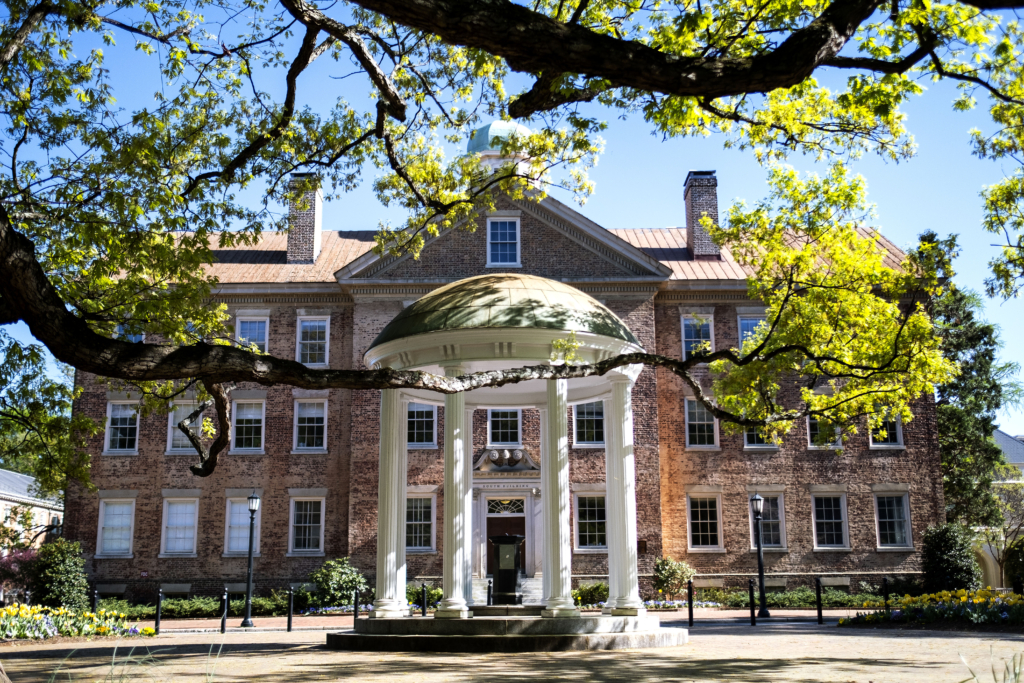
University of North Carolina at Chapel Hill. (Jon Gardiner/UNC-Chapel Hill)
Less than two weeks after formally authorizing administrators to secretly record classes, the University of North Carolina at Chapel Hill has reversed course.
Chancellor Lee Roberts told faculty Friday that the university will nix the newly adopted classroom recording policy, confirming that no faculty members will be secretly recorded unless and until a new policy is developed. University leaders will continue evaluating whether such a policy is needed.
“The whole idea was to create clarity and reassurance,” Roberts said during a Faculty Senate meeting, according to reporting from Inside Higher Ed. “That policy clearly has not achieved that aim.”
The abrupt reversal marks the latest twist in a controversy that began inside UNC’s Kenan-Flagler Business School in 2024 with the secret recording — and subsequent non-renewal — of longtime teaching professor Larry Chavis.
ATTORNEY: POLICY SHOWED ‘SELECTIVE POWER’
Artur Davis, an attorney and partner at HKM Employment Attorneys who is representing Chavis in a federal lawsuit against the university, tells P&Q that UNC targeted Chavis.
“One of the most troubling aspects of this case is the evidence that has emerged that Dr. Chavis was targeted: at least one other professor who faced student complaints about his behavior in class was never recorded,” Davis writes in an emailed statement to P&Q. “The power to record necessarily involves a selective power to single out academics who are not in favor with senior leadership.”
Chavis, who was a teaching professor at Kenan-Flagler for 18 years, filed a civil rights lawsuit in federal court in September 2024 alleging retaliation for his public criticism of the university on diversity, pay equity, and inclusion issues and claiming violations of his First Amendment rights. The suit followed revelations that UNC and Kenan-Flagler administrators had secretly recorded four of his classes in April 2024 in response to student complaints. Two months later, UNC notified Chavis his annual contract would not be renewed without explanation.
Chavis is seeking back pay, damages, and an injunction preventing similar practices. The case is approaching the summary judgment phase, where a judge will decide whether Chavis’ claims proceed to a jury.
“(Chavis) continues to seek a show of responsibility and growth from this institution and to remedy the undeserved devastation of his career,” Davis says.
Poets&Quants has asked UNC whether other professors who received student complaints were recorded without their knowledge and how those decisions were made. We will update this story if the university responds.
NEW POLICY LASTED 12 DAYS
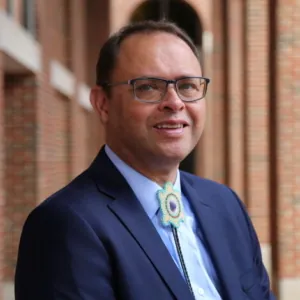
Larry Chavis
The now-abandoned policy was adopted in February and was set to take effect on February 16. It explicitly permitted university officials to record or access classroom recordings without the instructor’s knowledge when authorized in writing by the provost and university counsel for investigations or other lawful purposes.
Students, meanwhile, remained barred from recording classes without instructor permission.
UNC previously told P&Q the policy was intended to provide “procedural clarity” and protect both instructors and students.
But faculty reaction was swift and negative.
According to earlier reporting from Inside Higher Ed, professors across campus complained about transparency and shared governance. Many said they learned the policy had been finalized through their AAUP chapter or local news reports rather than direct university communication.
For Davis, the policy that was adopted, despite its short shelf life, was a threat to academic norms.
“The college classroom is not junior high school: it consists of highly intelligent adults who are being trained to absorb opposing viewpoints and data and make their own judgment. Recording threatens the integrity of the academic exchange,” he tells P&Q.
“It also censors creativity and expressiveness. The genuflections over this policy show that UNC has been slow to learn lessons and show genuine accountability, a perennial issue for this institution in cases we are litigating.”
THE CHAVIS CASE
The policy fight traces back to April 2024, when UNC administrators secretly recorded four sessions of Chavis’ undergraduate class after receiving student complaints about course content and conduct.
Senior associate dean Christian Lundblad told Chavis at the time that “notice is not required to record classes” during the formal review.
Chavis told P&Q the recordings appeared to contradict Kenan-Flagler’s own IT guidance requiring faculty permission. He also raised concerns about student privacy and academic freedom, noting his courses frequently included sensitive discussions on race, belonging, and equity.
Two months later, UNC notified Chavis his annual contract would not be renewed after 18 years. No reason was provided, but a confidential evaluation provided to Chavis cited a “misalignment” between course description and content.
Chavis shared the four-page review of his secretly recorded undergraduate International Development class on his LinkedIn and with P&Q. It included student complaints that discussions focused too heavily on Chavis’ personal experiences. Chavis, a member of the Lumbee Tribe of North Carolina, has been an outspoken critic of Kenan-Flagler and the university on topics like race, gender, LBGTQ+ issues, and pay disparities for several years.
Chavis disputed the evaluation’s characterization and said comments were taken out of context.
A RETURN TO ‘SHARED GOVERNANCE’
In Friday’s meeting with UNC faculty, Roberts noted that since Chavis’ case, he has not heard of another instance where secret classroom recording was seriously considered.
“So why go through this exercise that’s creating so much disquiet when this seems to be an extraordinarily rare type of occurrence?” he is quoted as saying.
Insider Higher Ed notes that UNC history professor Miguel La Serna feels the university’s reversal will help bring back a sense of shared governance.
“I know we come here and ask tough questions a lot, but I also want to acknowledge a moment when the administration has made a decision, gotten feedback and listened to that feedback and tried to reconsider it.”
DON’T MISS: UNC FORMALIZES SURVEILLANCE POLICY AFTER SECRETLY RECORDING KENAN-FLAGLER PROFESSOR and INTERVIEW: THE PROFESSOR WHO WAS SECRETLY RECORDED — THEN LET GO — BY UNC
The post UPDATE: UNC Chancellor Scraps Classroom Surveillance Policy Adopted 12 Days Ago appeared first on Poets&Quants.