
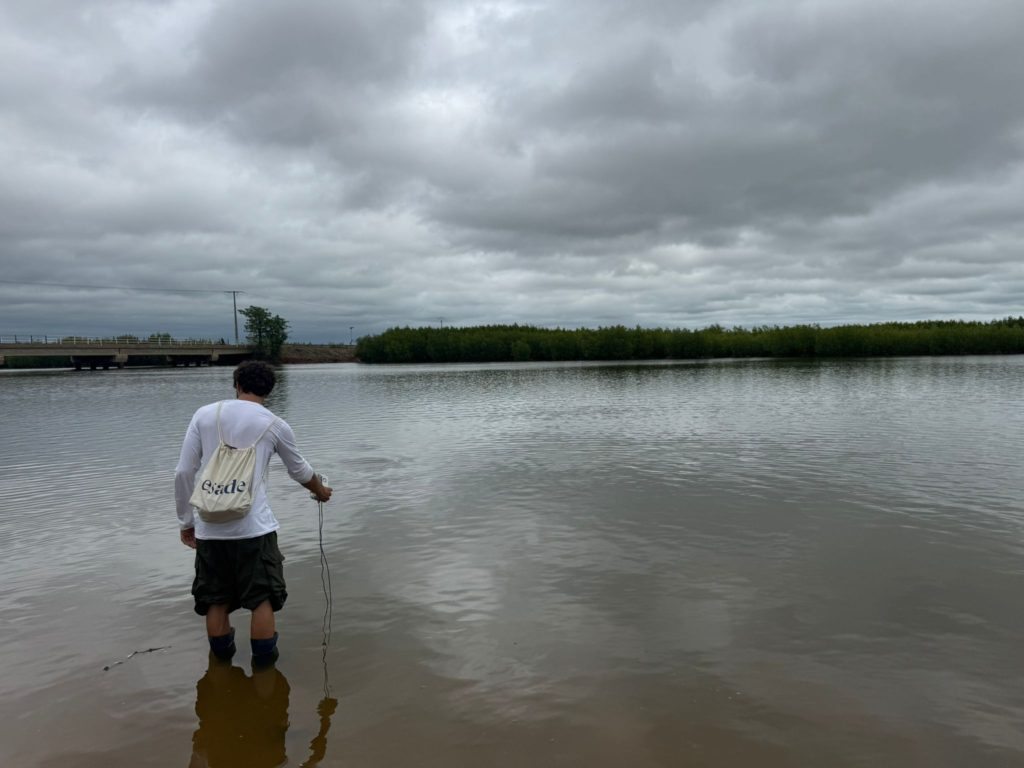
Marios Contopoulos, an MSc Business Analytics student at Esade Business School, tests water salinity near the University of The Gambia.
With each step, the Esade business student and a Gambian bird researcher sank deeper into the river. They walked barefoot, water lapping up almost to their knees, looking for the right depth to test their prototype in the field.
A successful test would empower locals in Sankandi – a small village in the Lower River Division of The Gambia – to find the best spots to plant mangrove trees based on the water’s salinity and pH levels. Healthy mangroves are essential here for fishing, farming, and protecting the region’s biodiversity.
An unsuccessful test? Months’ worth of design and planning by multiple students, NGOs, universities, and agencies across two continents would have to be taken back to the drawing board.
Marios Contopoulos – a MSc Business Analytics student at Esade Business School – and Lamin Jobaate – founder and executive director of the West African Bird Study Association – placed two devices in the river. One, a “professional” instrument that is expensive and requires specialized maintenance. The other, a low-cost version that locals can deploy, assemble, and repair on their own.
Contopoulos shouted the difference in readings to the larger team assembled on shore: A difference of just a gram or two of salt per liter – precise enough to provide accurate, actionable data in local mangrove restoration efforts. The crowd cheered.
“That moment validated all our hard work,” Contopoulos tells Poets&Quants. “It was a small win that meant everything.”

The ROOTS Project students from Fusion Point meet with The Gambian locals they are partnering with for the project. These include the dean and faculty from University of The Gambia, as well as officials from the Sankandi Youth Development Association (SYDA) and West African Bird Study Association (WABSA).
ROOTS PROJECT: ESADE’S ENTREPRENEURSHIP IN ACTION
Lead-up to this moment in the Gambia River started 3,000 miles away at Fusion Point, an innovation hub located on the Rambla of Innovation at Esade’s Sant Cugat campus in Barcelona, Spain. The hub brings together business and law students from Esade, engineering and technology students from the Polytechnic University of Catalonia (UPC) and design students from IED Barcelona Design University to solve real-life problems.
Among its core programs is the Challenge-Based Innovation (CBI) course connecting student teams with research and technologies to address pressing global issues aligned with the Sustainable Development Goals.
The Gambian challenge was proposed by the SALBIA Project, led by the Spanish National Research Council’s Institute of Environmental Assessment and Water Research. SALBIA investigates how freshwater salinization in the Gambia River affects biodiversity, carbon cycles, and community resilience. Two Esade Business School students – including Contopoulos and Adriene Rivera, MBA ‘25 – joined design and engineering students from the partner universities to create The ROOTS Project, a local solution to support mangrove restoration.
Working alongside SYDA (Sankandi Youth Development Association), the team set out to design low-cost, do-it-yourself kits to measure salinity, conductivity, and GPS data to match the right mangrove species to the right planting sites in Gambian waterways. Importantly, the kits could be locally deployed and maintained.
Students worked alongside numerous partners, both local and international, including NGOs, researchers, and conservation groups. These included University of The Gambia’s Departments of Biology and Physics, Youth for Climate Action The Gambia, The Great Institute, and others.
This degree of collaboration – between different academic disciplines, agencies, and cultures – is leadership training that is hard to get in a classroom, says Mireia Sierra, Esade’s academic coordinator for Fusion Point. It prepares Esade students to tackle sustainability problems directly, and create solutions that combine new ideas, clear goals, and community involvement.
“ROOTS also embodies Esade’s entrepreneurial spirit: turning empathy, creativity, and strategic thinking into action,” Sierra says.
“It shows how business can be regenerative, how innovation can be grounded in equity, and how education can empower both students and communities. In doing so, it brings to life Esade’s mission to develop leaders who drive systemic change with integrity and vision.”
WHY MANGROVES MATTER HERE
In Sankandi and across coastal West Africa, mangroves are essential to both people and planet.
They are nesting areas for birds. Their roots are breeding grounds for several species of fish and crustaceans. They store carbon, filter fresh drinking water, and are natural barriers against saltwater intrusion which is accelerated by climate change.

The ROOTS Project device.
For generations, people used them for firewood and shelter. Farmers rely on them to keep saltwater from seeping into rice fields, while fishermen rely on them to shelter young fish. They protect coastal communities from rising sea levels and storm surges, while slowing coastal erosion.
“Communities depend on healthy mangrove ecosystems for food security, building materials, and cultural practices,” Contopoulos says. “Restoring them means protecting not only the environment, but also the well-being and resilience of the people who live alongside them.”
But restoration efforts need accurate data. The wrong mangrove species in the wrong place won’t survive. It’s why the device test was so important, and why the team of students needed to visit Sankandi themselves.
ON THE GROUND IMPACT
Before arriving in Sankandi in late July, Contopoulos and Rivera spent months developing the low-cost kits with their design and engineering teammates.
Contopoulos used his technical background to connect the project’s tech with the needs of the local community, helping to adapt the device so it would be practical and easy to use. He also led the creation of a user manual and a step-by-step guide for assembling and operating the device, laying the groundwork for the training sessions the team would later conduct in the village.
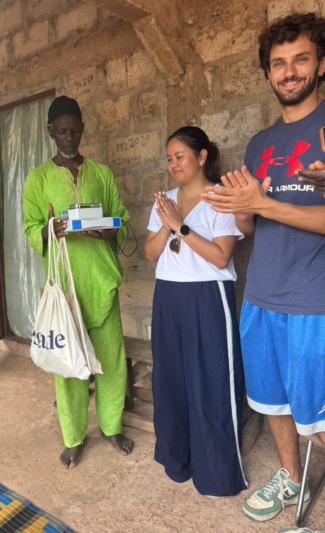
Esade students Mario Contopoulos and Adriene Rivera delivering the devices to the Alkalo, a Gambian village chief, in Sankandi.
Rivera helped define the problem they wanted to solve, interviewed local and international stakeholders, led ideation on the possible solution, and acted as project manager. She also helped develop training manuals and the process for data collection by the locals.
In July and August, they spent about two weeks on the ground in Sankandi, where days started early and ended late. They trained students from University of The Gambia to be the technical support for the device after they had left. They tested the device at multiple locations and taught locals how to use, adjust, and calibrate it. Most of the locals had never before worked with electronic devices, but they caught on quickly. The team had originally planned to collect on-the-ground water data through a mobile app, but created a paper process after realizing that some locals preferred to collect with a pencil.
They also discovered that the river’s salinity was higher than expected, and the team had to recalibrate and adjust the device with limited resources and time. “It was valuable that we were able to go and visit Gambia to see for ourselves the local conditions and speak to the locals to hear about their actual issues and concerns,” Rivera says.
On their second day, they attended a formal welcome meeting with the village elders. Contopoulos tried to speak a bit of their language, Mandinka, which he was learning from their guide. He thinks they appreciated the effort.
“The most valuable part has been witnessing the impact this project is already starting to have,” Contopoulos says. “Seeing how excited and grateful the local community is to use the machine, how eager they are to learn and take ownership of it, has been incredibly rewarding. It’s a reminder that even simple, well-designed solutions can empower communities and create long-lasting change.”
The ROOTS Project, along with other Challenge-Based Innovation, projects exemplify Esade’s commitment to experiential learning, Sierra says. Students don’t just learn about sustainability or social impact in theory; they work directly with communities to solve problems in real life. The students walked through mangroves, saw the environmental challenges, and felt first hand the urgency of preserving biodiversity and economic opportunities for the villagers.
“But what truly leaves a lasting mark is the human connection: sharing meals with local families, listening to the stories of the elders, meeting the Alkalo, cooking together, and experiencing daily life side by side,” Sierra says.
“These moments go beyond academic learning. They foster empathy, humility, and a deep sense of responsibility—qualities we believe are essential for the next generation of leaders. Through the ROOTS project, students not only contribute to change; they are changed themselves, becoming more grounded, globally aware, and committed to creating a positive impact in the world.”
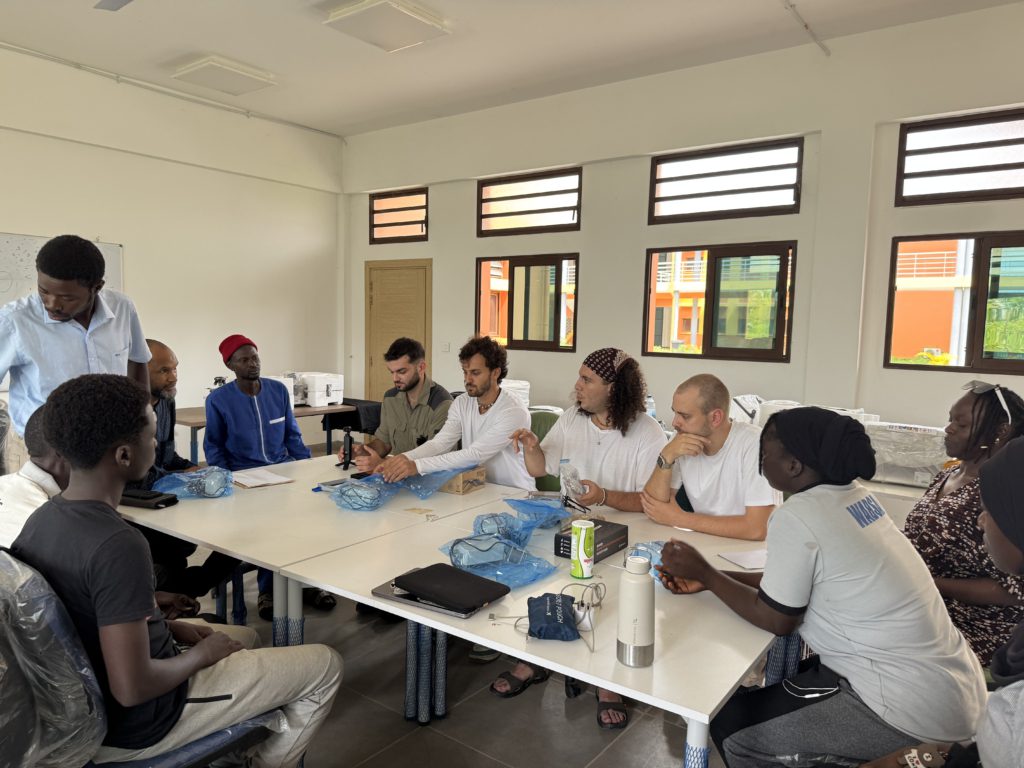
ROOTS Project students training a team from University of the Gambia on use of the water testing device.
TO CREATE LONG-TERM IMPACT
For the Esade team, long-term success of the ROOTS Project would mean Sankandi becoming a national hub for mangrove restoration in The Gambia, serving as a replicable model of locally grounded, interdisciplinary innovation that can be adapted for other communities. The salinity kits are intentionally low-cost and designed to be repaired or reproduced with local materials, making them scalable far beyond the village.
If local communities can learn to use the device effectively, Rivera believes it could guide them to select the best planting sites and match them with the right mangrove species. This would significantly improve reforestation success rates, raising them from roughly 60 to 70% to as high as 90 to 100%. With SYDA’s leadership and the backing of partners like the University of The Gambia, Rivera sees the community not just as beneficiaries, but as innovators and stewards of their land.
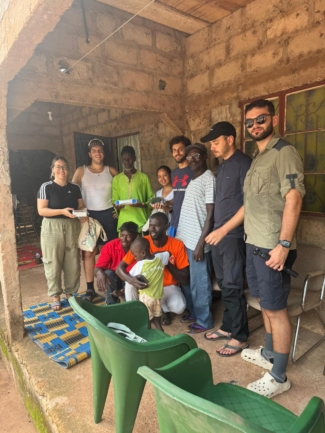
The Roots Project team delivers the devices to the Alkalo and the environmental committee in Sankandi.
“This will help the local communities have a consistent source of livelihood including new sources like carbon credits,” she tells Poets&Quants.
The project’s long-term impact is personal as well. In Rivera’s case, working across language and cultural barriers helped hone effective communication skills. She also learned to collaborate with people with varying expertise, adapt to new audiences, and apply the innovation and ideation process to new knowledge and on-the-ground facts as they came in. While not directly tied to her current role as Global Marketing Manager for Motion Digital Services at ABB, they are skills she will take with her.
She has a photograph of the Sankandi children who followed the team everywhere they went. While they might not have fully understood the work of the ROOTS Project as it was happening, it’s comforting to think they will reap the benefits in the future, she says.
Sitting under the shade of a mango tree, Rivera sipped green tea with a local leader of the Sankandi Youth Development Association while donkeys and goats wandered nearby. They talked about the group’s work and history, why it’s been successful, and how the ROOTS Project could contribute to its mission.
It’s a moment she won’t soon forget: “I think it’s a perfect picture of what this whole project has been about.”
DON’T MISS: A NEW GEOPOLITICS PUSH? HOW INTERNATIONAL B-SCHOOLS ARE RESPONDING TO GLOBAL CHAOS AND VISA RULES, POLITICS & BILLIONS IN PLAY — AACSB SOUNDS THE ALARM ON STUDENT MOBILITY
The post In The Field: Esade Students Partner With Locals To Restore Mangroves In The Gambia appeared first on Poets&Quants.