

Badruka School of Management, a new business school in Hyderabad, enrolled its first PGDM cohort last year with 34 students. They will graduate in May 2026. Courtesy photo
Arunachalam calls it “incumbent inertia,” the difficulty of established business schools in changing course. But as the newly appointed dean of a brand new business school, Arunachalam has the rare opportunity to build from the ground up, free of decades-long traditions, entrenched faculty, and institutional habits.
The Badruka School of Management (BSM) launched just two years ago in Hyderabad, looking to carve out its place in India’s crowded PGDM market. While it is loosely affiliated with its parent institution, the Badruka Educational Society which has operated for 75 years, the business school is an autonomous institution.
Arunachalam’s first mission is to build a PGDM program that develops industry-ready graduates for an AI-driven world. Rather than embedding AI skills into an existing core, the program is building around an AI spinal cord, Arunachalam says. It will be central to every subject, from finance to marketing to operations.
“That’s my vision as the new dean. My goal is to distinguish BSM from the many PGDM programs in India by explicitly focusing on AI adoption,” Arunachalam says.
Q&A WITH S. ARUNACHALAM
BSM’S first degree offering is a two-year, residential Post Graduate Diploma in Management (PGDM), the Indian equivalent of the MBA. It is approved by AICTE, an Indian regulatory body. As a fully autonomous institution, BSM awards its own degree while remaining loosely connected to the Badruka Educational Society, best known for its undergraduate commerce and IT colleges as well as a junior college (equivalent to U.S. high school.)
Next May, BSM will graduate its very first class of 34 students. A second cohort of about 55 to 60 students just completed orientation.
Arunachalam took over as BSM dean just two months ago. We recently spoke with him about BSM’s ambitions, its AI-driven curriculum, and what it means to launch a business school designed for a new and evolving business landscape shaped by AI and rapid technological change. Our conversation has been edited for length and clarity.
Tell me a little about your history and why this opportunity at a brand-new business school was attractive to you.
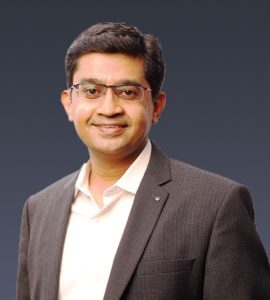
S. Arunachalam, dean and director
I earned my PhD from Iowa State University in Ames, Iowa, so I call myself a Midwesterner. My PhD was in Business and Technology, majoring in marketing with a minor in statistics. I completed it in 2014.
I always wanted to come back to India, where my roots are. I was on the faculty at the Indian School of Business (ISB) in Hyderabad for eight years. Then I returned to the U.S., where I spent three years as a tenured marketing faculty at Texas Tech University. My research and teaching have centered on marketing strategy, sales, and innovation, as well as executive coaching.
When this opportunity came along, I felt the time was right. I could help build a world-class institution that doesn’t suffer from what I call “incumbent inertia.” If you are an established business school, changing is really, really tough. At BSM, yes, we have the “liability of newness,” but we also have the opportunity to be nimble and agile, and to be completely market-focused.
Even before I officially joined, I told the board we needed two things: one, a deliberate move toward being industry-ready; and two, embracing AI not just as a specialization, but horizontally across all disciplines. The perfect analogy would be AI is the spinal cord of our educational system. It is integrated into marketing, finance, innovation, organizational behavior, and beyond.
Was the AI “spinal cord” vision something the school was founded on, or was that what you wanted to bring?
That’s a very good question. The school already had a larger vision: to break out of the traditional mold of the Badruka Educational Society and build a world-class autonomous institution. That vision was broad.
I focused that vision a little further. My pitch was that we can build a world-class school by creating a curriculum with an explicit focus on preparing managers to excel in an AI-driven world. The board liked the idea. It is market-focused and feasible, and now we are experimenting with ways to make it real.
What does it look like to make AI a “spinal cord” of the program?
I call it the “three A model” of AI adoption: adopt, apply, absorb. We need to adopt AI, and then we need to start applying the concepts of AI, and then try to absorb the benefits across business functions – finance, accounting, operations, marketing, entrepreneurship, and so on.
Next, how do we do it? We begin with coursework. For example, all students must take AI for Non-Technical Managers as a core requirement, not an elective. Another course we will introduce is From Zero to Hero: Generative AI and Its Business Applications. These courses give students enough technical exposure to understand the fundamentals – what a large language model is, what the building blocks are – without asking them to code models from scratch. They are not engineers, but they must understand how to use AI.
We use specific tools: ChatGPT, Microsoft Copilot, DALL·E for text-to-image, and Python-assisted analysis. Students don’t need to master every tool, but they need hands-on exposure to avoid AI anxiety.
Then we move to application-oriented courses for industry practitioners, with case studies in manufacturing, healthcare, and fintech, for example. This phased model – adopt, apply, absorb – will help students embrace rapid change. AI evolves daily, so the only way is to embrace it, not fight it.
As I said, we haven’t yet graduated a single batch, but we are building with this in mind.
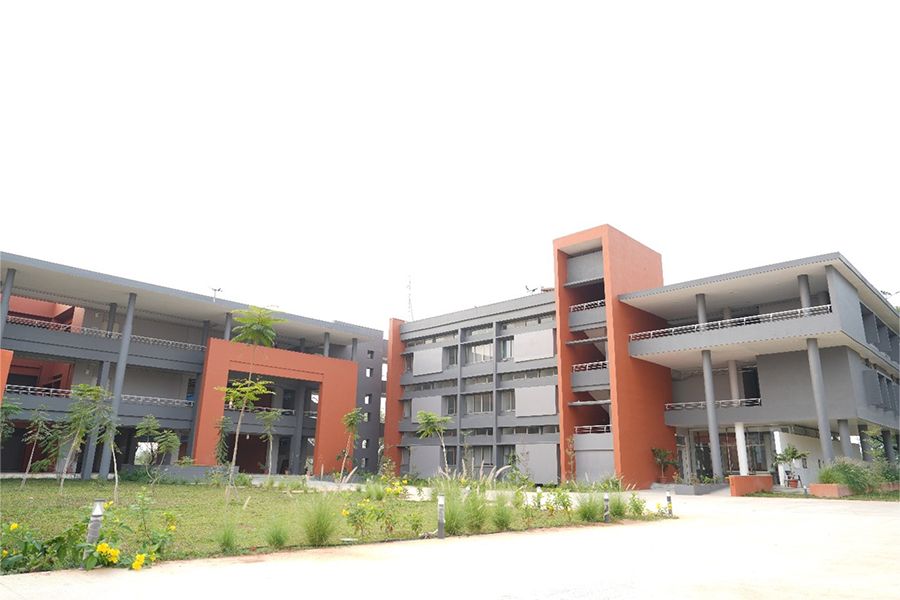
Badruka School of Management is located on a 15-acre campus in Hyderabad. Its two-year residential PGDM is built with AI as its foundation, and a mission to deliver industry-ready graduates. Courtesy photo
You started the PGDM with 34 students in the first cohort. The incoming cohort has between 55 and 60. Is that growth due to planned scaling or increased market awareness? Where do hope to end up in terms of enrollment?
Market awareness is picking up, and we expect it to grow further. Our infrastructure and vision can support 100 PGDM students per batch. I am ready to scale to that number.
We also emphasize internships. After the first year, students complete a compulsory 2.5-month internship. The college helps facilitate placements with top firms. Our first batch just completed internships at top multinational companies, both at established organizations and startups.
Once we reach 80 to 100 students per batch, I also plan to launch executive education programs, particularly focused on AI applications for managers.
What have you heard from students about choosing a brand-new program, which carries risks?
That’s something I’ve been thinking about. I think the current and incoming batches were attracted by the unique innovations we brought about in the curriculum.
For one, we use a block teaching model where each tri-semester is divided into 15-day blocks. In one block, a student takes only one course. For example, if you are taking Managerial Economics, that’s the only course for those two weeks. Each day you spend three hours in class. By the end of 15 days, you’ve completed 30 hours and earned three credits. This allows students to go deeper into one subject and reflect on their own interests. I believe postgraduate education is about self-discovery, and this model encourages that.
Second, our courses are taught by a deliberate mix of academic experts and seasoned business leaders. For example, Procter & Gamble’s global head of learning and development is going to teach 30 hours on organizational behavior. We have a phenomenal visiting faculty list from India, Singapore, the U.S., and other countries.
Finally, we have made a deliberate attempt to build a program around ESPs – Essential Skills & Perspectives – with short modules that emphasize holistic student development. Business school is not just gaining knowledge, it’s about learning to communicate with clarity. If you want to be a manager and transform yourself into a leader, you have to be a powerful communicator. We have a one-credit, 10-hour applied course on essential managerial skills – communication, presentation, diction, executive presence – taught by the experts from industry.
Are you attracting students locally, nationally, or internationally?
Our first goal is to be a pan-India school in the next three to five years. We want to appeal both to fresh graduates and to young professionals with two to three years of work experience.
Internationally, the plan is to build international collaborations and partnerships with U.S. universities, leveraging the networks I already have. The idea is to create what I call “twinning programs,” where a student could complete four or five trimesters here, and then – through an MOU with strong U.S. business schools – transfer to complete the remaining credits and pursue further education and opportunities in the U.S.That’s the international exposure angle.
What is your five-year plan?
In five years, I want BSM to be ranked among the top 30 MBA/PGDM programs in India. That’s the primary goal.
We also plan to offer specialized certification programs for working professionals, especially through partnerships with U.S. and Canadian universities.
The third way I would like to expand is on a proper residential executive education program, offering shorter programs for mid-level managers, consultants, and healthcare executives, and so on.
Our strength is the visiting faculty. The knowledge and market power they bring, from both academia and business, will help us build multiple programs in three to five years.
Would those executive programs also have the AI spinal cord?
Yes, definitely. In fact, the first executive education programs I want to offer are applications of AI for mid-level managers. That is what the market needs.
But I also envision programs beyond AI. For example, India lacks professional sales programs. There is a huge market for certificates in high-performance selling, digital selling, sales management in a digital world, and B2B vs B2C sales. These could be high-power, market-oriented programs, with AI integrated where relevant.

Badruka School of Management plans to scale to cohorts of between 80 to 100 PGDM students while offering a portfolio of executive programs.
How do you think AI will reshape business education in the coming years?
AI is not optional. It is a paradigm shift reshaping business education.
One way is curriculum integration. Another is personalized learning pathways. For example, we are experimenting with an internal GPT-based chatbot trained on our curriculum and policies. Students could interact with it to get guidance on courses, career paths, and learning progress. It could act as a smart companion.
But beyond academics, I see AI supporting student well-being. With rapid AI adoption, students will face “AI anxiety,” similar to math anxiety in the U.S. Combined with attention challenges, this creates stress. A chatbot could provide a safe, non-judgmental companion for students, supporting mental as well as academic well-being.
If we can build a healthy ecosystem that emphasizes emotional quotient as much as IQ, we will have succeeded. EQ is critical for managers and leaders.
What feedback have you received from industry?
Because of our block model, we also have a one-on-one mentorship program. After a few blocks, each student is assigned an industry mentor—executives from Amazon, BCG, Uber, and so on. They give industry overviews and help students understand what managerial roles look like in practice.
Industry executives appreciate that we are not just “feeding” students to companies, but involving them in the learning process itself. We are co-creating education with industry. Internship partners tell us our students already seem industry-ready, not just theoretically prepared.
How many full-time and visiting faculty do you have, and what is recruiting like?
We currently have about 12 full-time faculty. Recently, I recruited two more in operations and in data sciences.
Most of our faculty are visiting, deliberately chosen as a mix of PhDs from academia and senior executives from industry. Going forward, I want to grow to 20 to 25 full-time faculty within two years. That balance of resident and visiting faculty will be ideal.
Recruiting is promising. Younger PhDs with emerging technology skills are especially attracted because we value their expertise in AI and don’t force them into traditional molds. That is an advantage of being a new school.
Do your faculty, by and large, have a lot of experience in that space? Are you actively looking for AI expertise in your faculty?
That’s a great question. I think every school faces this challenging phase. Seasoned executives are often not fully up to speed on cutting-edge AI, while newer PhDs – rookies just finishing their degrees – are usually more advanced with AI toolkits.
Here’s where my advantage comes in. Because BSM is a new school, we can be agile and nimble. We don’t have a large, entrenched faculty that is too classical in approach. That gives us the flexibility to go to the market and say clearly: this is the curriculum we want, and your emerging technology skills are valuable and useful for us.
That is my pitch to faculty, and I think it makes us more attractive to current doctoral students who are about to graduate and become academicians. They like that someone values their new-age skills, rather than insisting on the traditional academic pattern.
So I believe we are at an advantageous position in that respect. Hopefully we can continue to build on it.
DON’T MISS: ‘A CLASSIC PRISONER’S DILEMMA’: IMD’S DAVID BACH ON WHAT INDIVIDUAL ACTION MAY MEAN FOR U.S. UNIVERSITIES AND IN THE FIELD: ESADE STUDENTS PARTNER WITH LOCALS TO RESTORE MANGROVES IN THE GAMBIA
The post In India, Building A B-School With AI As Its Spinal Cord appeared first on Poets&Quants.