
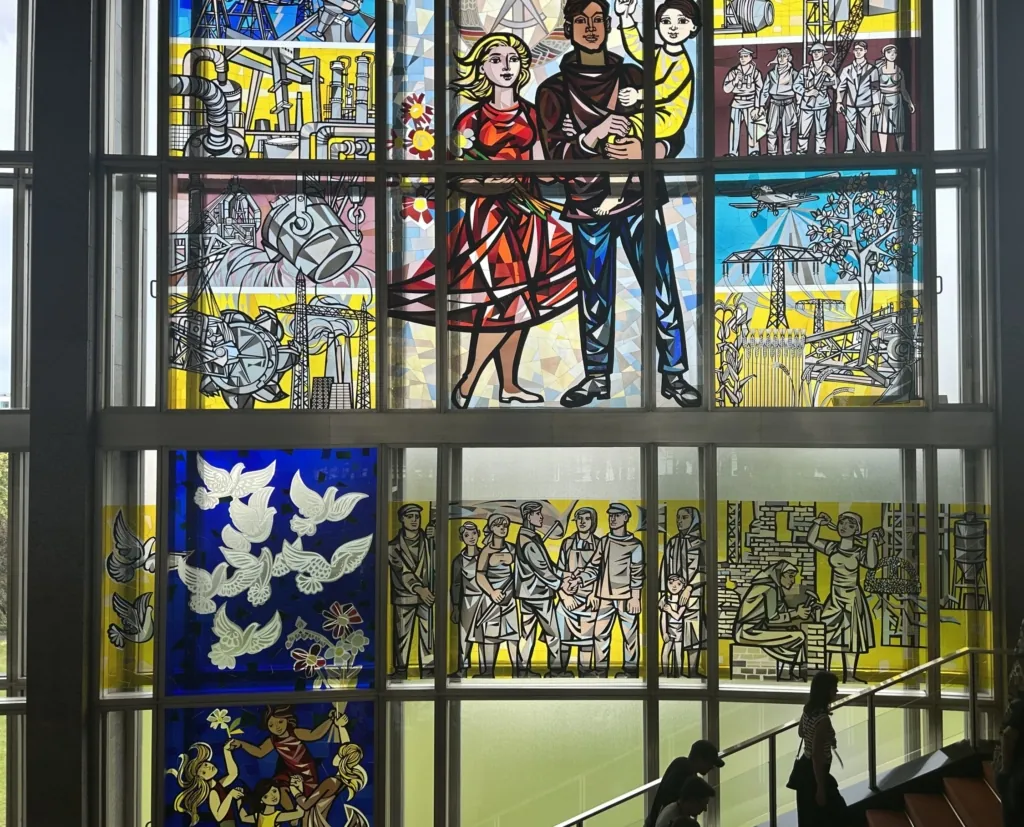
Visitors walk in front of a stained-glass mural by East German artist Walter Womacka overlooking the main staircase of ESMT Berlin’s historic campus at Schlossplatz 1.
If ESMT Berlin were a business student, it’d barely be old enough for its own MBA.
The European School of Management and Technology was founded in 2002 by 25 global companies looking to move beyond Germany’s traditional model of executive training and create a truly international business school. It’s been growing ever since.
It launched its first MBA program in 2006, followed by the Executive MBA in 2007, the Master in Management in 2014, and online and part-time MBAs in 2019. Three years ago, it launched a new Master in Innovation and Entrepreneurship to more deeply connect with Berlin’s burgeoning startup economy. It also offers masters in global management as well as analytics and artificial intelligence and a Phd.
More than 3,500 executives participate in its executive education programs each year, and over 36,000 have completed them since its founding. It enrolls more than 1,000 MBA, Master’s and PhD students from about 100 countries each year. Its International MBA enrolls between 55 to 65 students per year, with more than 90% coming from outside the country.
Today, it is one of Germany’s highest-ranked business schools, and one of only four in the country with triple-crown accreditation. It finished second in Germany and No. 19 in Europe in The Financial Times’ 2024 European business schools ranking, and its MBA ranked No. 8 for entrepreneurship in Poets&Quants’ 2025 ranking.
“Our vision is to be a global space where people, no matter where they come from, can find a home and the opportunity to develop their ideas,” says Jörg Rocholl, president of ESMT since 2011.
“Traditionally, international students went to the United States or the U.K. But Europe, especially Germany, has become a great destination. There are excellent job opportunities, a high quality of life, a strong entrepreneurial spirit, and robust support for starting companies.”
A BLEND OF OLD & NEW
Rocholl tells Poets&Quants that ESMT’s story has been one of growth on every front, from research to teaching, to programs and global reach. The next phase will come through expanding its programs, to provide more access to more students.
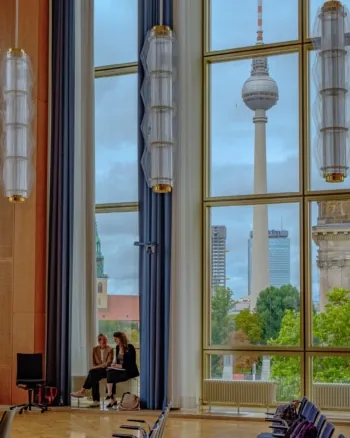
From ESMT Berlin’s auditorium, floor-to-ceiling windows frame the iconic Berlin TV Tower on Alexanderplatz. The tower inspired the school’s logo, symbolizing its blend of history, innovation, and global perspective.
But the school is simply running out of room.
ESMT Berlin moved into its current home at Schlossplatz 1 in 2006, taking over one of the most storied addresses in the city. Built in the early 1960s, the building once housed the State Council of the former German Democratic Republic, later the Federal Chancellery under Chancellor Gerhard Schröder.
Today, it is a bridge between old and new: Original leather-paneled walls, porcelain tiles, and a stained-glass mural by artist Walter Womacka depicting the German labor movement stand alongside central Berlin’s largest rooftop solar installation, which generates a quarter of the school’s electricity.
A frieze depicting East German life circles the auditorium – the State Council’s former banquet hall overlooking Berlin’s cultural heart. Life in the GDR by German artist Günter Brendel depicts scenes of East German art, industry, and daily life. Even the school’s logo is inspired by the Berlin TV Tower visible from the auditorium’s floor-to-ceiling windows.
ESMT is now planning a 2,000-square-meter West Wing to welcome more students to its programs. Longterm, it envisions an integrated campus that combines student housing, research, teaching, and entrepreneurial spaces in the heart of Berlin.
DEEP TECH & GLOBAL AMBITIONS
Alongside the physical space, ESMT wants to expand its footprints in both deep tech and global outreach.
In September, it appointed Henry Sauermann, ESMT professor of strategy, as its first TEAM GLOBAL Chair for Disruptive Innovation, an endowed professorship supported by Berlin entrepreneur Lukasz Gadowski. The chair will bridge scientific breakthroughs with its entrepreneurial DNA to bring new ideas to market. The chair will be supported by David Robinson, the J. Rex Distinguished Professor at Duke University’s Fuqua School of Business and an ESMT affiliate professor.
The chair will be embedded in both ESMT’s master’s programs and executive education, working closely with Vali Berlin, the school’s entrepreneurship hub.
In October, ESMT will host the third Berlin Global Dialogue summit, “Shifting Power, Shaping Prosperity,” with President of the European Commission Ursula von der Leyen, Kosovo President Vjosa Osmani, and Nigeria’s Foreign Minister Yusuf Tuggar alongside industry barons and CEOs. ESMT launched the project three years ago to bring together leaders from business, government, and academia to find solutions to major world challenges.
And in June, ESMT became the first German business school to secure a prestigious Alexander von Humboldt Professorship,the country’s most generous research award. Michael Weber, currently a professor at the University of Chicago Booth School of Business, will join ESMT next spring to launch the European Expectations Center, a research hub exploring how households’ and firms’ inflation expectations shape real-world decisions.
“Michael Weber is one of the most influential voices in household finance and macroeconomic expectations today,” Rocholl said in June. “His appointment will significantly strengthen our research in economics and policy and further position ESMT as a leading hub for evidence-based insights in Europe.”

ESMT Berlin’s campus at Schlossplatz 1, the former State Council building of the German Democratic Republic, illuminated at dusk. The historic site has housed the international business school since 2006.
Q&A WITH ESMT PRESIDENT JÖRG ROCHOLL
Rocholl, who is German, earned his PhD in finance and economics at Columbia University and CBS. His first faculty position was at University of North Carolina-Chapel Hill. He returned home in 2007 to join the faculty at ESMT. He became president in 2011.
“The driving force behind my work is a question I was often asked in the United States: Why isn’t there a single top business school in Germany, given that it is the largest and most important economy in Europe?” he tells Poets&Quants.
“ESMT is, in a way, the answer to that question. It shows that it is possible to create a school of international caliber in Germany, and that’s what I am passionate about.”
Rocholl is the Deutsche Bank professor in sustainable finance at ESMT, advisory board chair of the German Federal Ministry of Finance and chair of the steering committee of the Global Network for Advanced Management.
During a recent campus visit, Poets&Quants sat down with Rocholl to talk about ESMT’s continued growth, its ambitions in deep tech and AI, and how it is positioning itself on an increasingly chaotic global stage. Our conversation, presented below, has been edited for length and clarity.
Let’s start by looking at the growth of ESMT since you first came as a professor, and then since becoming president in 2011.

ESMT President Jörg Rocholl
When the school was founded in 2002, it didn’t have a single degree program. It had some initial executive education programs, but no faculty. It really started from scratch.
We launched our first MBA program in 2006 and the EMBA program in 2007. That was also the first program I taught in. We started our Master in Management program in 2014 and later added online part-time MBA programs around 2019 and 2020.
We significantly grew our executive education program. We hired professors from 20 different countries. We created centers and institutes focused on technology, innovation, and entrepreneurship. We expanded our facilities substantially and continue to do so.
It has been a full story of growth across all dimensions, research, teaching, and the platform that supports them.
What are the big initiatives or pushes for 2025?
We have created a number of new initiatives that we want to continue building at the same pace as before. For example, we launched the Berlin Global Dialogue two years ago, a major platform that brings together CEOs, heads of state, government representatives, and academics. It has received tremendous feedback. This year we’re hosting the third edition, and it’s set for further growth.
We also want to expand our footprint in deep tech. DEEP, our Deep Tech Innovation Institute, allows students, as well as external participants, to develop their ideas and turn them into companies. This is not only about innovation but also about creating employment.
Across our programs, we are embedding more entrepreneurial and technological elements. One major focus will be AI. We already have a master’s program dedicated to it, but AI will increasingly be integrated throughout everything we do, both in terms of expertise and in the processes we use.
Finally, we want to take our campus a significant step forward. We are at capacity constraints and simply cannot host certain events that are highly relevant and interesting. Growth has been so strong that we are running out of space.
Are you still in growth mode in terms of programs and students? Are you still trying to expand numbers?
Absolutely. We have grown significantly by introducing new programs, and now the focus is on expanding those programs themselves. For this, we also need additional space. Some of our growth projections are constrained simply because we don’t have the facilities available.
We receive great applications and have outstanding students, but too often we have to turn them down because we can’t accommodate them. We hope that will soon change.
The expansion will happen in two stages. First, we will build the West Wing – what we call Wing A – which will add 2,000 square meters of first-class facilities. Then, we have a broader campus development in mind that we are also discussing. It’s really just a question of getting public approval, but we have received very positive feedback on our plans. It would be fantastic to create an integrated campus in the city of Berlin that combines student housing, research, teaching, entrepreneurial activities, and so on.
ESMT recently hosted the INNOVA Europe Grand Finale pitch competition, and it has done well in P&Q’s MBA entrepreneurship ranking. How would you describe the entrepreneurial ecosystem around Berlin and Germany?
Berlin is a great place for entrepreneurship. The city’s former mayor once described it as “poor but sexy.” Because of its history, the separation of East and West Berlin, there wasn’t a single top-listed company here in Berlin. But that has changed. The entrepreneurial scene has taken over, and today more venture capital flows into Berlin than into any other European city.
Berlin also offers a great lifestyle. It provides the freedom and opportunities to fully engage in an entrepreneurial setting and launch startups. At ESMT, we see ourselves as enablers for students who want to go down that path. We attract those who are interested and then support them with classes, platforms, and very practical means of getting things done.
We also connect them with other entrepreneurs, venture capitalists, policymakers, and often their first customers – larger companies that can buy their products.
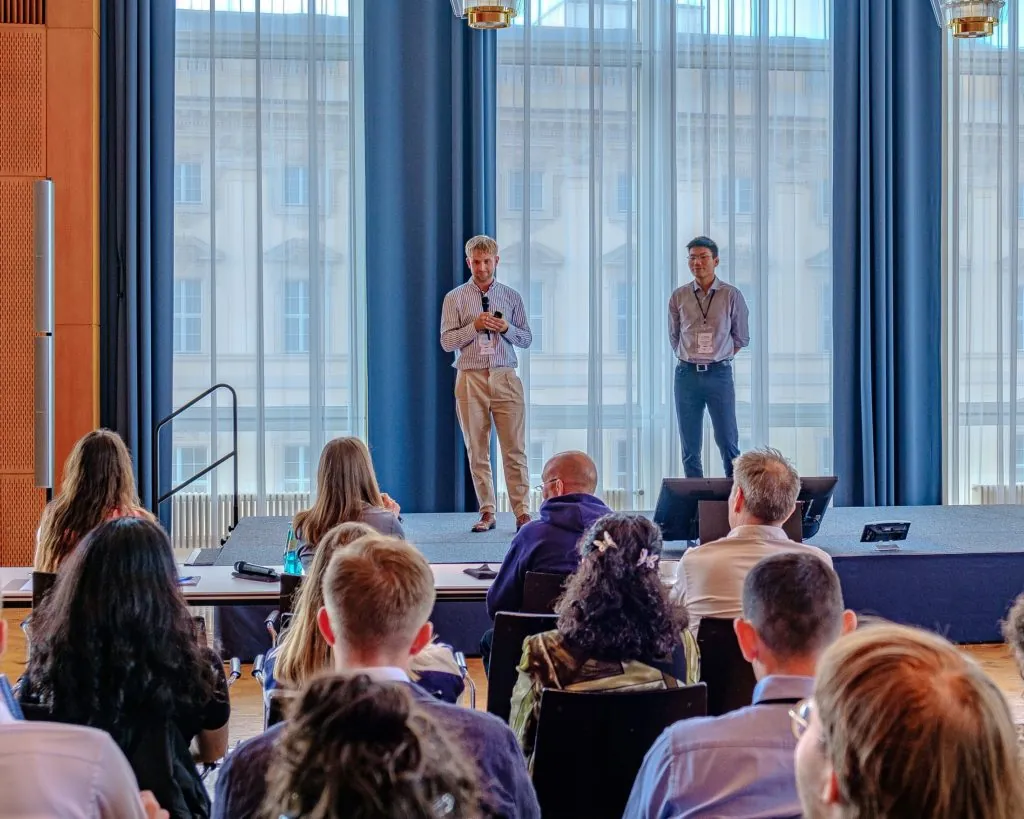
Arthur Fordham of AcouBatt pitches their “battery listening” startup at the INNOVA Europe 2025 Grand Finale at ESMT Berlin, as teammate Chris Xu (at right) looks on. The London Business School duo won the Rising Stars category and €20,000 for their technology that uses acoustic sensors and machine learning to hear what batteries are saying—helping manufacturers cut waste and boost performance. (Courtesy photo)
How many students are choosing ESMT specifically for entrepreneurship programs versus those looking to work in established German companies? What is the balance?
In our mission statement, we clearly emphasize educating entrepreneurial leaders. That’s very important to us. This applies both to students who create their own companies and to those who take on entrepreneurial roles within existing companies. It represents a major share of our student body.
More precisely, we created the Master in Innovation and Entrepreneurship, where the focus is obviously 100% on entrepreneurship. But even across all our other programs, a significant portion of students pursue entrepreneurial paths.
We see this in the fact that a majority of our students, regardless of where they come from, want to stay in Berlin. They want to create companies, join startups, or work in companies with a strong entrepreneurial spirit. Zalando is a good example. It didn’t exist 15 years ago, and now it’s part of the major German stock index. It’s an established company, but it still has the feel of a startup and an entrepreneurial culture.
For the MBA, there are many who become founders, but also many who join very entrepreneurial companies. Some go to the big hyperscalers in the United States, while others become tech entrepreneurs or pioneers here in Berlin.
Tell me about some of the new initiatives in your entrepreneurial ecosystem at ESMT.
We started the Master in Innovation and Entrepreneurship three years ago because we saw such strong interest in these areas. The first graduating class finished two years ago.
One important initiative is Vali Berlin. It was created by Baris Efe, an ESMT alumnus and is designed to support students through summer programs, guidance, mentoring, and networking. Students are encouraged to work on their companies during their studies, with extended time dedicated to developing their ventures.
Another initiative is our DEEP Institute, which hosts the EMST Creative Destruction Lab. This provides mentoring and support for young companies at a very early stage, sometimes even leading to initial funding. We collaborate with Charité, one of the world’s leading hospitals, to train their postdocs in turning medical research into companies. We teach them how to write business plans, position themselves competitively, and navigate commercialization. There has been strong demand from other science-based institutions to work with us in similar ways.
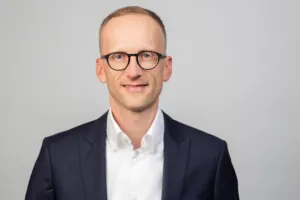
Henry Sauermann, the first TEAM GLOBAL Chair for Disruptive Innovation
We’ve received significant support from foundations that want to foster science-based startups. To strengthen this further, we have hired professors in the field and we just inaugurated a new Chair in Disruptive Innovation. This chair was founded and supported by a major Berlin entrepreneur. When I asked him why he came to us, he said, “Well, you are known for bringing out great entrepreneurial students, so let’s bring even more disruptive innovation.”
What do you think is special and unique about INNOVA compared to other startup competitions?
What I see as special is the close link to business schools and academic institutions. It symbolizes what we know best.
It reminds me of the motto by the German philosopher Leibniz, who spoke of theoria cum praxi: we are grounded in academic insights and research, but the question is always how to transfer this into practical knowledge for the benefit of those who participate. INNOVA is a prime example of this principle.
In 2025, with the disruption of AI, geopolitical shifts, tariffs, etc., what are some of the challenges you see for business education going forward?
I would frame this in terms of what we think future and current business leaders need to be aware of. First, they must have technological expertise in AI and digitalization to approach strategic questions from a technology perspective. Mastering technology is key.
Second, they need geopolitical knowledge. Understanding how the world is evolving – the role of the United States, tariffs, China, raw resources, supply chains, and so on – is now fundamentally important. This wasn’t something leaders needed to know much about 10 or 20 years ago, but today it’s essential.
Third, they must cultivate an entrepreneurial spirit. It’s not enough to simply react to challenges. Leaders must create new opportunities in a world of uncertainty.
And then certainly, I would also argue for us at ESMT, we strongly believe in looking at sustainability as a competitive advantage. Green tech and related innovations are not just ethical imperatives but also prerequisites for profitability and competitiveness.
Finally, we emphasize social impact. At ESMT, social impact projects are integral to everything we do. For example, our students have gone to Addis Ababa, Ethiopia, to reorganize a paper recycling firm, and to Saint Lucia to support women recovering from domestic violence by helping them rebuild and create new opportunities. (See: How ESMT Berlin Students Are Revitalizing Germany’s Poorest City With Business Innovation)
This emphasis on social impact is an identifying factor for ESMT and has led to collaborations, such as with UVA McIntire. They explicitly said this is a strength we should foster.
As business schools push both sustainability and AI, how do you balance the two given the energy demands of AI?
For us, the balance is about making sustainability tangible and integrated. In very practical terms, we created the largest solar panel installation in central Berlin, covering our entire learning building. It’s the biggest in the city center. This shows that we don’t just talk about sustainability, we implement it.
We also have alumni working in sustainability-related solutions, and colleagues conducting research on sustainable energy production. In this way, sustainability and AI are not in conflict but go hand in hand. They must be combined.
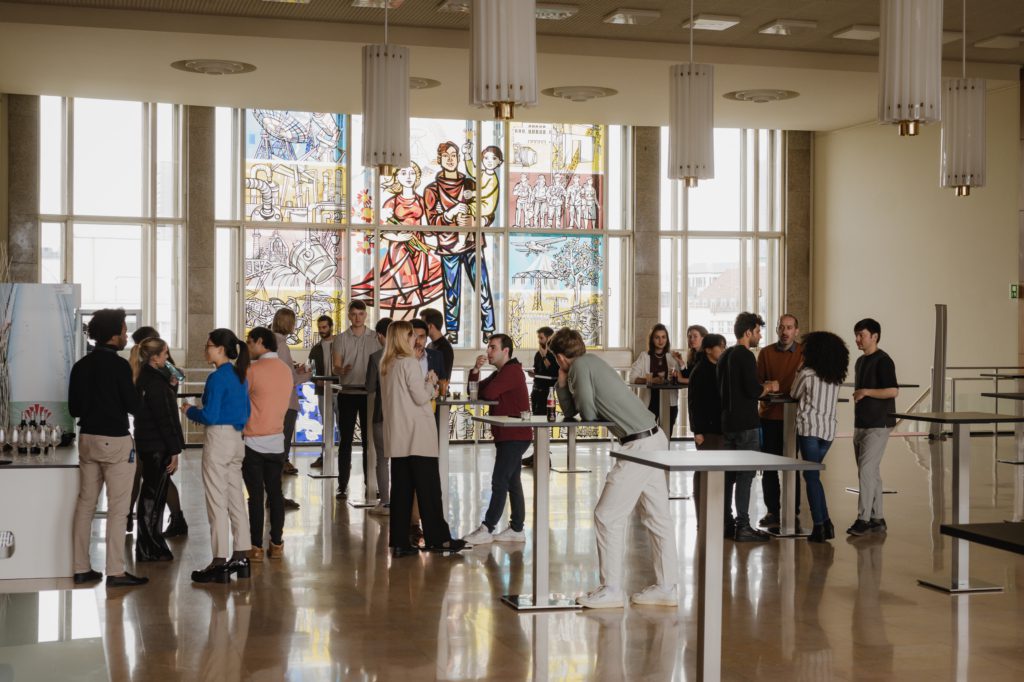
ESMT Berlin students mingle during Demo Day of the Summer Entrepreneurship Program. ESTM photo
What are some of the unique opportunities for ESMT in this 2025 moment?
On the one hand, globalization faces certain challenges. At the same time, we strongly believe in being an open, truly global institution. We already have students from 100 nationalities on campus, and we hope to welcome even more.
Our vision is to be a global space where people, no matter where they come from, can find a home and the opportunity to develop their ideas. That is a great opportunity for us.
Of course, tariffs, supply chain issues, and other frictions make some transactions more difficult. But this makes it even more important to position ESMT as a place that is global in nature and attractive to people from all over the world.
Anything else you’d like to add?
One thing we are currently pushing builds directly on your last question. Germany offers fantastic opportunities for students – whether it’s visas, work opportunities, or comparatively lower tuition.
Nonetheless, you could say ESMT is still an outlier in terms of top rankings and visibility. That’s why we want to do even more to attract students from around the world and show them that this is a great place to study.
We launched an initiative with other German business schools called Say ‘Ja’ to Germany. It highlights the many opportunities available here and encourages students to see Germany as a destination for their studies and careers. Many of our students want to stay in Germany, and we want to make that path even stronger.
Traditionally, international students went to the United States or the U.K. But Europe, especially Germany, has become a great destination. There are excellent job opportunities, a high quality of life, a strong entrepreneurial spirit, and robust support for starting companies.
So despite the challenges, this is a real chance for students.
Have you seen more interest from international students choosing Europe over the U.S.? And is this also a moment for European business schools to attract professors?
On the student side, we will likely see the impact in the next recruiting cycle. Certainly, that’s what we want to offer. At the same time, I hope the United States continues to play its role as a model for academic freedom and excellence. This is a public good that transcends the United States. I personally benefited greatly from my time there as a PhD student and professor. In many ways, ESMT itself is built on that role model.
That said, we are now at a stage where the quality and opportunities in Europe are very high. There are enough students who could also come here.
Michael Weber, Assistant Professor of Finance at University of Chicago Booth School of Business
On the faculty side, there’s probably not a single week when I don’t receive a call from colleagues in the United States interested in joining us.
We secured, as the first private university in Germany, an Alexander von Humboldt Professorship. This is a highly funded professorship created by the Federal Republic of Germany to attract professors from all over the world. It provides generous support €1 million per year for research funds, doctoral students, and related expenses.
Through this program, we attracted Michael Weber from Chicago Booth, which created significant public recognition for ESMT. It showed that we could draw faculty from one of the leading business schools in the world.
I would hope the German government scales up these programs, because the demand is there, the supply of outstanding professors who want to come is clear. What we need are the financial means to make it more viable.
DON’T MISS: INSIDE INNOVA EUROPE 2025’S IMPACT-DRIVEN STARTUPS AND 2025 MBA TO WATCH: GÁBOR BALOGH, ESMT BERLIN
The post The P&Q Interview: ESMT Berlin President Jörg Rocholl On Growth, Deep Tech & Competing For Global Talent appeared first on Poets&Quants.