
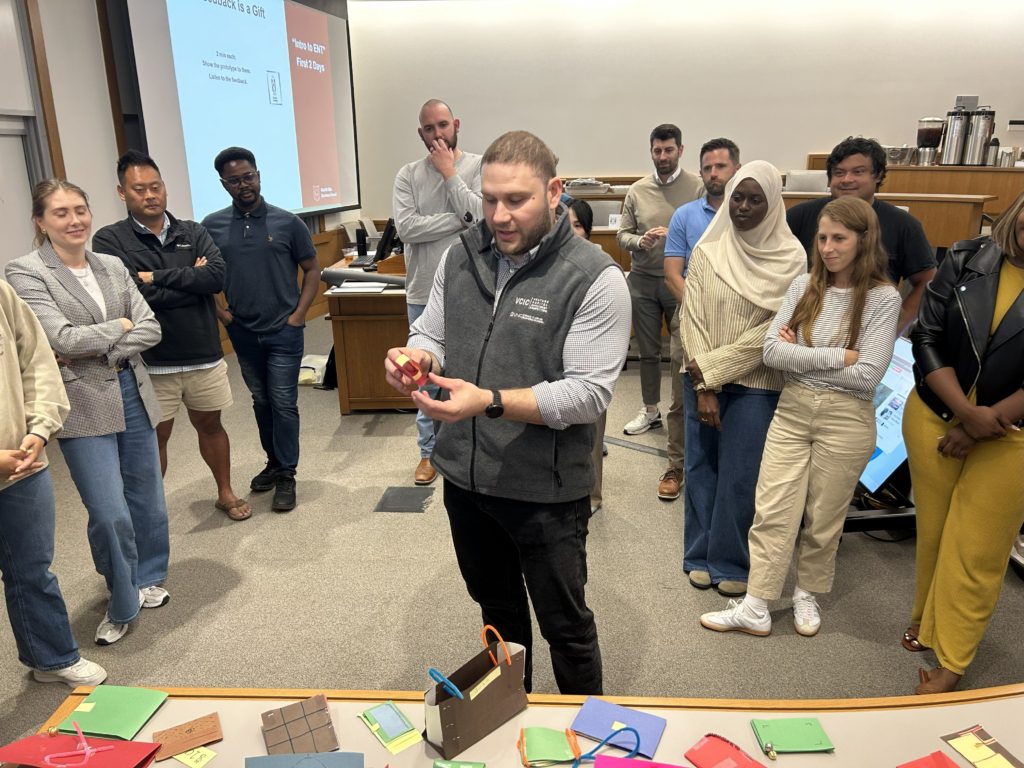
MBA student Daylan Skidmore displays a wallet prototype he created during a design-thinking exercise in Professor Doug Villhard’s Fall 2025 Introduction to Entrepreneurship course.
OLIN’S WINNING FORMULA
Olin’s program is experiential by design. It doesn’t just teach students how to start companies – though it has plenty of courses and mentors that do just that – but to think like founders no matter where their career takes them.
“The education at Olin is like a ‘build your own adventure.’ If you bring your venture into class and apply the lessons directly, you’ll be in a strong position after graduation,” says Taylor, founder and CEO of Block Club.
“It’s not easy, but I’m grateful for a foundation built by great professors and mentors at WashU.”
If you need an example, just follow Taylor’s own founder journey. In Olin’s famed Hatchery course – one of the first business planning courses in the country – he gained the confidence to pitch his idea with the problem at the center, explaining it to anyone willing to listen. He moved on to “Launching and Scaling New Enterprises,” created by Villhard and now taught by II Lucrisi, Assistant Vice Provost for Innovation and Entrepreneurship and Managing Director of the Skandalaris Center.
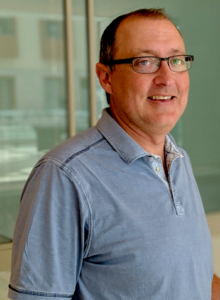
Doug Villhard, Olin’s academic director of entrepreneurship and serial entrepreneur
Throughout, he worked with real St. Louis companies on real entrepreneurial projects. He went on “field trips” to area startups founded by WashU graduates, connected with Olin’s highly engaged entrepreneurial alumni, and learned from a long and growing list of founders who come to the school as guest speakers and mentors. Mentorship remains one of Olin’s strongest metrics in the P&Q ranking, and Olin reported the second highest number of mentors per MBA at 5.5.
More than half of Olin MBAs are “entrepreneurially minded,” Villhard says, and nearly all students gain hands-on startup experience, either through their own ventures or classmates’ projects. In fact, Taylor says he learned as much from his entrepreneurial peers as he did from the coursework.
Taylor spent almost as much time at the university-wide Skandalaris Center for Interdisciplinary Innovation and Entrepreneurship as he did at home. He took Block Club through the 10-week Skandalaris Launchpad accelerator for WashU student ventures, and even found an intern to help push the venture forward.
Block Club won funding through the Skandalaris Venture Competition in 2024 and a $75,000 Arch Grant in 2025. Arch is a citywide program giving non-dilutive investments into St. Louis startups or companies that relocate to St. Louis.
FALLING IN LOVE WITH THE PROBLEM
Olin’s entrepreneurship track spans four semesters and a paid summer accelerator that takes students from idea inception to actually getting customers.
“It’s fun watching students test, pivot, and even drop ideas to start new ones with classmates,” Villhard said. “It’s not about falling in love with your solution—it’s about falling in love with the problem.”
Since last topping P&Q’s MBA entrepreneurship ranking two years ago, the program has continued to innovate and evolve. Recent innovations include the Koch Center for Family Enterprise, which added fellowships for MBAs pursuing Entrepreneurship Through Acquisition (ETA). The university-wide WashU Venture Network links student and alumni startups with early-stage investors. It recently entered a partnership with the Chancellor’s office to launch a $150,000 fund to invest in Arch Grant winners with WashU DNA, like Block Club.
“Students act as analysts, reviewing deals and recommending investments,” says Lucrisi. “It’s hands-on venture education in action.
AN ECOSYSTEM SPANNING OLIN, WASHU & ST. LOUIS

Managing Director of the Skandalaris Center
Olin ranked first or nearly first in three metrics on this year’s ranking: Percent of MBAs starting ventures within three months of graduation (a five-year average), the ratio of entrepreneurship mentors to full-time MBAs, and ratio of mentor hours logged with MBAs. Alumni founders regularly return to the classroom as guest speakers or as more formal mentors.
“Being a founder is often very lonely. You’re waiting around, trying to make something happen, wondering if the way you’re going about it is the right way,” Villhard said. “The beauty of our program is that we have so many founders who remember that feeling. They open their networks, connect students to investors, and pay it forward.”
Lucrisi agrees: “I’ve never called someone from the WashU network and had them say no. People are eager and excited to help.”
Another secret of Olin’s entrepreneurial success? The sheer reach of its ecosystem.
Saint Louis offers all the benefits of a big city with the accessibility of a small town. Its own startup ecosystem has matured alongside WashU’s, from Arch Grants and Cortex Innovation District to T-Rex and St. Louis Startup Week.
At nearly all these events, you’ll find a WashU thread. The entrepreneurship mindset that Olin strives to teach permeates across the university. Most of WashU’s academic schools have their own entrepreneurship center, under the Skandalaris umbrella.
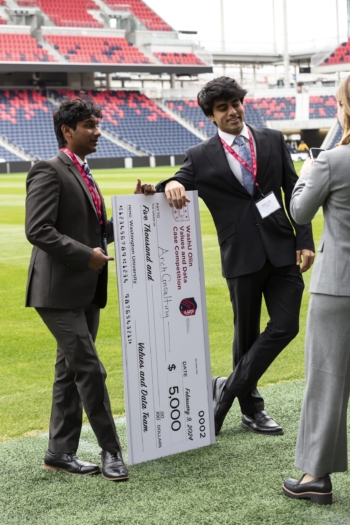
students Rahul Chavali and Arman Patel participate in the Koch case competition at St. Louis City in February 2024. Photo by Jerry Naunheim Jr.
“At many universities, the business school is separate from the main campus,” Lucrisi says. “At WashU, Olin sits right in the middle of everything. You’re getting a lot of interactions with the entire campus community that creates ongoing ideation and support from that. Students in the MBA classrooms are sitting alongside engineers and law students ”
As part of the university’s new strategic plan, Olin this year launched its new Business of Health initiative, connecting MBAs with doctors, hospital administrators, and scientists to commercialize health-tech IP developed on campus. WashU is also launching a new School of Public Health – its first new academic school in 100 years – which will create brand new intersections between business, health, and engineering, Lucrisi says.
Olin’s newest frontier is artificial intelligence. The school is embedding AI into its entrepreneurial coursework for rapid prototyping, draft pitch-deck generation, and other tasks. This fall, the Skandalaris Center partnered with Mayfield, one of Silicon Valley’s oldest venture capital firms, to host an AI Hackathon, bringing together engineers, MBAs, and designers to tackle challenges in early-stage technology ventures.
Olin’s 2026 return to the top spot underscores how deeply entrepreneurship runs through its MBA program, the university, and St. Louis itself. One of the most important lessons Taylor learned through the journey is this: If you’re on the fence about starting something – anything – just start.
“Talk to customers, learn fast, and keep going. An imperfect action beats a perfect plan.”
NEXT PAGE: Cornell Johnson’s big entrepreneurial jump