
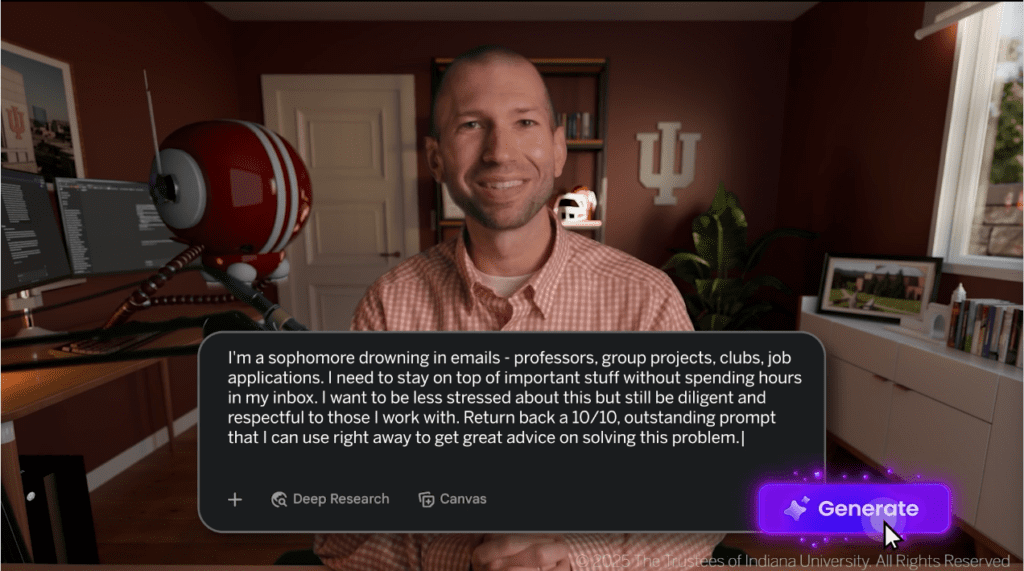
Brian Williams, an accounting professor at Indiana University’s Kelley School of Business, records a lesson for GenAI 101 alongside Crimson, an animated AI co-teacher designed to model how students can question, challenge, and learn from generative AI in real time.
Brian Williams teaches directly to the camera, sitting at a desk, wearing a red-and-white button down emblazoned with Indiana University’s iconic Trident. This particular lesson is all about using AI as your personal prompt coach.
His teaching partner interjects: “Brian, I’ve been watching you bootstrap prompts, and I have an idea. What if instead of just improving prompts, I could do even more?”
Williams swivels his chair to answer his partner directly. “Exactly right, Crimson. And here’s something that blew my mind when I first started: You can actually use AI to learn how to talk to AI.”
And with that, his teaching partner does a loopty-loop somersault mid-air, disappears behind Williams’ chair, and peaks shyly out the other side. It then floats up to the side window, seemingly to stare out into the void.
For some students logging into IU’s new GenAI 101 course, the interaction is mostly cutesy engagement. For others, it’s a demonstration of how AI is neither a theoretical abstract nor a black box regurgitating outputs with little rhyme or reason. It is something you can talk to, question, challenge, and learn alongside.
“We often hear that AI will replace professors,” says Williams, an accounting professor at IU’s Kelley School of Business and a Poets&Quants Best Undergraduate Professor of 2024.
“I decided to make it a co-teacher instead.”
THE LARGEST GENAi COURSE IN HIGHER ED?

Brian Williams, accounting professor and chair of Kelley’s new Virtual Advance Business Technologies Department
Since launching in August, GenAI 101 has reached nearly 107,000 enrolled learners across nine IU departments and campuses, making it perhaps the largest generative AI course in higher education, says Williams. It was originally intended as a required course to welcome freshmen to campus, but soon expanded to faculty and staff.
As word got out, alumni started calling and wanted to take the course themselves. It is now available, free of charge, to IU’s more than 805,000 alumni worldwide.
Williams developed the course at the direction of IU President Pamela Whitten who wanted a practical, workforce-focused generative AI course that could be deployed quickly and broadly. While curriculum approval in higher education usually moves at a glacial pace, Williams launched the course in 66 days.
Notably, the course was built and deployed by the Kelley School of Business rather than a computer science unit, reflecting IU’s view of generative AI as a core professional skill, not a niche technical specialty.
“Employers were coming to IU – including the president’s office and the provost’s office – and saying, ‘Your students need these skills or we will not hire them,’” says Williams, chair of Kelley’s new Virtual Advance Business Technologies Department.
MEET CRIMSON, THE AI CO-TEACHER
GenAI 101 looks more like a polished YouTube series than an online business course with professors lecturing from PowerPoint slides. That’s by design.
The course consists of 31 videos, each about seven minutes long. Students move from knowing nothing about generative AI to building their own AI assistant in roughly three and a half hours of course work. They learn how prompts work, why context matters, and how models trained on human data can get things wrong.
“There’s no theory,” Williams says. “It’s very much, you will learn this skill in this video.”

Crimson, AI co-teacher
Crimson – the Pixar-esque character vaguely resembling a Hoosier’s helmet with retractable robot arms – floats through the course as Williams’ on-screen co-teacher. The idea for an AI co-host came from a brainstorming session with Jellison Studios, Kelley’s internal production facility. The team wanted a course that would be more engaging for learners used to short, highly-produced content, while also clearly demonstrating AI skills they can immediately try for work, school, or everyday lives.
Because Crimson is an animated character to represent an AI chatbot, Williams actually scripts their actual interactions. When he swivels his chair to smile at Crimson or laugh at his jokes, that is Williams deploying his newly acquired acting chops.
“It took some practice to know how far to turn and all that. Some of the early videos especially took many takes,” Williams says. “It’s not something I expected to be doing as an accounting professor, but like anything, it’s a skill. So I got better at it as time went on.”
Throughout the course, Williams scripts Crimson to make mistakes, hallucinate, and offer confident answers that are wrong – just like any AI chatbot.
That’s actually crucial, he says. One of his big concerns is how casually students use AI without questioning its output. How many students are just taking homework problems and plugging them into ChatGPT to get answers?
Williams and his team also trained a separate AI tutor, dubbed Crimson Junior, on the course transcripts. It functions as a 24/7 teaching assistant, available to every learner to answer questions, walk through concepts, or help troubleshoot prompts.
For Williams, it’s a glimpse of how business schools can scale personalization and engagement without losing the human element. The professor still designs the course, sets the standards, and models critical thinking. AI simply extends that presence to thousands of learners at once.
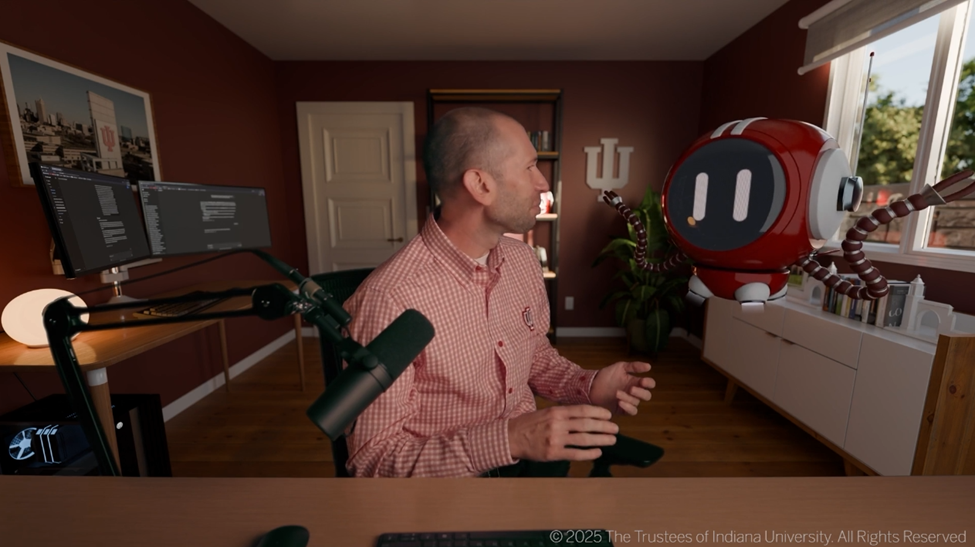
A still from a GenAI 101 lesson shows Brian Williams of Indiana University’s Kelley School of Business interacting on camera with Crimson, an animated AI co-teacher whose scripted dialogue requires careful timing and performance.
AI GOOD? BAD? NEUTRAL?
As chair of Kelley’s Virtual Advanced Business Technologies Department, Williams leads about 75 faculty from every department across the business school. Kelley created the new academic department last year to accelerate innovation in teaching and research focused on advanced technologies, particularly AI.
The department is intentionally interdisciplinary, cutting across traditional silos and taking a whole-of-school approach to emerging technologies. The department has grown into one of the largest organizational units within Kelley.
It’s also working through some of the pricklier questions about the still-emerging tech. Williams understands there are real problems with AI. Think copyright violations, environmental costs, and the mass production of AI slop. He pushes back on uncritical AI enthusiasm.
He also pushes back on blanket resistance.
One of the most compelling ethical arguments in favor of AI he’s encountered came from an interview Williams did with CEO of Cook Medical, a minimally invasive device company based in Indianapolis. The company can trace recent breakthroughs in medical devices directly to AI. It has saved lives, the CEO said.
“For him, it’s unethical not to use AI,” Williams says.
There’s also the fear that AI will automate its users out of the very jobs it’s now making more productive. Executives certainly would like to automate jobs, and it’s never fun telling workers they need to just change their skills when it happens to them.
But, at the same time, AI is creating new jobs like AI systems architects, AI transformation teams, and dedicated internal groups focused on rethinking operations.
“Even at Kelley, we’re hiring multiple people into brand-new positions called the AI Corps. Their only role is to help us advance what we’re doing with AI,” Williams says. “Students who know how to do AI are getting really outstanding job offers. The ones who don’t are having a harder time.”
CRIMSON 2.0?
Williams is already developing a GenAI 201 course that will be required for Kelley undergraduates. It will build on the AI fundamentals while diving into business-specific applications, from ROI calculations to AI governance to organizational design. Other schools at IU plan to use the framework to build their own advanced courses.
While he doesn’t interact with students in GenAI 101 like he would in a regular classroom, Williams has learned a lot from students through end-of-module assessments. He’s surprised and delighted to see how English, biology, and education majors, for example, use AI in ways he would have never considered.
“Some students are using prompts to solve roommate disputes,” Williams says. “Others are using it to choose between internships.”
Upon completion, students earn digital badges they can post to Linkedin and list on their resumes. They also like that the class appears on their official transcripts, an immediate signal to prospective employers.
Employers notice too. Several companies have asked about offering the course to their existing employees.
“The most frequent feedback we’ve gotten is when is the next one?” Williams says.
DON’T MISS: INDIANA KELLEY HAS PUBLISHED AN ‘AI PLAYBOOK’ AND POETS&QUANTS’ RANKING OF THE BEST ONLINE MBA PROGRAMS OF 2026
The post Meet Crimson, Indiana Kelley’s AI Co-Teacher For The Largest GenAI Course In Higher Ed appeared first on Poets&Quants.