
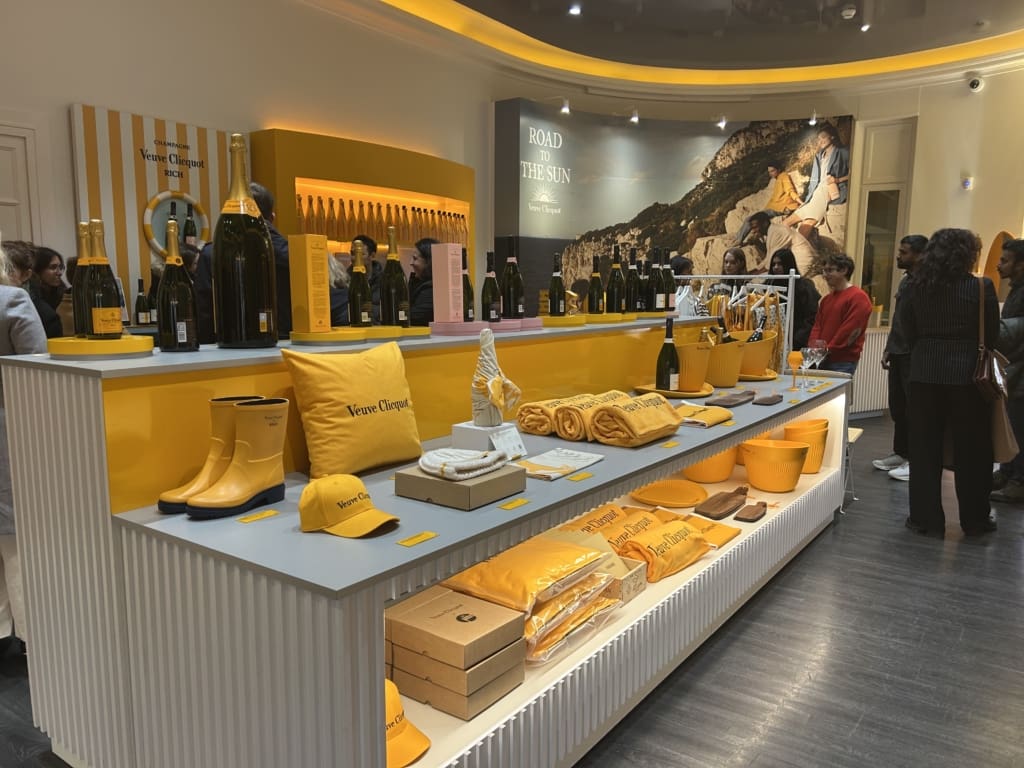
Branded merchandise and bottles in Maison Veuve Clicquot’s signature yellow fill the retail space in Reims, where NEOMA Business School MSc Wine & Gastronomy students began an evening visit focused on heritage branding and luxury positioning.
When descending to the cellars beneath Maison Veuve Clicquot, best to mind the stairs. They are steep and there are many. No telling how long you’d tumble after one misguided step.
On this night, a group of NEOMA Business School students grip the handrail as they make their way slowly down into the ancient Roman chalk mines, carved from the same soft, powdery limestone that makes France’s Champagne region a genericization for sparkling wines around the world. The darkness, constant humidity, and stillness allow Champagne to age with consistency year after year, a tour guide tells them.
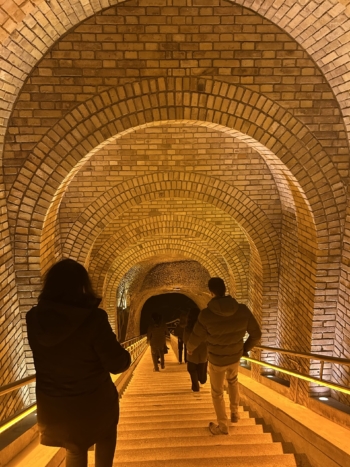
NEOMA students descend into the chalk cellars Maison Veuve Clicquot where Champagne ages at a constant temperature and humidity.
Speaking of guides, best to mind them as well. The crayères under Maison Veuve Clicquot extend for 35 miles, an interconnected maze lined with hundreds of dust-caked bottles linking several other major Champagne houses in Reims. They are so vast, in fact, they were used as a school, hospital, and church during World War I, sheltering thousands of French civilians from bombardment. You can still see names, dates, Red Cross insignias, and doodles carved into the soft limestone. Lose the guide and you’re almost certain to lose yourself.
This is not a casual tour. The students, who will end their walk with a tasting from Veuve Clicquot’s iconic Yellow Labe, are here to understand how a legacy brand balances tradition with innovation at scale.
For a rigorous business degree, there are worse lessons to learn.
“Tasting is a good example of how learning works. You can learn a lot of theory, but if you don’t do the practical part, you do not get the full lesson,” Romane Truffert, MSc Wine & Gastronomy student and Veuve Clicquot scholar at NEOMA Business School.
“I’m honestly shocked by how much my palate has developed. I can put names to certain things now. For example, because of the WSET certification, we can identify which method was used to create certain aromas, like the malolactic method that gives that Greek yogurt note. I couldn’t do that two months ago.”
‘TASTE AND TELL’
Launched in 2020, NEOMA’s MSc Wine & Gastronomy was built to translate Neoma’s long-standing Champagne expertise into a graduate program with real market relevance, says Nathalie Spielmann, a marketing professor and the program’s director. It is structured to immerse students in the business realities of wine and food, not just their romance.
“Can you really sell food and wine without understanding geopolitics? Probably not. Trade policies and tariffs matter,” Spielmann says.
“Can you price a product if you don’t understand accounting? Can you understand a market if you haven’t learned statistics or how to commission market research? That also means food economics, the circular economy, and sustainability.”
This is not a culinary degree, nor a sommelier track. It is a full-time business program, taught in English, grounded in strategy, marketing, finance, and operations. It runs 15 months, with an optional two-year track for students entering through an international pre-master. It culminates in a mandatory internship, a standard feature of French MSc degrees.

A Veuve Clicquot guide leads NEOMA Business School MSc Wine & Gastronomy students through the chalk cellars beneath Maison Veuve Clicquot, where barrels, bottles, and storage racks underscore the scale of Champagne production. Carved by the Romans nearly 2,000 years ago, the caves now serve as the house’s aging cellars.
Nearly 100% of graduates find jobs within six months of graduation, about a quarter work abroad, and the average gross starting salary is €40,500, competitive figures for a specialized master’s tied to a niche global industry.
Throughout the program, wine and gastronomy are treated as interconnected businesses shaped by regulation, geopolitics, sustainability, branding, finance, and consumer behavior. The first semester leans heavily on business fundamentals. The second shifts decisively toward practice, with many courses taught by Champagne house executives, luxury food and beverage leaders, and industry veterans.
One distinctive feature is what Spielmann calls “Taste & Tell” conferences, which bring industry professionals into the classroom to present real business challenges. In one session, students spoke with a foie gras producer about confronting ethical perceptions of the delicacy. In another, they examined how a whiskey brand produced in the French Alps found its market. Each discussion is paired with tasting — not as spectacle, but as analysis.
“What I want them to come in and do is present a problem and then how they overcame it, and then have the students taste whatever it is that they make,” Spielmann says.

Rows of aging bottles sit beneath a sign marking a vintage in the Veuve Clicquot cellars, where students studied how heritage brands preserve consistency across generations.
ASSIGNMENT: SIPPING CHAMPAGNE FROM A TULIP GLASS
Siri St. Louis stands with two classmates, holding her stemmed glass at eye level. Veuve Clicquot recommends a tulip glass which, unlike the narrow flute, gives the Champagne room to open, letting aromas rise along with the bubbles. The tulip shape reveals a steady stream of fine bubbles rising from a single point at the base, traveling through the widest part of the bowl before narrowing at the rim.
A U.S. student from Minnesota, St. Louis majored in French as an undergraduate and spent time bartending after graduation. Her mentor told her that she should take some wine courses. She took an introductory WSET course and ended up loving it.
That experience sent her searching for graduate programs that blended business training with wine expertise, ideally in France. NEOMA stood out for its business school framework with deep industry immersion, capped by a mandatory, paid internship.
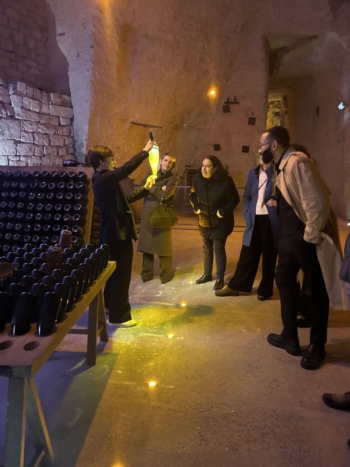
A Veuve Clicquot guide explains riddling and bottle aging during a guided walk through the underground cellars carved from Roman-era chalk mines.
St. Louis plans to stay in Europe for her internship, with an eye toward imports, exports, and distribution — and possibly wine education down the line. For now, she is focused on absorbing how brands like Veuve Clicquot operate behind the scenes, translating centuries of heritage into modern business decisions.
NEOMA designed the program to ensure graduates can operate comfortably inside companies, while also understanding what makes wine and gastronomy different from any other consumer sector.
That’s where the sensory and cultural components like this tour come in. Students study food anthropology and sociology to understand why people eat and drink the way they do. They learn how terroir shapes branding and how sensory marketing influences perception and value.
Alongside coursework, students can pursue professional certifications such as Wine & Spirit Education Trust (WSET) Level 2 or Level 3 credentials and a Champagne MOOC. Much of the learning also happens peer to peer. Classmates organize tastings, lead sessions on olive oil or rum pairings, and share daily wine slides with one another.
Program alumni work as brand ambassadors, product and brand managers, commercial and sales directors. Some hold positions with regulatory bodies or are pursuing entrepreneurial ventures of their own.
THE PROXIMITY ADVANTAGE
Aishwarya Yadav came to France from India, intending to pursue luxury marketing after earning a bachelor’s degree in digital marketing. She discovered French culture of wine and cheese, and wanted to do something in that vein.
After pivoting to the MSc Wine & Gastronomy program, she’s considering roles in spirits, food pairing, and the possibility of entrepreneurship, a future she hadn’t imagined before experiencing the industry up close.
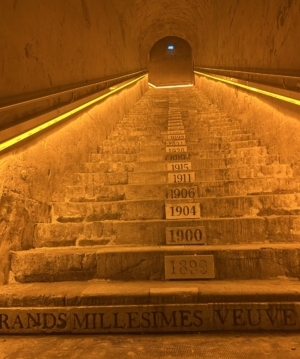
The staircase etched with vintage years leads up from crayères, visually mapping more than a century of Champagne production below ground.
“Several alumni come in and tell us about the businesses they’re working in now. We also have a new alumni network that makes it easier to talk with people working in the field,” Yadav says. “And being in Reims helps a lot. Champagne is right here, so you can a very real understanding of the industry.”
Yadav – along with St. Louis and Ramone – are recipients of the Veuve Clicquot scholarship, a program meant to expand access to a sector that has traditionally been shaped by privilege and proximity. Open to women enrolled at NEOMA Business School, in any program, the scholarship covers full tuition and provides monthly support for living expenses, along with mentorship from senior executives at the Champagne house.
For Truffert, the French student who came through the country’s demanding preparatory class system, knew early on that business school was the right path. Discovering that NEOMA offered a specialized MSc in wine and gastronomy was only part of the equation. Being able to attend it was another. The Veuve Clicquot scholarship didn’t just make the program accessible, she says, it sharpened her ambition.
She sees her future in consulting, helping hospitality businesses grow and adapt. Maybe she’ll own something of her own one day.
“I want to help people open their restaurant, their pop-up stores, anything that involves people eating and drinking,” Truffert says. “I feel it brings people together.”
DON’T MISS: BOOKS FOR MBAS: WHARTON’S JERRY WIND ON CREATIVITY, LEADERSHIP, AND THE AGE OF AI AND 2025 BUSINESS SCHOOL RANKINGS: THE COMPLETE COLLECTION
The post This French Degree Program Turns Champagne Cellars Into Classrooms appeared first on Poets&Quants.