

Ya-Ru Chen, Nicholas H. Noyes professor of management and former dean for China Initiatives at the Cornell SC Johnson College of Business, shares a laugh with Chinese students at a welcoming event for participants in the Cornell-Tsinghua Finance MBA program in 2018. Jonathan Miller photo
For Cornell University, engagement with China is not a recent experiment or a tactical response to global market shifts. It is, as Andrew Karolyi sees it, part of the institution’s DNA.
Over the past several years, shifting geopolitics, regulatory scrutiny, reputational risk, and the rise in reputation of China’s own business schools have led a number of U.S. universities and B-schools to quietly scale back China-focused initiatives, pause new partnerships, or rethink the role of in-country programs altogether. Some have closed China centers or redirected global strategy toward other regions. Against that backdrop, Cornell’s decision to maintain — and deepen — two dual-degree graduate programs in China stands out.
Karolyi, dean of Cornell’s SC Johnson College of Business, likes to remind colleagues that Cornell was among the first U.S. universities to teach Chinese language courses, dating back to the 1870s. Cornell’s first Chinese graduate, Ruby Sia, earned his degree in 1910; another of its earliest Chinese alumni, Hu Shih, graduated in 1914 and later became a leading intellectual force behind modern Chinese liberalism and language reform.
“Whether it’s languages or engineering or agriculture or business, Cornell and China have ties that bind,” Karolyi tells Poets&Quants. “This was never tactical or opportunistic. It’s core to who we are.”
FROM ORIGIN STORY TO INSTITUTIONAL COMMITMENT

Cornell’s Ya-Ru Chen: “Our goal is to educate – to teach people how to run a business, how to lead, how to communicate with diverse others, and how to think critically. If that is what we do, I can’t imagine anyone, anywhere, opposing it”
That long view helps explain why Cornell today operates the two dual-degree graduate programs in China – a Finance MBA with Tsinghua University’s PBC School of Finance in Beijing, and a hospitality- and services-focused MMH/MBA with Peking University’s Guanghua School of Management – at a time when many U.S. institutions are reassessing, or retreating from, academic partnerships in the region.
The foundation for both programs was laid by Ya-Ru Chen, the Nicholas H. Noyes professor of management, who recently returned to the Cornell Johnson faculty after eight years as dean of China Initiatives. Chen was the architect and driving force behind Cornell’s China strategy, beginning with early discussions in 2012 that led to the launch of the Cornell-Tsinghua Finance MBA in May 2015, followed by the Cornell-Peking dual degree in 2021.
Chen’s core belief was simple but unconventional: Instead of leading with physical “centers” in China, Cornell would commit institutionally through full degree programs, built with elite partners and grounded in academic parity. Teaching would be bilingual. Faculty on both sides would teach in their native languages. Students would be expected to operate fluently in both Chinese and English.
“We stick to our lane,” Chen told Poets&Quants in a 2023 interview. “We are educators. Our goal is to educate the next generation of leaders with a global perspective.”
That philosophy now defines both programs, according to Cornell’s current leadership.
“The goals for both dual-degree programs,” Karolyi says, “were to have global impact through our research and teaching innovations. And to render that relevance where it can have great impact – among future management leaders based in greater China.”
THE FINANCE MBA TODAY – STEADY SCALE, SHIFTING CAREERS

Cornell’s Andrew Karolyi:
Nearly a decade after its launch, the Cornell-Tsinghua Dual-Degree Finance MBA has matured into a stable, post-pandemic program with consistent demand and a clearly defined market niche.
The most recent entering cohort, the FMBA Class of 2027, enrolled 81 students, with two additional admits deferring to the following year. The program’s target intake remains about 120 students once the current admissions cycle is completed. Women now make up 50.6% of enrolled students.
Vishal Gaur, dean of the Johnson Graduate School of Management, says the long-term trajectory matters more than any single year.
“We started with about 40 students in a cohort and grew steadily,” Gaur tells P&Q. “Now we typically range between 90 and 110 students a year. There was a dip last year due to a change in admissions policy in China, but that was a short hiccup.”
Career outcomes have evolved alongside China’s capital markets. Early cohorts were dominated by professionals moving from finance roles back into finance. Today, Gaur says, graduates are increasingly headed into venture capital, private equity, and tech-driven investment roles, often with cross-border dimensions centered in Hong Kong.
“That shift reflects the evolution of demand,” he says. “The market has changed, and the program has changed with it.”
WHY THE MODEL WORKS
Asked what Cornell got right, Gaur points to three factors. First, partner alignment. Tsinghua’s PBC School of Finance brought deep technical expertise, while Cornell contributed general management depth and global perspective. Second, governance. A joint program committee, staffed by faculty from both institutions, oversees everything from admissions to graduation. Third, faculty commitment.
“When our faculty travel to China to teach, they also do research, visit companies, and learn how markets are evolving,” Gaur says. “That engagement feeds directly back into our teaching.”
Karolyi underscores another point: Cornell was never chasing scale for its own sake.
“We are not pursuing size for the sake of size,” he says. “Excellence comes first. Doubling the size of a program has never been our aspiration.”
A VERY DIFFERENT KIND OF HOSPITALITY DEGREE
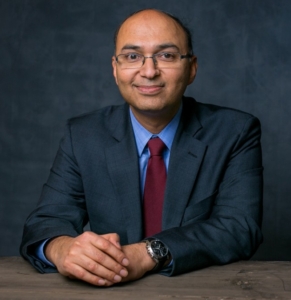
Cornell’s Vishal Gaur: “When our faculty travel to China to teach, they also do research, visit companies, and learn how markets are evolving. That engagement feeds directly back into our teaching”
If the FMBA reflects China’s evolving financial landscape, the Cornell-Peking MMH/MBA tells a different story altogether.
Launched in 2021 during the pandemic, the program is now in its fifth year, with cohorts typically in the 50-to-60-student range. Kate Walsh, dean of Cornell’s Nolan School of Hotel Administration, says the student profile has been more surprising than anyone expected.
“We originally envisioned hospitality leaders and some family-business executives,” Walsh tells P&Q. “What we found instead were physicians, lawyers, scientists, and entrepreneurs.”
Roughly a quarter of students are entrepreneurs, many running tech, manufacturing, or services businesses. Few are pivoting directly into hospitality. Instead, they are seeking service-based frameworks – customer experience, operations, leadership – to enhance the work they already do.
“They want to learn service concepts that help them innovate in their businesses,” Walsh says. “And they bring pressures and perspectives that make us better researchers and instructors in return.”
WHY PARTNERSHIP MATTERS
Like the FMBA, the Cornell–Peking program rests on what Karolyi calls a distinctly Cornell instinct – partnership over greenfield expansion.
“We never seriously considered doing this without elite partners,” he says. “The idea that one plus one can be more than two is fundamental to how we approach these collaborations.”
Walsh describes Peking University’s Guanghua School of Management as a natural match, citing its intellectual openness and focus on broad societal questions. “It married beautifully with Cornell’s ‘any person, any study’ tradition,” she says.
ALUMNI, NETWORK EFFECTS, AND A SHARED ECOSYSTEM

Cornell’s Kate Walsh: “Through ebbs and flows, Cornell’s belief in global impact has never wavered”
One of the most visible signs of maturity, Cornell leaders say, is what has emerged around the programs rather than within them.
Cornell has established a Greater China Dean’s Alumni Council to connect graduates of both dual-degree programs. Annual China Business Forums bring alumni together for panels, keynotes, and industry engagement, strengthening ties across finance, services, and entrepreneurship.
“These alumni don’t just identify with their individual programs,” Karolyi says. “The common bond is Cornell.”
The exchange runs both ways. Students travel to Ithaca and New York City for residential sessions, interacting with Cornell’s full-time MBA population and alumni they might never otherwise access. Those encounters, Gaur notes, deepen the global perspective of Cornell’s U.S.-based students as well.
WHAT COMES NEXT – DEEPER, NOT BIGGER
Looking ahead five years, Cornell’s leaders are cautious about predicting expansion – and deliberate about what they rule out.
None expect to add additional dual-degree programs in China. None see rapid growth in cohort size as a goal. Instead, the emphasis is on deepening engagement.
“The success of these programs has raised our share of voice in China and across Asia,” Karolyi says. “That’s opened doors to new ideas, particularly in custom executive education and industry-driven initiatives.”
Walsh describes that commitment as unwavering. “Through ebbs and flows, Cornell’s belief in global impact has never wavered,” she says.
For Gaur, the opportunity lies in learning as much as teaching. “Even without growing the programs, there’s so much for us to understand about China’s markets, industries, and alumni trajectories,” he says.
For Ya-Ru Chen, who has now returned to the Cornell Johnson faculty after eight years as dean of China Initiatives, the purpose of the work has not changed – and will not. “We are in the education business,” she told P&Q in 2023. “Our goal is to educate – to teach people how to run a business, how to lead, how to communicate with diverse others, and how to think critically. If that is what we do, I can’t imagine anyone, anywhere, opposing it.”
DON’T MISS MEET CORNELL JOHNSON’S MBA CLASS OF 2027
The post With 2 Pioneering Programs, Cornell Takes A Different Path In China Than Most U.S. B-Schools appeared first on Poets&Quants.