
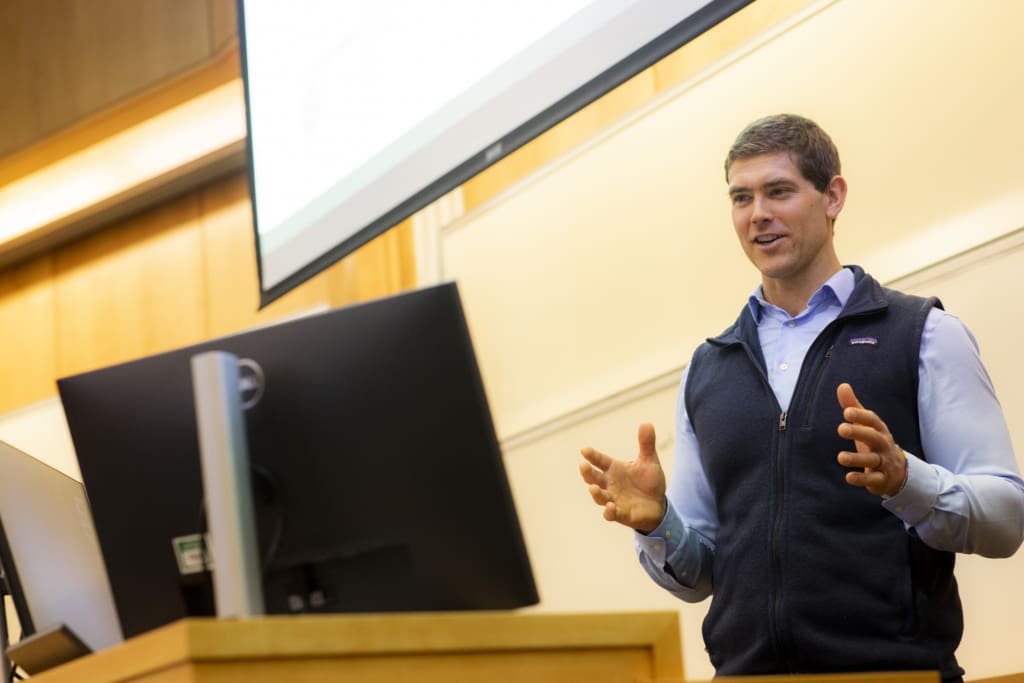
Andy Kaestle, Tuck MBA ’17 and now a career adviser and lecturer at the Tuck School of Business, leads a virtual session during Tuck’s inaugural Consulting Bootcamp in January.
When Lily Aspen started thinking about consulting as a career, she didn’t know where to begin. The psychology major – with minors in Native American & Indigenous Studies and Human-Centered Design – had little to no exposure to consulting’s famously grueling recruitment process. She didn’t really know what a case interview was, much less how to prepare for one.
Then Aspen, a junior at Dartmouth College, spotted a flyer for the Tuck Consulting Bootcamp, an intensive, skill-based program designed to help undergraduates and recent graduates prepare for one of the most competitive recruiting paths in business.
It seemed to be just what she was looking for.
“A moment that noticeably improved my understanding of case interviews was during the alumni breakout session, where (a Tuck alum) guided me and another participant through a case. The step-by-step guidance helped me become more comfortable,” says Aspen, who plans to pursue a PhD in psychology or sociology and eventually work in social impact consulting.

Lily Aspen, Dartmouth College, Class of 2027
“Interacting with alumni who are not much older than me but work in consulting helped me overcome my fear that working in consulting is unattainable.”
FILLING THE CONSULTING PREP GAP
Aspen was among the inaugural 40-student cohort to complete Tuck’s new bootcamp in January. While consulting remains a popular career path for undergraduates no matter their major, it is also one of the most selective. Students without a business background often have limited access to the kind of preparation needed to compete.
Dartmouth College’s Tuck School of Business doesn’t offer an undergraduate business degree or minor per se, but it has built a robust suite of programs for non-business students. Its flagship undergrad offering, the Tuck Business Bridge program, has introduced core business fundamentals to undergraduates for nearly three decades.
Bridge is a certificate program designed to connect the education of liberal arts and STEM students with the career skills typically developed in a business degree. The intensive three-week curriculum is adapted from Tuck’s MBA program and taught by its faculty. Offered four times a year, Bridge draws students from Dartmouth as well as roughly 100 universities across the country.
Each year, large numbers of Bridge students express a strong interest in consulting, wishing they could go deeper.
“While Bridge provides a really good, strong foundation in core business concepts and experiential learning, there just is not time within Bridge to go into the level of depth required to prepare students specifically for consulting,” says Lisa Tedeschi, Tuck’s assistant dean of undergraduate education.
The consulting bootcamp was designed to fill that gap. It is open to business and non-business majors alike, including students at Dartmouth and other universities, as well as recent graduates. The three-day virtual program focuses on the most challenging aspects of consulting recruiting, particularly case interviews, behavioral interviews, and networking.
THE TUCK CONSULTING DIFFERENTIATOR
For non-business students, consulting recruitment is unlike anything else they encounter – especially those grueling case interviews where candidates are expected to solve business problems in real time and with incomplete information. Students must structure their thinking, ask for the right data, and communicate clearly under pressure.
“Tuck felt uniquely positioned to provide an offering to these students, just given the consulting resources we have here,” says Andy Kaestle, career services director at Tuck. Tuck enrolls roughly 300 MBA students per class, about half of whom typically pursue consulting.
That includes Kaestle himself. After studying accounting and finance in undergrad, he joined Ernst & Young as a consultant. He chose Tuck for his own MBA based on its consulting recruitment chops and a desire to explore different industries and functions. He recruited to the MBB – an acronym for the Big Three in consulting, McKinsey & Company, Boston Consulting Group, and Bain & Company – and landed a summer internship at Bain.
Kaestle stayed with the firm for about four years before moving into a role in Tuck’s career services department, where he now helps students navigate the same recruiting process. He helped develop, lead, and even teach in the consulting bootcamp.
“The recruiting engine here at Tuck for consulting is awesome. It is a key reason why I was able to be successful in going through that process,” Kaestle says.
“We have many individuals who have gone through that process, worked in consulting, completed internships, that we were able to bring them in (to the bootcamp). The amount of energy and engagement, the quality of questions, just the willingness of the students to really lean in was honestly contagious.”
A THREE-DAY CRASH COURSE
The inaugural bootcamp brought together about 40 students from a range of schools, including Dartmouth, Cornell, University of Virginia, and Boston College. The program ran virtually over three full days, formally from 10 a.m. to 5 p.m., but sessions often stretched to 6 p.m. as students asked more and more questions.
Each day was designed with a mix of large group instruction and small-group breakouts. Students learned structured frameworks for breaking down business problems, analyzing data, and working through case math, then applied those tools in live practice sessions with Tuck alumni and MBAs. This gave students direct feedback on how they think, communicate, and interact during cases.

Hunter Howard, Hamilton College, Class of 2027
The bootcamp also covered behavioral interviews and resume preparation, helping students craft personal stories and position their experiences in ways that align with what consulting firms value. Each participant received access to a prep platform and was encouraged to continue practicing with each other after the program. Many connected on LinkedIn and formed ongoing case practice groups.
Hunter Howard, a junior at Hamilton College majoring in economics and philosophy, went through Tuck’s Bridge Program over the summer. He hopes to work in global strategy consulting after graduated, and wanted the more targeted consulting practice offered through the bootcamp.
“The most intimidating part of the consulting recruiting process is getting from an application to an interview. Bootcamp faculty went over how to stand out on your application, both through networking and resume, but also in being memorable in conversations,” he says.
The bootcamp helped him sharpen how he presents himself and how he approaches problems. He polished his skills on structured, creative brainstorming while learning to apply judgment and “sense checks” on those ideas.
“A concrete skill I have already begun putting into practice is how to request data. Not simply fishing for such, but having an objective by stating what I want to look at, expressing why I need the data to continue developing my hypothesis, and giving an example of what insights I might gain from such,” he says.
“I learned I can show the interviewer I am making self-checks, being internally analytical, rather than solely interacting with the case materials.”
NEXT CONSULTING BOOTCAMP
Tuck now envisions the consulting bootcamp as an annual offering, with the next session planned for January. If demand grows, they may offer a second session, while keeping the cohort small enough to offer the individual feedback and coaching organizers believe is required.

Lisa Tedeschi, assistant dean of undergraduate programs
The school may also consider similar bootcamps for other career paths, depending on student demand.
“Our Bridge students ask about many other topics, but we just don’t have the time for all of them in the program,” says Tedeschi.
“There’s a clear opportunity to offer a focused, career-oriented boot camp for those interested in investment and asset management. Nothing is on the calendar yet, but we’ll be guided by what we hear from students coming through our programs.”
At the same time, Kaestle notes that the skills taught in the consulting bootcamp are increasingly relevant across industries, from tech to finance to corporate roles, where case-style interviews are becoming more common.
“What we’re teaching here is structured problem solving,” he says.
The next Tuck Consulting Bootcamp will be January 11-15, 2027. Cost is $1,650, and applications will open this fall. The program is open to current college students from any university (sophomores and higher classes) as well as recent graduates (Classes of 2024-2026). Registration on a first-come, first-served basis. Check the program page for more information and registration updates.
DON’T MISS: POETS&QUANTS’ BEST UNDERGRADUATE BUSINESS SCHOOLS OF 2026 AND IU KELLEY STUDENTS RAISE $7.8M FUND, SCALING NATION’S LARGEST UNDERGRADUATE REAL ESTATE PE PLATFORM
The post Tuck’s Consulting Bootcamp Gives Undergrads A Competitive Edge In Recruiting appeared first on Poets&Quants.