
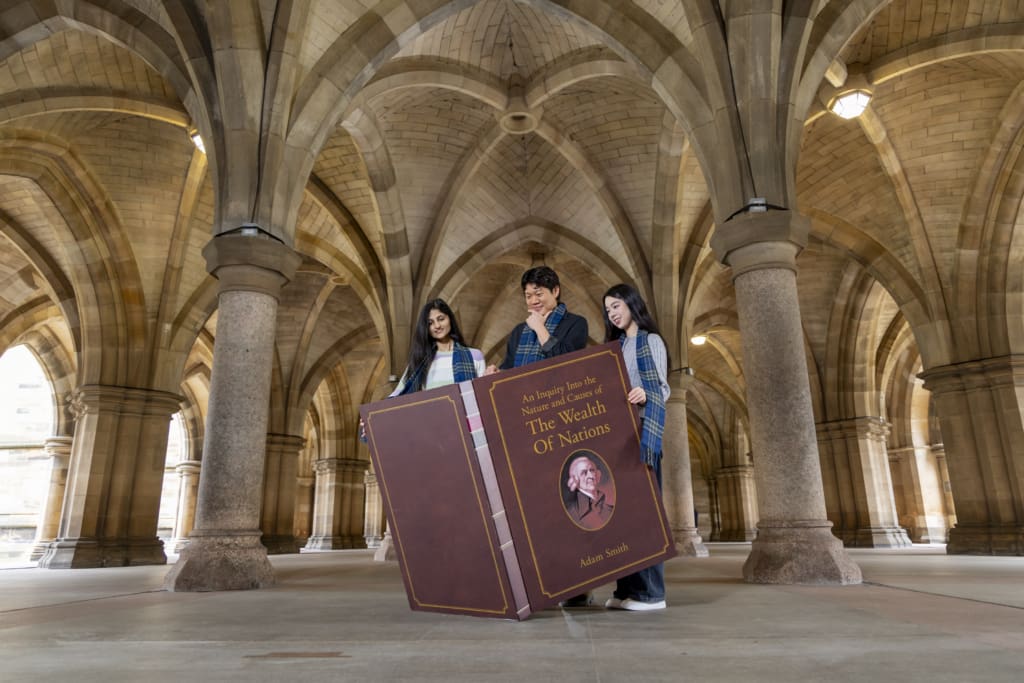
University of Glasgow Adam Smith Business School students pose with an oversized “The Wealth of Nations” book, written by Adam Smith, the “father of economics” and namesake of the university’s business school. 2026 is the 250th anniversary of the book. Photograph by Martin Shields
Wendy Loretto has been appointed the new head of the University of Glasgow Adam Smith Business School in Scotland.
Loretto, former dean of the University of Edinburgh Business School, officially begins the role on April 20, a moment of mounting pressure — and opportunity — for management education in the United Kingdom and beyond.
Loretto served as dean in Edinburgh from 2017 to 2024 and spent years in senior leadership roles, including deputy dean, director of research, and director of undergraduate programs. A professor of organizational behavior, she has built an international reputation for her research on work, aging, and employment, with a particular focus on mid- to later-life careers and the intersection of gender, health, and labor markets.
Her appointment comes as UK higher education faces tightening immigration policies, shifting international student demand, and growing questions about the value and delivery of management education. Loretto, who also chairs the Association of MBAs and the Business Graduates Association, brings a global vantage point shaped by accreditation work, employer engagement, and close observation of business schools across markets.
Q&A WITH WENDY LORETTO
Named after the “Father of Modern Economics” and a University of Glasgow alumnus, Adam Smith is among the top 1% of business schools worldwide to hold triple accreditation from AACSB, AMBA, and EQUIS.
While the University of Glasgow is one of Scotland’s four ancient universities, founded in 1451, he business school itself is just 40 years old, officially established in 1986. Throughout 2026, tThe university will celebrate the 250th anniversary of Smith’s seminal work, “The Wealth of Nations,” first published in 1776.
Loretto tells Poets&Quants that she was drawn to the school’s ambition to raise its international profile and what she describes as a young, energetic leadership team. She sees an opportunity to help shape the next phase of the school’s evolution focused on global visibility, interdisciplinary research, and deeper engagement with industry.
All of it unfolds against a backdrop of rapid technological change, rising geopolitical pressures, and renewed scrutiny of what business schools should deliver. In this conversation, Loretto talks with P&Q about the pressures facing UK management education, her early goals for Adam Smith, and how business schools must adapt in the age of AI. Our conversation has been edited for length and clarity.
Why don’t we start with your professional introduction and what brought you to Adam Smith? Can you walk me through your progression?

Wendy Loretto, new head of University of Glasgow Adam Smith Business School in Scotland
I’ve been at the University of Edinburgh for a long number of years and have taken on various management roles, including serving as Dean of the Business School there for eight years, from 2016 to 2024. I thoroughly enjoyed being in a business school and wasn’t necessarily looking for another deanship.
However, what really attracted me to Adam Smith was the fact that it had been through quite a strategic overhaul and has real ambition as a school. It has always had impressive talent, but particularly at the moment, I think there is some really strong capability. The combination of talent and ambition—especially in what is a very challenging climate—stood out, along with a genuine motivation and enthusiasm.
For me, one of the things that really resonated is that it’s a relatively young team in terms of the school leadership and where they are in their academic careers. The opportunity to work with them, to help shape the school they want to build, and to develop the next generation of leaders, both within the school and beyond, was very attractive.
Speaking of those challenging times, can you lay out the current climate for management education in the UK and what you see as the main challenges facing the sector as a whole?
I think within the UK, the biggest challenge comes from the quite significant and rapid drop in the number of overseas students wanting to pursue postgraduate education—mainly master’s degrees. Many universities, and arguably the whole UK higher education sector, had grown on the assumption that this was a largely unlimited market and would continue to be attractive.
I think it is still academically attractive, both in terms of the quality of programs and the overall experience students have when they come to the UK. But we’ve been hit with a succession of challenges. Some of these are geopolitical and are shared with other countries, including the U.S. But within the UK, the government has also taken steps to curtail the number of student visas and limit opportunities for post-study employment.
The UK is one of the very few countries that includes student numbers in immigration figures. By using measures to reduce those numbers, it allows the government to say it is cutting immigration. But, of course, most students come, study, and then leave again. Some may stay for a period to gain work experience, but they typically return to their home countries and reinvest what they’ve learned.
So it’s a difficult position for UK higher education. Institutions are trying to operate within increasingly constrained parameters, while also fundamentally disagreeing with many of the policies that have been introduced.
Do you have a sense of the scale of the impact, either at Adam Smith or more generally across the sector?
There’s an association called the Chartered Association of Business Schools in the UK—CABS—and they did a piece of work a few years ago. The figures still broadly hold true: about a third of all international students in the UK are studying business. So business has always been a very attractive area for international students.
What we do know is that business and management—broadly including economics and finance—have held up better than some other disciplines. There is still a strong pool of international demand. What we’ve seen, though, is that the international market has become more diversified. A few years ago, recruitment may have been overrepresented by certain countries. Now, there’s been a shift toward greater diversification, which is a positive development.
Schools like Adam Smith are able to attract students from all over the world. Declines in some key markets—China being one of the main ones—have been offset by increased diversification. I think that’s been a really positive outcome for business education more broadly.
So I would say the business school sector is not necessarily the one suffering most. However, recruitment has become more challenging. For example, one of the government measures that particularly affected MBA programs was removing the ability for most students to bring spouses or family members. That option is still available for PhD students, but not for others. From work I did with colleagues at the time, about 40% of MBA students were bringing family members, largely due to their stage of life.
So while overall numbers may not have been dramatically affected, recruitment has become more difficult and the composition of cohorts has changed. I don’t have a specific figure for you, though there may be updated estimates from CABS. What I would emphasize is that business and management numbers are holding up, but it’s becoming more challenging to recruit while maintaining quality. At Adam Smith, we are very focused on not diluting quality and on continuing to diversify our international student base, which I think is a very good thing.
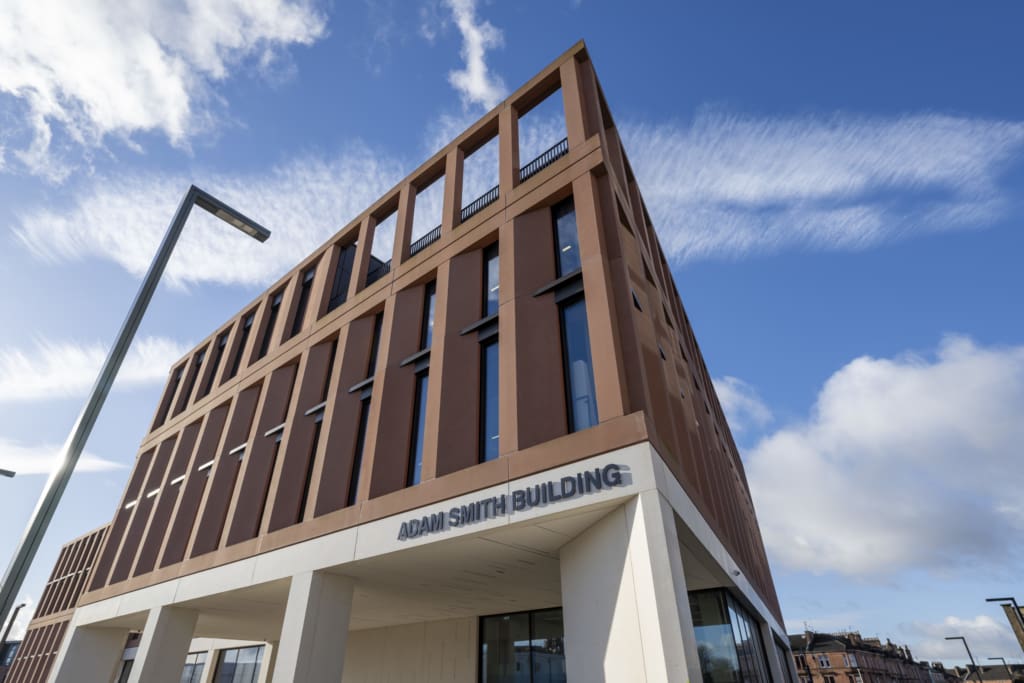
Exterior of the Adam Smith Building at University of Glasgow
Are you seeing more interest from American students in this climate who want to study at a UK business school?
I would say that during Trump’s first term, we saw a significant surge in interest from American students, and that hasn’t waned much since. I’m not sure how much additional impact there has been from a second term, but there is certainly continued interest.
What is your argument against the political restraints on immigration? What is the higher ed argument for why this may not be the right approach?
I think there are several arguments. The first is that these are not immigrants in the sense of permanent settlement. Students come, they contribute enormously to the economy, and then most leave. Their impact isn’t just on universities directly, but on the wider economy as well.
In Scotland, for example, the importance of universities to local economies is very clear. Take Dundee: it has transitioned from a declining port city into a much more vibrant center for tech, innovation, and higher education. Universities have played a central role in that regeneration. I think that’s true in many places, including Glasgow. International students contribute directly through their spending, but also through work while they study.
There are also important workforce contributions. I’ve done research in the care sector, particularly elderly care, and students—and in some cases their families—help support that sector, which often struggles to attract domestic workers. They also fill many of the more typical part-time roles in areas like hospitality. So their contribution is significant across multiple parts of the economy.
Beyond the economic case, there’s a broader, more intangible argument. What value do we place on fostering international understanding and global relationships? Higher education plays a key role in helping people engage with the world beyond their own national or local context. That global perspective is incredibly important.
You mentioned earlier that you weren’t necessarily looking for another deanship. What was it about Adam Smith Business School that changed your mind?
I would reiterate what I said earlier. I come from a research-intensive background, and Adam Smith is part of another research-intensive university. But what really stood out is that it’s not research for its own sake—it’s research that aims to make an impact beyond academia.
The context of Glasgow is also important. The Adam Smith Business School is deeply embedded in both the contemporary civic community of Glasgow and its surrounding region, while also drawing on its historical roots through Adam Smith and the Enlightenment. You see those values carried through: a commitment to collegiality, innovation, and sustainability. These may feel quite contemporary, but they really stem from Enlightenment thinking.
Having that strong historical foundation, while being equally—if not more—relevant to modern management education, is very powerful. That culture has also helped attract some very exciting intellectual talent among the faculty, both in terms of their research and their approach to teaching.
There’s a real energy that comes from that, and it makes the school a very attractive place to work.
What are some of your main goals coming into the role? Where would you like to position the school, and what are you hoping to work on?
I think Adam Smith Business School has been quietly doing a lot of excellent things for a long time. More recently, it has started to step onto the world stage, but I would really like to help push that further. I’m not talking narrowly about rankings, although we will consider them. It’s much more about strengthening a clear sense of distinctiveness—what Adam Smith Business School is known for.
That distinctiveness should come through across teaching, research, and wider engagement or impact. I want to help the school articulate and amplify that identity.
The previous dean worked with the school to develop a strong strategy with clear KPIs. My goal is not to come in and overhaul that, but to help deliver on it and push it further. In particular, raising the school’s profile internationally and strengthening its presence on the global stage is something I would really focus on.
What are some examples of how that can be achieved?
I think it comes through strengthening the school’s presence in areas like international partnerships and outreach beyond the immediate Glasgow campus, including transnational education opportunities. There’s also the role of research—building a hub that Adam Smith is known for, which attracts international interest from top researchers, whether through visiting positions, collaborations, or joint grant work.
Another important area is honing the distinctiveness of the program portfolio. The school offers strong programs at all levels, but it’s about asking: what is the “Glasgow flavor” that comes through in these? Business schools all need to deliver the fundamentals, but accreditation bodies increasingly ask where a school is truly distinctive.
So it’s about making the most of the university, the school, the city, and the people within them. That combination can help sharpen a clear identity across both teaching and research, and ultimately strengthen the school’s global positioning.

The 250th Anniversary of Adam Smith’s “The Wealth of Nations” will be celebrated across the university throughout 2026. celebrated by University of Glasgow. Photograph by Martin Shields
Are there any curriculum, course, or degree innovations you’re exploring, especially as management education looks to redefine itself in challenging times?
In some ways, it’s a little early for me to give a definitive answer, and I may come back to you with more detail. But my initial thinking is that there should be a strong emphasis on employability across both undergraduate and postgraduate programs.
That includes moving away from more traditional formats, like dissertations, toward more contemporary, project-based work—often involving real company clients and incorporating tools like AI. That shift is happening broadly across business education, so the key question is what the “Glasgow flavor” of that looks like.
I also think there is a significant opportunity in postgraduate economics. Traditionally, many programs have focused on training theoretical economists who go on to further academic study. But increasingly, there is a need for applied economics—programs that equip students to address real-world challenges. So I do expect innovation in that space, though we’re not yet at the stage of announcing specific programs.
Another major area is interdisciplinary collaboration. That goes beyond the disciplines within the business school to include the wider university. One of the strengths of Glasgow is the breadth of expertise across fields, including areas like health and population sciences, which are physically close and increasingly connected. The question is how to foster those collaborations in a meaningful way to address major global challenges.
That’s an area I have strong ambitions for going forward.
More broadly, how do you think business and management education in the UK—and globally—needs to update or adapt?
I don’t think there’s a simple answer to that. One thing I would say is that sometimes we get too carried away with trying to innovate and do something completely different, and we risk overlooking what really matters.
In my role as chair of the Association of MBAs and the Business Graduates Association, I’ve had the privilege of seeing what’s happening globally and reviewing research on what employers actually want. What comes through very clearly is the continued importance of so-called “old-fashioned” interpersonal skills. In fact, in the age of AI, these are becoming even more critical. Employers want graduates who can work in and manage teams, communicate effectively, and apply critical thinking. Those fundamentals remain essential, and I think that’s something Glasgow does very well.
So in terms of adapting, part of it is simply refocusing on what is truly important for employers and for students—both now and in the future—and not overlooking those core skills.
Beyond that, another major area is the form of education itself. There’s an ongoing debate, accelerated by AI, about the balance between face-to-face, online, and hybrid learning. Different markets may require different approaches, and institutions are still working out what that mix should look like.
Closely tied to that is the challenge of lifelong learning. There’s broad agreement that it’s important, but delivering it in a sustainable, commercially viable way is difficult. Many institutions have strong ideas, but turning those into durable programs—rather than initiatives that last a couple of years and fade—is still a challenge.
We’ve already seen shifts. For example, a few years ago there was a surge in fully online MBA programs, whereas now more hybrid formats are gaining traction. That can take many forms, from mostly online with limited in-person contact to more blended models. The key is building flexibility into program design so institutions can adapt as demand continues to evolve.
Do you currently offer an online MBA or other online programs?
No, we don’t at the moment. That’s something I want to look at very closely—both in terms of degree programs and in the executive education space.
On the degree side, that would mean credit-bearing programs, such as an online MBA. But I also think there’s real opportunity in non-credit executive education, which can support lifelong learning in a more flexible way.
From what you’ve seen so far, how is Adam Smith engaging with AI? Are there formal policies, and what does it look like in practice?
Yes, there are formal policies developed at the university level, which are then adapted at the school level. In terms of the specifics, it’s still a bit early for me to go into full detail, but I do know there’s some exciting work happening.
One example is experimentation with AI-enabled, enhanced case study teaching. That’s being developed in collaboration with INSEAD and has been trialed in an undergraduate course this year, with the intention of rolling it out further. That’s something I find particularly interesting.
More broadly, we’re still grappling with how to best engage students in a post-COVID environment. Sometimes that conversation gets bundled together with AI, but the two aren’t exactly the same. I think part of the challenge comes from the experience students had during the pandemic—learning in isolation—and how that has shaped their expectations and engagement.
There’s also a concern that students might rely too heavily on AI tools rather than actively engaging. So when you combine those dynamics, using AI in a way that enhances learning—like in case-based teaching—becomes really important. It’s about finding ways to bring students together, deepen engagement, and use AI as a tool to support that, rather than replace it.
What opportunities are particularly exciting to you at Adam Smith? What really motivates you?
I think the biggest opportunity is people development. That’s probably number one for me—working with really talented, motivated colleagues and helping them grow in their careers. There are a number of staff at the associate professor or senior lecturer level, and one of the things I focused on at Edinburgh was supporting people to progress to full professor, particularly women. That’s something I’m very passionate about, and it’s a big part of what excites me here.
Externally, I’m really motivated by the opportunity to raise the school’s profile on the global stage. We know there’s strong international interest in engaging with Scotland and the UK, and I’d like to position Adam Smith as the first-choice partner in that space. When institutions around the world are looking for a Scottish partner, I want Adam Smith to be top of mind.
The third area is strengthening engagement with industry. There’s already a lot of good work happening, but there’s an opportunity to build on that—enhancing the student experience through stronger industry connections and ensuring that research has clear relevance beyond academia. That link between research, industry, and student outcomes is something I’m keen to develop further.
Can you tell me more specifically about the talent at Adam Smith in terms of structure and areas of strength?
In terms of structure, the school is organized around three main subject areas: economics, management, and accounting and finance. Across each of those areas, it’s fair to say we have world-class expertise.
The opportunity now is not just to showcase that expertise more effectively, but to build on it through interdisciplinary work. Taking my own area—management—as an example, there is some excellent research happening around health in the workplace. That includes questions like how we support people as they work longer, how we respond to an aging population, and how we help people who have left the workforce due to health issues return to work. These are major challenges, particularly in the UK labor market.
What’s exciting is the potential to bring together economists, management scholars, and colleagues in accounting and finance, and then extend that collaboration beyond the business school—working, for example, with health researchers in the College of Medicine. Those kinds of cross-disciplinary efforts are where I see real opportunity.
So it’s not about creating entirely new areas, but about making the most of the strengths we already have and expanding their impact—positioning the business school to lead collaborations across the wider university.
How do you think about the intersection of aging workforces, AI, and the future of jobs? Are we at risk of educating students for roles that may not exist?
I’m perhaps slightly less pessimistic than some, though with a big caveat—we don’t really know how this will play out. One of the key concerns for me is the combination of AI with what we’ve seen, particularly post-COVID, in terms of reduced confidence and social skills among some students. That could be a real risk. But that’s also where universities have a crucial role to play—teaching students that AI is a tool, not a replacement for people.
From conversations with major graduate employers, including in areas like consulting, there has been some discussion about a potential erosion of graduate roles. But it’s not entirely clear how much of that is driven by AI versus broader labor market cycles. What we’re seeing at the moment seems to be more about the cycle than a wholesale displacement of jobs.
Importantly, there are still strong opportunities for graduates who know how to use AI effectively—who can harness it to improve productivity and decision-making. That’s where business schools need to focus: ensuring students are equipped to work alongside these technologies.
I think it also raises the bar for management education. Traditional “chalk and talk” approaches are no longer sufficient. Students need a more applied, engaging, and skills-oriented experience.
We’re also seeing evidence in the UK that outcomes vary significantly depending on the institution, not just the subject studied. The university experience as a whole—how students are prepared, supported, and challenged—makes a real difference. With so many business schools globally, there will likely be increasing polarization between those that adapt effectively and those that don’t.
This is turning into a broader discussion, but what do you make of concerns about AI replacing human creativity and interaction—music, films, even social life?
It’s interesting, and it’s actually part of my research. I’m working on AI and humanness, particularly in relation to supporting well-being at work. So I feel quite strongly about this.
In terms of education and society more broadly, I do think we’re starting to see a bit of a backlash. In the UK especially, students and young people are showing a real desire to come together physically again. That’s really encouraging.
You can see it in things like the rise of social activities—chess clubs, for example, but not in a traditional sense. These are lively, social environments with music and a real sense of community. The same goes for board games. Students may have first encountered these online, but there’s now a clear pull toward in-person interaction and shared experiences.
So while AI is advancing rapidly, I think there is also a strong counter-movement toward human connection. That suggests we won’t simply lose what makes us human—we may, in fact, become more aware of its value.
As you step into this new role, what would you like us—and others—to watch for at Adam Smith Business School?
I think the key thing to watch is how we develop and articulate a clear sense of distinctiveness—what the Adam Smith Business School “flavor” really is. Whether a student is coming for an MBA or an undergraduate degree, what makes that experience different? What do they gain that is uniquely tied to this school? Sharpening and communicating that identity is something I really want to push.
The second area is the development of activity in the executive education space. That’s an area with strong potential for growth, particularly as demand for lifelong learning continues to evolve.
The third is internationalization—building and deepening partnerships globally, and strengthening the school’s presence on the international stage. Those are the main areas where I’d expect to see progress and momentum.
Would your goal be to attract more international students, or to create more international opportunities for domestic students?
Both. They’re equally important. This isn’t a transformation project—it’s more of an evolution—but within that, there can still be step changes.
In terms of internationalization, one clear step change would be developing transnational education partnerships. That’s probably the most concrete example of how we can expand our global reach.
Beyond that, a big area of focus is alumni. We’re thinking about how to build a really vibrant, distinctly Adam Smith Business School alumni community on an international scale. Traditionally in the UK, alumni networks have been managed centrally at the university level. But there’s a strong case for business schools to have more autonomy in building their own communities.
That’s something I worked on at Edinburgh—harnessing alumni as ambassadors, mentors, guest speakers, and contributors to the school. They can play a powerful role in supporting students and strengthening the school’s global presence.
So another thing to watch is how our alumni strategy develops, particularly in terms of deepening international engagement.
Is there anything else on your agenda that we haven’t touched on yet?
I think one important area is ensuring that higher education—and academia more broadly—remains an attractive career path, not just a place to study. We often focus on attracting students, but this is also a profession, and we need to think about how we attract, support, and retain talented people within it.
That idea of capacity building is something I care deeply about—bringing in the brightest and best, motivating them, and enabling them to build sustainable, fulfilling academic careers. It’s something I’ve focused on before, and I expect to continue that at Adam Smith.
The school already has strong foundations, but it is also facing some of the broader challenges affecting the sector. My hope is that by strengthening international presence, sharpening distinctiveness, and building a strong sense of community, we can continue to make Adam Smith not just a great place to study, but a place where people can build and sustain meaningful academic careers.
One other area I didn’t emphasize enough is innovation, particularly on the more commercial side. We’ve talked about innovation in terms of programs and curriculum, but I’m also interested in how the school develops innovation in a more outward-facing, commercial sense.
That links closely to our relationships with industry. There’s already a strong foundation, but I think there’s an opportunity to go further—exploring how research and expertise can translate into innovative services or products that have real-world impact.
It’s something I worked on at Edinburgh, and while it’s never “job done,” it’s about embedding that commercialization mindset into the day-to-day life of a business school. Making that language—and that way of thinking—part of business as usual is something I’d really like to develop at Adam Smith.
How important is that kind of commercial innovation, especially as student flows become more uncertain?
Yes, definitely. In the short term, it may be about diversifying revenue streams, but more broadly, it’s about stepping outside the academic bubble and asking: what is academia for?
At its core, it’s about contributing to society. Arguably, the most important thing we do is educate the next generation of leaders and citizens. But we also have a wider role to play in shaping society through the knowledge we create and how we apply it.
That broader impact—through innovation, engagement, and commercialization—is an area that hasn’t always been as fully developed as it could be. Strengthening that is an important part of how business schools can remain relevant and impactful.
DON’ T MISS: AT CORNELL JOHNSON, A CONSULTING TRACK BUILT FROM THE GROUND UP AND THIS NEW 9-MONTH MASTER’S IS DESIGNED TO FAST-TRACK GRADS INTO CLIMATE & SUSTAINABILITY CAREERS
The post With Global Ambitions, Wendy Loretto Takes The Helm At Glasgow’s Adam Smith Business School appeared first on Poets&Quants.