
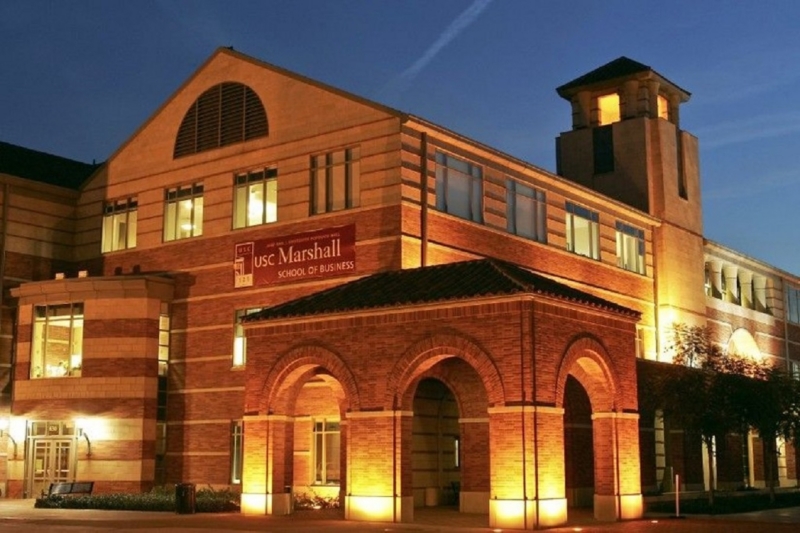
USC, Marshall School
Think rankings don’t matter?
Many times, their ups-and-downs reflect deeper issues at institutions. That is certainly the case at the University of Southern California’s Marshall School of Business .
 Two weeks ago, USC Marshall’s Full-Time MBA program lost another spot to finish 25th in the ever-influential U.S. News Ranking. Even more, the school has lost 10 spots in the past three years alone in U.S. News. That news pales in comparison to a letter recently delivered to Marshall Dean Geoffrey Garrett according to a report from LA Material. Signed by 52 business professors – which amounts to roughly a fifth of its full-time faculty – the letter seemingly acts as a vote of no confidence in school leadership.
“We believe that there are clear signs of our downwards trajectory in terms of academic reputation, commitment to excellence in research and the demonstrated academic excellence of the students which graduate from our programs.”
A ‘DOWNWARD TRAJECTORY’
And the most damning part? The faculty signees lay the blame at the feet of USC Marshall’s administration.
“This downward trajectory does not appear to be based only on environmental conditions,” the letter continues. “Many of our peer institutions appear to be weathering these pressures more effectively. This downward trajectory has coincided with a centralization of decision authority and a reduction in the information and consultation provided to the faculty…The consensus among faculty is that decision authority and information does not rest with those who need to do their jobs, and this is leading to a demonstrated decline in the enrollments and quality of students at our school.”
In many ways, the letter represents a confluence of issues dogging higher education, notably deficits and budget cuts that have resulted in institutions scaling back programming and staffing. The letter’s signees admit as much, pointing to proposed cuts to the PhD program as a threat to Marshall’s “academic reputation.” Beyond protecting a seeming untouchable, the letter points to bread-and-butter issues that could threaten the larger operation.
“Preliminary admissions figures across our four MBA programs point toward a significant revenue shortfall in the coming academic year.”
Translation? This is only just the beginning…and it’s only going to get worse.
Oh…and the latest U.S. News ranking smarted a little too.
“It doesn’t help that we’re ranked below UT Dallas,” said one anonymous faculty member to LA Member.

Dean Geoffrey Garrett
FACULTY FEELS FROZEN OUT
In some ways, the letter acts as a classic defensive management tactic, a Cassandra-like warning that there is still time to protect the walls if the powers-that-be would just listen. However, it could also be considered a classic power play – one that would result in c-suiters marching out the malcontents if it were pulled in the private sector. True to form, the letter’s signees produced a ten-point plan for reform, one that reveals as much mistrust as hubris.
In many cases, the letter is a call for communication and transparency. Most telling, the signees request that the school more clearly convey its long-term strategy, trajectory, and vision to faculty – a damning indictment of leadership.
“Rather than focusing narrowly on cost-cutting due to external factors, this vision must outline how USC Marshall intends to strengthen and sustain its position as a top-tier institution,” the letter continues, “including but not limited to its intentions towards investing in research, strategic hiring and retaining of top faculty, and recruitment of high-caliber students. Moreover, it should also indicate how the school will clearly and effectively communicate these priorities to external audiences to reinforce the school’s brand and market its value.”
Even more, the letter broaches the question of authority when it comes to academic leadership, with many faculty feeling shut out of decision-making.
“Recent events suggest this boundary has drifted and that faculty are not sufficiently involved in governance, but are impacted by these decisions. There is also sentiment that had faculty been consulted, better decisions would have been taken and that the School would be in a better position today.”
A HARBINGER OF THINGS TO COME?
At the same time, the letter might make a case study on overreach. Among the demands, the signees request access to all enrollment and admissions data, not to mention a written presentation on the budget with the “underlying figures.” That doesn’t count a written out two-year revenue strategy and expenditure plan. In addition, the Faculty Council expects “monthly standing updates” on “budget, enrollment, and the revenue and expenditure plans above, through the end of the fiscal year.” Aside from the extra work load, such demands, if implemented, would position faculty as a de facto board of directors that could dictate policy to school leadership.
That won’t fly.
Maybe the most salient point involves faculty consultation before cuts are enacted – a bit that exposes both the underlying question driving the letter and the degree of skepticism held by a segment of the USC Marshall faculty.
“Meaningful consultation through the Faculty Council before decisions are finalized, not briefings after the fact,” the letter states. “There is sentiment among the faculty that this is not currently being done sufficiently and that faculty feedback is not sufficiently considered. When cuts must be made, faculty are best positioned to advise on which academic capacities are most important to protect.”
Still, the letter may be a tip of the iceberg in academia, where political headwinds, reduced revenues, and changing expectations have fostered an existential dread among faculty and administrators alike. It is particularly notable that these conflicts have arisen at Marshall, one of the country’s largest business schools that’s home to nearly 7,000 business majors and graduate students (along with roughly 1,350 business minors). It also serves as a black eye to Dean Garrett, who has turned Marshall into a powerhouse for Sustainability and Blockchain, while elevating the undergraduate program to rank among the Top 5 according to P&Q.
Thus far, the response of Marshall’s administration has remained relatively muted. According to The New York Post, Dean Garrett issued a letter stating that he would hold a meeting on May 4 to “address the faculty concerns directly” and “reaffirm my ongoing commitment to engaging openly and in good faith with our community.”
Editor’s Note: P&Q was unable to secure a copy of the letter or a statement from the school at press time.
To read the full letter, go to the next page.
DON’T MISS:
‘WE’RE NOT LEARNING ANYTHING’: STANFORD GSB STUDENTS SOUND THE ALARM OVER ACADEMICS