
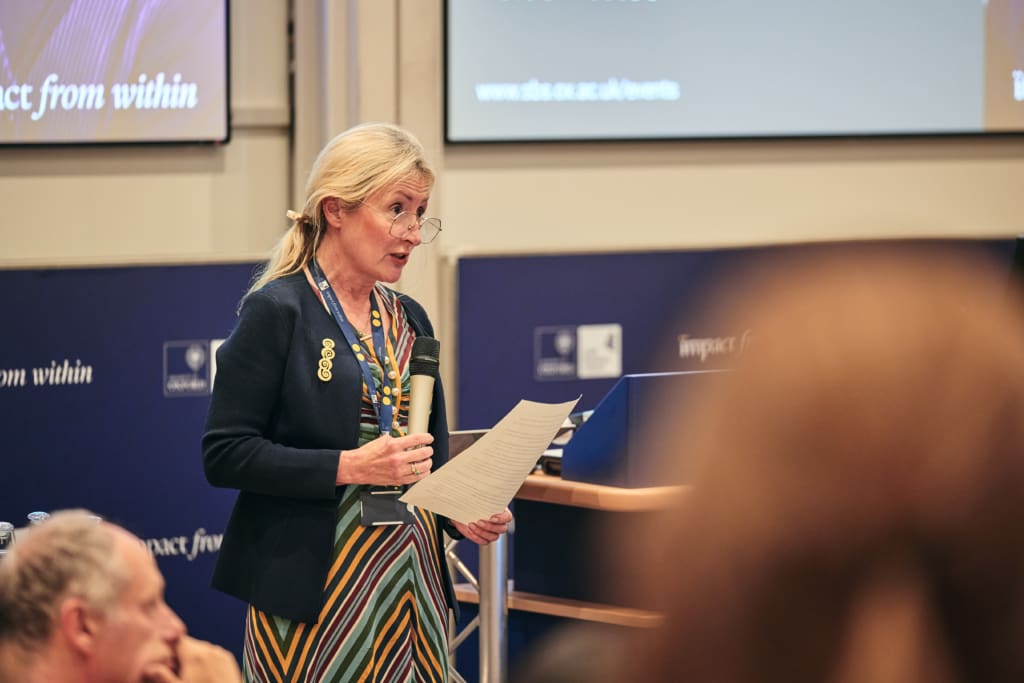
Last year’s inaugural Global Youth Climate Summit. Courtesy photo.
At this moment, institutions everywhere are trying to navigate how to meaningfully engage young people in climate action initiatives. In England, Oxford Saïd’s Business School has created a summit that is bringing together the global climate action community to showcase projects that are both far reaching and deeply impactful.
The year’s summit will take place over a solid 24 hours. Students, educators, and business leaders across the globe are invited to attend.
A FOCUS ON CLIMATE, HUMAN RIGHTS, & TECH
This year’s summit is expanding its focus to address one of the biggest questions facing the next generation of leaders: “How do climate action, human rights, and emerging technologies come together to create meaningful change?”
“Last year, the topic was focused on both climate and human rights,” says Purdey Morgan, the school’s climate content marketing manager. “This year, we are introducing tech innovation as well. These will be the three core pillars of the summit.”
AI, data tools, and digital infrastructure are shaping the future of climate resilience, so its a natural addition, she says.
The summit will take place on June 5th, World Environment Day.
“This is a platform for universities and business schools to showcase their incredible research, work, teaching, and student projects,” says Morgan. “This may have our name on the front, but really it’s for other schools to showcase their work.”

Michael Jones, participant in last year’s Saïd’s Global Youth Climate Summit.
GLOBAL PARTNERS DRIVING COLLECTIVE ACTION
Saïd is hosting the summit in partnership with Right Here, Right Now and UN Human Rights. They also have contributions from institutions including the University of Colorado Boulder, Tsinghua University, the University of Geneva, George Washington University’s Alliance for a Sustainable Future, and Reichman University. Many of these names are universities returning from last year.
“There is always room for more partners as well,” adds Morgan.
Young people working on climate solution projects need more than just passion alone, says Morgan. “They need the tools to weigh trade‑offs, use technology responsibly, and understand the human rights implications of climate decisions.”

Uganda panel – last year’s Saïd’s Global Youth Climate Summit.
The summit is designed to build that capability through real examples, practical tools, and youth‑centered learning. It’s also part of a broader, year‑round pipeline that includes the Oxford Saïd Global Climate Tech Challenge, a global competition inviting high school students and teachers to develop tech‑driven climate solutions.
KEYNOTES, WORKSHOPS, DEBATES AND YOUTH VOICES
This year’s agenda includes a mix of keynote talks, workshops, panel discussions, and debates. In typical Oxford style, that also includes an MBA‑led debate on the risks and responsibilities of deploying AI for prevention and decision‑making.
“This year’s topic feels especially relevant as AI becomes more deeply embedded in climate strategy,” Morgan says.
Saïd plans to invite local students to campus to watch the live-streamed sessions in person this year. They emphasized only inviting those based locally, because the goal is to keep the summit’s footprint minimal.
Some of the most wonderful moments came from the student speakers last year, says Morgan.
“We’ve got some great student speakers with some inspiring stories this year too,” she adds. One student speaker on the schedule is Isaac from Ghana – an alumnus of Oxford Saïd’s Future Climate Innovators summer program. He’s scheduled to share how he secured VC funding for his venture, Second Wave, which turns polluted coastal seaweed into biodegradable packaging.
David from Nigeria will be a returning voice from lat year’s summit. He’s an alumnus of Saïd’s AI and Machine Learning Pioneers summer school who founded DigiBridge to help young people build real‑world projects with basic AI tools.
“Last year, when the students showcased their ideas, it garnered seed funds from people who were investing in their ideas as well,” Morgan recalls. “That’s what we want. We want others to realize that these young people have ideas that could be world-changing.”
EXPANDING IMPACT ACROSS THE GLOBE
As the summit continues to grow, it’s been expanding its reach within the United Nations ecosystem, drawing contributions from UNEP, UNDP, the UN Major Group for Children and Youth, and the Advisory Board for the UN Decade on Ecosystem Restoration. Business Schools for Climate Leadership (BS4CL) has endorsed the summit as well.

Satara Uthayakumaran -participant in Oxford Saïd’s Global Youth Climate Summit last year.
This year, Morgan is most looking forward to seeing how the new technology pillar enriches this year’s summit experience. “I’m looking forward to how those at the summit are keeping up to date with the changes we’re seeing in our world associated with AI,” she says.
Jo Fawkes, Oxford Saïd’s director of global inclusion and youth education highlighted a key element of the summit.
“We are going to be giving away free online materials on climate and sustainability. These will be free resources alongside the video resources,” she says.
“Our whole goal is to give these young people a voice on a public and global platform where they can showcase their ideas and some of the amazing solutions they have come up with. These participants truely are our future change makers.”
DON’T MISS: HOW CLIMATE CAREERS FOR MBAS WENT FROM NICHE TO NECESSITY AND ON EARTH DAY, B-SCHOOLS DOUBLE DOWN ON CLIMATE INNOVATION
The post Inside Oxford Saïd’s Second Annual 24‑Hour Global Summit appeared first on Poets&Quants.