
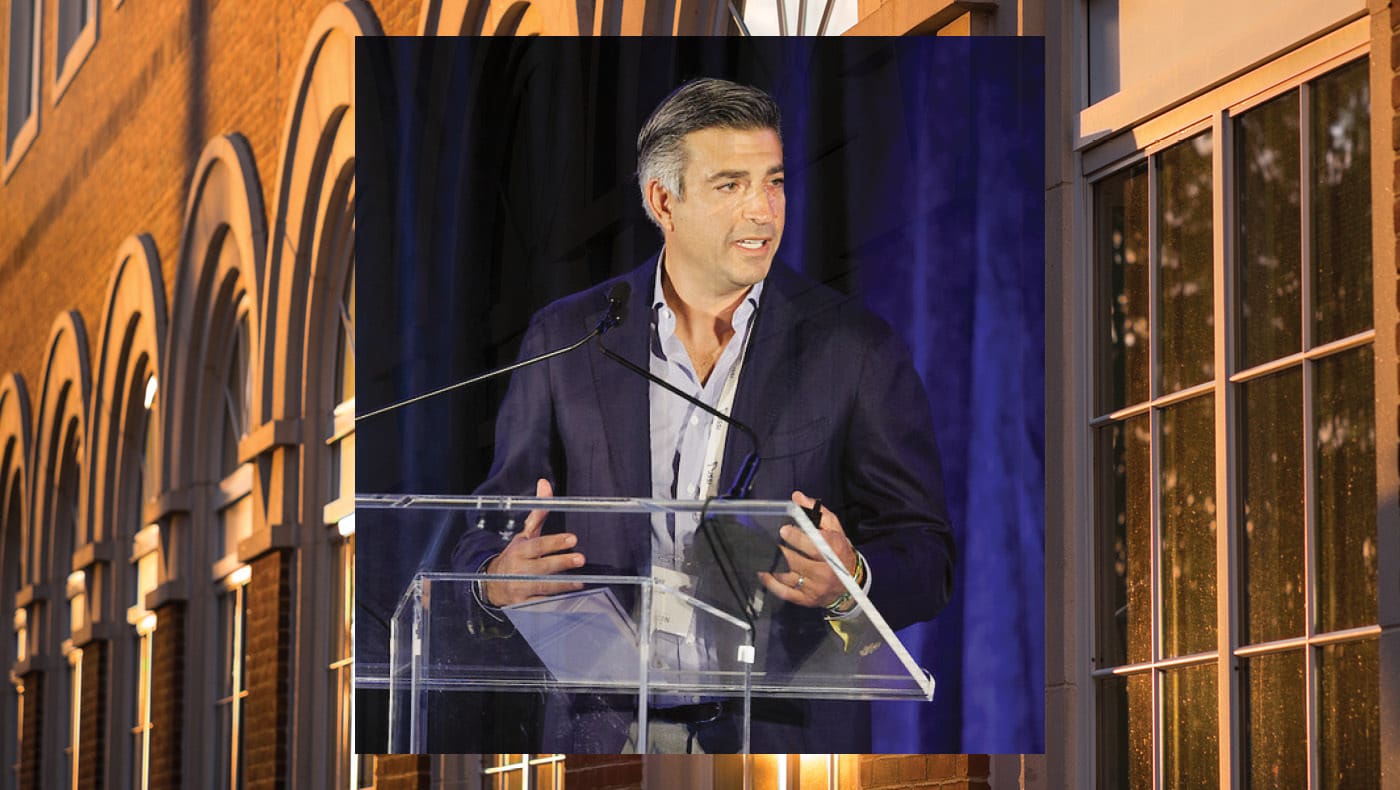
Neil Book on his gift to Delaware Lerner: “We are living through one of the most consequential periods of innovation in history, and AI is rewriting the rules of business in real time. Our mission is to equip students with the skills, mindset and tools to solve real-world problems, launch impactful ventures and lead with vision”
Neil Book didn’t go to Wharton or Michigan. He went to Delaware. And the 1999 graduate of UD’s College of Arts and Sciences, now president and CEO of business aviation firm JSSI, has just put his name on a new academic unit at the University of Delaware’s Alfred Lerner College of Business and Economics: the Neil Book School of Innovation and Entrepreneurship, launching July 1.
The relationship goes back more than a decade, Lerner Dean Oliver Yao tells Poets&Quants. Book first connected with the college through its executive mentoring program, then moved into entrepreneurship work through what is now Horn Entrepreneurship, eventually rising to chair its National Advisory Board.
“Neil has always been deeply engaged with Delaware,” Yao says. “Our alumni are very loyal and willing to give back because they believe it was life-changing for them. Many of them tell me that if they hadn’t spent those four years here, their lives would look completely different. Neil is the same way.”
A DECISION MADE BEFORE THE GIFT
The decision to create a new school came first, Yao says, separate from any gift conversation.
“From an academic perspective, we decided it was time to establish a new academic unit – a school of innovation and entrepreneurship,” Yao says. “After we made that decision, we talked to supporters, and Neil was very enthusiastic. He said it was a great idea and he was willing to help. That led to the naming.”
Horn Entrepreneurship was already nationally recognized before the reorganization. What changes with a named school, Yao says, is consolidation and reach.
“We had an entrepreneurship program, an academic unit with a curriculum, majors, minors and certificates, and Horn Entrepreneurship operating as a center, with so many programs – the Summer Founders program, various launch programs, pitching competitions, everything. Now we’re putting it all together and integrating it as a single school, elevating it to the top level as an academic unit. That gives us the visibility, the identity and the resources to carry out our vision.”

Delaware Lerner Dean Oliver Yao: “We teach our students to identify problems, test ideas, work across disciplines and lead under uncertainty. Those are the skills of the innovative, entrepreneurial mindset”
AI AS THE CATALYST
Book has framed the school around artificial intelligence, telling UD that AI is “rewriting the rules of business in real time” – adding, “Our mission is to equip students with the skills, mindset and tools to solve real-world problems, launch impactful ventures and lead with vision.”
Yao says the connection to Lerner’s existing AI push – which last year produced what he says was the country’s first generative AI graduate certificate at a business school – is direct.
“AI is a catalyst,” Yao says. “The pace of change in the past three years has been staggering, and higher education relevancy has become a real challenge, particularly for business schools. A lot of work that used to require professionals – accounting, finance, many other areas – can now be done by AI. AI can replace technical skills. But it cannot replace innovative, entrepreneurial mindsets.”
That mindset, Yao adds, is broader than launching startups.
“We teach our students to identify problems, test ideas, work across disciplines and lead under uncertainty. Those are the skills of the innovative, entrepreneurial mindset – and if students can genuinely do those things, I believe they can compete with AI. For coding, for data analysis, AI is already better than us. But the things we’re focused on, those are things AI cannot fully replace, at least not in the foreseeable future.”
REACH BEYOND LERNER
UD President Laura Carlson has said the new school will have impact across the university regardless of a student’s home college. Yao says that is by design.
“Entrepreneurship is interdisciplinary by nature – it already encompasses finance, accounting, operations, management and marketing,” he says. “The school will serve Lerner students, but its ambition is much bigger than Lerner. We’re going to offer entrepreneurship courses for students across the university – engineering, nursing, sciences, history – and we already have minors in place across nearly every college.”
The school builds on an experiential learning model Yao says Horn Entrepreneurship pioneered within Lerner.
“Our entrepreneurship curriculum has always been built around experiential learning,” he says. “Students shouldn’t just learn in the classroom – they should work on real problems, talk to real customers, prototype, pitch, receive feedback and iterate. The entrepreneurship program is our pioneer in this. It’s the role model for the rest of Lerner.”
RESEARCH RANKINGS ON THE MOVE
The Book School also fits into Lerner’s research ambitions. The college has climbed from outside the top 90 nationally in research rankings to No. 69, Yao says, up from 79 a year ago.
“This school is going to support pioneering research on commercialization, technology transfer, cultural entrepreneurship and how early-stage companies can succeed with the right financial and marketing models,” Yao says. “Our faculty are on a trajectory to be nationally recognized – some already are. We can make a real mark in entrepreneurship research specifically, in a way that would be very difficult in a crowded field like finance or accounting.”
A NEW BUILDING, AND A NEW DEPARTMENT MAP
The new school will eventually be housed in a planned business school building, Siegfried Hall, though the project remains in its early stages. Yao says groundbreaking is targeted for the end of 2028, with completion by 2030, while the college continues fundraising and works with an architectural firm on programming and design. The Book School will occupy roughly half the building once it opens.
The launch comes as Lerner completes a broader departmental reorganization this year, moving from five departments to six plus the new school, including a new department focused on technology.
“Transformative excellence means continuous improvement – it never ends,” Yao says. “In the past two to three years, we are very proud of what we’ve accomplished. We’re on schedule, and probably ahead on a lot of it. But you can always move the bar higher.”
DON’T MISS 10 BUSINESS SCHOOLS TO WATCH IN 2026 and WOW! UNIVERSITY OF DELAWARE’S LERNER COLLEGE GETS HISTORIC $71.5 MILLION GIFT
The post ‘AI Can’t Replace This’: How Delaware’s New School Will Prepare Students To Compete In An Automated Economy appeared first on Poets&Quants.