

Startup Wise Guys, an early-stage accelerator in which Estonian Business School holds an ownership stake, is part of EBS’s larger entrepreneurship network in Tallinn. Across Europe, business schools are leaning into startup hubs, venture studios and founder pipelines to help students create opportunity in a changing job market.
Timmu Tõke arrived at Estonian Business School (EBS) in 2013 with a clear idea of what he wanted from business education, and it wasn’t corporate recruiting.
He wanted to start a company. He’d spent a year studying computer science, and he was looking for support in launching his early vision for what would become Ready Player Me.
EBS gave Tõke and his cofounders space – an office that basically served as an incubator, workshop, and room to experiment. It gave them access to tools and resources that allowed them to build the early 3D scanners that could turn human bodies into digital avatars for multiple gaming platforms. Tõke met his co-founders at EBS, and the school’s founder became a mentor and early backer.
“He first gave us the confidence to think big,” Tõke tells Poets&Quants.
During the company’s fragile early years, EBS provided a few short-term loans when the startup needed a few weeks of runway. The school and its network invested in multiple rounds.
Ready Player Me would go on to build an avatar platform used by thousands of developers, raising about $72 million in venture funding from investors like Andreessen Horowitz and the founders of Roblox, Twitch, and other platforms. Last year, it was acquired by Netflix.
Ready Player Me is a useful proof case for a question now facing schools across Europe and beyond: What should business education prepare students for when the jobs themselves keep changing?
Entrepreneurship is becoming an increasingly larger part of the answer. Not only as a founder track, but as a broader way to teach agency, adaptability, and resilience.
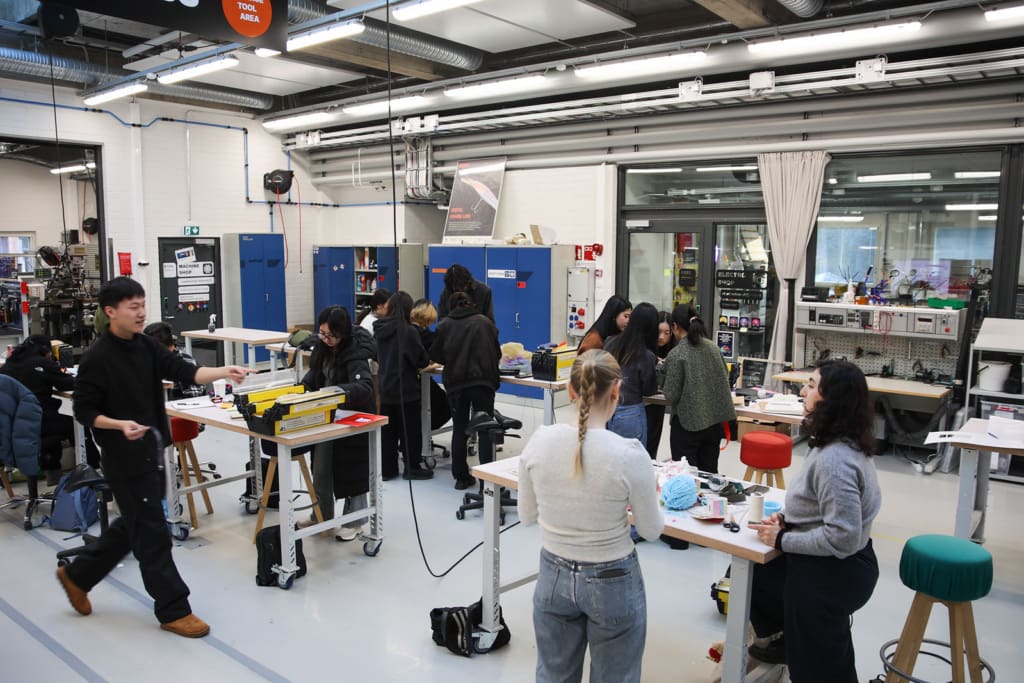
Aalto University’s Design Factory is a cornerstone of its entrepreneurship ecosystem, giving students space, tools and industry-backed projects to move from ideas to working prototypes.
CAREER INSURANCE IN AN UNCERTAIN ERA
Over the last couple of years, business school graduates have entered a job market that looks much different than when they enrolled. Geopolitics and economic uncertainty has made recruiters more cautious. The threat of AI is squeezing junior hires at investment banks, consulting firms, and other traditional business school pipelines.
Across Europe, business schools are embracing entrepreneurship as a necessary career skill. The point is not that every graduate should start a company. It is that business schools may need to teach students how to create value — and sometimes jobs — before someone offers them one.
“In a world where AI can perform more and more tasks, entrepreneurial capability becomes the ultimate career insurance,” says Andreas Veispak, head of Research, Innovation and Development and member of the management board at Estonian Business School.
“The graduates who will thrive are not just those who can do a job, but those who can create one.”
That could mean rethinking what employability now requires. Job descriptions are being rewritten as technical tools change month to month. Candidates who can identify problems, build teams, and act under uncertainty – all part of the entrepreneurial toolkit – will stand out.
“Teaching for a job is a risk right now, because the jobs are changing so fast,” says Timo Korkeamäki, dean of Aalto University School of Business in Finland.
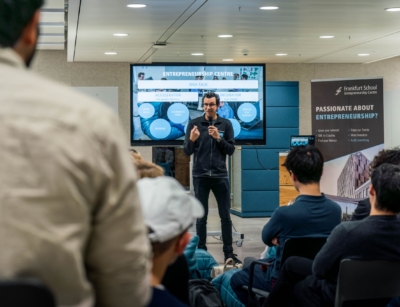
Frankfurt School’s Entrepreneurship Centre has become a central hub for students and alumni interested in venture building, with more than 200 startups incubated, a community of 5,200-plus startup enthusiasts.
Three years ago, corporate stakeholders wanted more Aalto graduates who could code. Had the school built its business curriculum around that demand, it might already be chasing yesterday’s trend. Now, Korkeamäki says, AI can largely do the coding.
Instead, the school has leaned into an entrepreneurial ecosystem that spins out about 100 startups each year. This ecosystem has produced four unicorns since the university’s founding in 2010, but is now hunting centaurs. Its entrepreneurship unit created Founder School last year to help Finland reach its 100×100 goal: 100 companies with at least €100 million in annual recurring revenue by 2050.
In Germany, Frankfurt School of Finance & Management established its Entrepreneurship Centre four years ago in response to a clear shift in student expectations, says director Ram Shoham. It is now the central hub for students and alumni interested in venture building with more than 200 participating in mentorship days. It has incubated more than 200 startups and has a community of more than 5,200 startup enthusiasts. Supported startups have secured €37.7 million in venture funding, and about 10% of Frankfurt School students pursue entrepreneurship shortly after graduation &
Frankfurt students have become more aware that career paths are changing, Shoham says.
“As traditional career paths become less predictable, the opportunity cost of building a startup becomes more comparable to joining an established company,” he says.
EBS: A STARTUP SCHOOL IN A STARTUP NATION
Estonia, one of Europe’s smallest countries, is often described as a unicorn factory. It is credited with 10, despite having only about 1.4 million people.
Estonian Business School in central Tallinn is within walking distance of many of those unicorns. The school enrolls about 1,000 full-time students across bachelor’s, master’s, and PhD programs, with another 700 to 800 participating in executive education each year. The 2026 Redstone University Startup Index ranked EBS No. 1 among 1,050 European universities for startup creation efficiency. That’s ahead of HEC Paris, ESADE, and INSEAD.
“The question for business schools is no longer whether students will become entrepreneurs,” Veispak says. “The question is whether they will develop entrepreneurial thinking. Even those who join large companies are expected to identify opportunities, build new ventures, and navigate uncertainty.”
For Tõke, Estonia itself helps explain why such a path felt plausible. Its startup culture was shaped by necessity. After the Soviet Union collapsed, Estonia did not have deep corporate pipelines comparable to larger economies. There were fewer obvious ladders into banking, consulting or large-company careers. People built because building was where opportunity was.
Government invested in technology and tech education to create an engineering base. Early successes such as Skype and Wise gave way to a fuller ecosystem of founders, investors and experienced operators. Now, young Estonians can look around and see people not far removed from themselves building globally relevant companies, Tõke says.

ESB’s new Eedu Education and Entrepreneurship Campus, set to open in 2027, will be located in Tallinn’s Maakri quarter.
INSIDE ESTONIA’S STARTUP PIPELINE
EBS was founded in 1988 as the first higher education institution in the Soviet Union to offer English-language business education. Today, its entrepreneurship footprint extends well beyond the classroom.
It holds ownership stakes in several accelerators, including Startup Wise Guys, which helps early-stage companies launch and scale across Europe and Africa. It also has direct investments in about 15 startups, including alumni-founded ventures operating in the U.S.
In October, EBS helped launch Too Early Ventures, a legally separate venture studio co-founded by Aneth Tinnus. Unlike a traditional incubator, it works with ideas at their earliest stage — some not yet formal companies — and helps turn them into businesses.
 Even in Estonia, the earliest part of the startup pipeline is increasingly neglected. Much of the funding has shifted toward later-stage rounds resulting in fewer new companies and new ideas, Tinnus says.
Too Early is designed to close this gap. It is working with about 10 ideas with roughly 30% to 40% connected to EBS students, graduates or alumni. While it is sector agnostic, ideas must have a digital-first or digitalization component.
The studio has organized hackathons in defense and circularity and hosts monthly community events for roughly 35 to 40 people, including open-mic pitches, founder presentations, guest speakers and curated networking.
Too Early will move into the new Eedu Education and Entrepreneurship Campus, a 30-story mixed-use high-rise under construction in Tallinn’s Maakri quarter. Scheduled to open in 2027, Eedu will combine startup incubation, event venues, co-working areas and residential living. Its lower floors will be home to EBS, creating a new urban hub for students, entrepreneurs, and the wider community.
TRAINING STUDENTS TO BUILD
At Polimi Graduate School of Management in Milan, Angelo Cavallo directs the International Master in Innovation and Entrepreneurship, a program housed within one of Europe’s top engineering universities. It is designed for graduates and early-career professionals who may want to become founders, as well as students who want to become change makers inside established companies.
The master includes a pre-incubation lab where students move from idea generation toward venture launch. They receive more than three months of practitioner tutoring and pass through checkpoints with investors, mentors and alumni. Cavallo also created a practice week where companies like BCG, PwC, Reply, and Amazon lead guest lectures about specific projects so students can see how innovation work happens in real organizations.
“Companies don’t need employees anymore. They need entrepreneurial employees,” Cavallo says. “You cannot just be a mere executer anymore.”

Members of the Polimi GSoM Alumni Entrepreneurship Club meet to test ideas, find co-founders and challenge each other’s assumptions. The club has become part of Polimi’s broader entrepreneurship ecosystem, extending venture support beyond graduation through alumni-to-alumni and alumni-to-student networks.
The school recently launched a Master in AI & Entrepreneurship in partnership with Albert School in Paris, a school that blends STEM and business education in all programs. The new master includes more than 200 hours of real-world application including work in the lab, sessions with industry managers, and business challenges.
Polimi’s entrepreneurship support does not end at graduation. Its alumni network has become another layer of venture support, connecting students and graduates who have ideas with people who can help test them.
Felipe Aguilera, MBA ’18, co-founded the school’s Polimi GSoM Alumni Entrepreneurship Club after noticing how often strong ideas from students and alumni never turned into companies. The ideas were there, but the courage, co-founders, and execution support often were not.
The club began with about 20 people four years ago. Now it has about 600.
The club hosts events, maintains a Telegram group, and offers support through what it calls “alumni for alumni” and “alumni for students” channels. Here, both students and alumni find co-founders, investors, and honest feedback. One of Aguilera’s newest ventures came from two students he met while serving on the jury for their project work.
One of the club’s most distinctive feature is what Aguilera calls a small army of “sparring partners.”
“We don’t advise; we learn together,” he says. “We are kind of a mirror of your assumptions and of your biases.”
THE RISK OF PLAN B ENTREPRENEURSHIP
At NEOMA Business School in France, entrepreneurship has been a central pillar for more than 15 years. The school’s Startup Lab supports students and alumni from idea emergence to market launch. Its Inspire program introduces entrepreneurship through discovery, exploration and hackathons. Its Venture Studio is a two-month pre-incubation program focused on market validation and MVP development, and is recognized as equivalent to an internship. NEOMA also operates three incubators across its campuses, supports more than 100 projects each year, and has helped launch more than 400 startups.
Its Coding School, once focused on web development and app creation, has evolved to include no-code, low-code and AI tools. The shift reflects a broader belief that the boundary between business and tech has become obsolete.
But Denis Gallot of NEOMA also offers one of the clearest cautions against overselling entrepreneurship as an answer to a sluggish job market.
The environment facing graduates of top business schools has undeniably become tougher over the past two years, with longer job searches, more selective recruiters and shrinking opportunities in some sectors, he says. Still, a deteriorating labor market does not automatically create real entrepreneurs.
Students who turn to startups by default because they failed to secure an internship, apprenticeship or first job often do not have the profile, focus or persistence entrepreneurship requires.
“Pressure in the job market does not create new entrepreneurs; it merely tests the strength of those who were already inclined toward entrepreneurship,” Gallot tells P&Q.
Business schools cannot simply tell anxious graduates to start companies because corporate hiring has become less predictable. Instead, they must build ecosystems that promote agency, resilience, judgment, and technical fluency. Give students the ability and confidence to act on opportunity, whether it is launching or joining startups, commercializing research and deep tech, take over an existing business, or even enter corporate organizations with entrepreneurial toolkits.
HOW ENTREPRENEURS WILL STAND OUT IN AN AI WORLD
In a world where AI can perform more tasks, where entry-level roles may shift, and where employer needs change faster than curriculum committees can respond, business schools are betting that entrepreneurial capability is becoming a core graduate skill.

Timmu Tõke
Tõke is excited by the technology, but he is also watching to see whether Estonia can adapt quickly enough to the new way companies are being built. The old SaaS playbook — hire large teams, scale engineering headcount, repeat the model that worked last time — may not translate neatly into an era of agents, automation and faster experimentation.
When he thinks about building his next company, Tõke says he is not sure he would default to hiring experienced leaders trained in the old model.
“Am I going to hire experienced leaders that have done it in the old way … or I’m going to hire a super motivated young person that speak to multiple agents every day?” he says.
For students, that creates an opening. AI may threaten some junior work, but it also gives younger builders a chance to develop skills faster than older workers or organizations can change their habits.
Tõke’s advice to business students is simple: Build things, experiment with agents, and try to solve problems, even for free if that is what it takes to learn. In other words, try to become as AI native in this new world. If you have an idea, try it.
“Right out of school, you have absolutely nothing to lose. Worst case scenario is you end up living like a student for a couple of more years,” he says.
“Even if it fails … you’ll end up learning a lot more in those few years than like doing a junior’s job.”
DON’T MISS: AALTO’S BLUEPRINT FOR BUILDING FOUNDERS, STARTUPS & CENTAURS AND THE MAN WHO DISRUPTED ENTREPRENEURSHIP EDUCATION SAYS AI JUST DISRUPTED HIM
The post How European B-Schools Are Teaching Entrepreneurship To Help Students Build Their Own Jobs appeared first on Poets&Quants.