
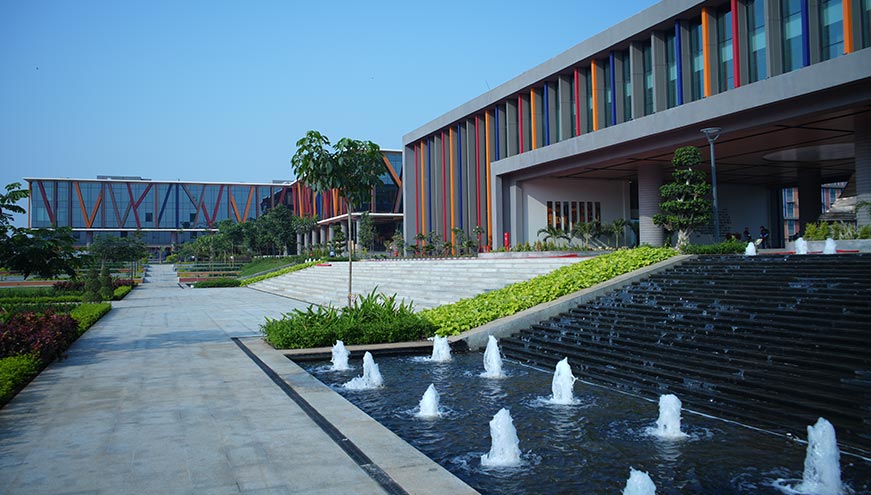
BITSoM School of Management welcomed its most diverse MBA class yet this fall
The BITS School of Management was founded in 2021 as a new chapter under the 60-year legacy of BITS Pilani — and the new B-school is setting a standard for what a strong Indian MBA program looks like.
When BITSoM launched, it entered a crowded field of Indian B-schools. But just five years in, it is already distinguishing itself — not only for its global ambition but for the diversity, creativity, and future-readiness of its MBA students. This year’s entering MBA class, the Class of 2027, is the most diverse in the school’s history.
“The goal when we set up BITSoM was for it to be a global business school,” Dean Saravanan Kesavan, a veteran academic with more than 25 years of experience, tells Poets&Quants. “A lot of what we do is very much along the lines of what you’d see in the U.S.”
A BALANCED COHORT — AND A BROADER DEFINITION OF TALENT
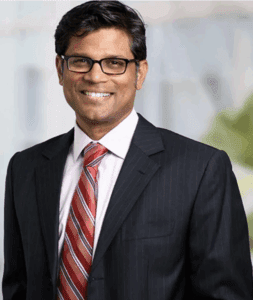
BITSoM Dean Saravanan Kesavan: “The most successful employees of the future won’t be the ones who are just quantitatively strong, but the ones who are creative, have soft skills, and can leverage AI to answer questions”
BITSoM’s 2027 cohort is evenly split by gender and academic background: 50% male, 50% female, and strikes an equal balance between students with engineering and non-engineering degrees. “Achieving this type of gender-equal cohort naturally happens here,” Kesavan says. “Having a mix of genders is wonderful. It brings different perspectives and adds richness to classroom discussions. It also reflects the complexity, creativity, and humanity of the world we live in.”
But diversity at BITSoM goes beyond demographics. This year’s cohort includes a puppeteer, a national gymnast, martial artists, and startup founders — students from backgrounds rarely seen in a traditional MBA classroom.
“I think these students enormously influence the classroom,” Kesavan says. “The classroom should be representative of the workplace, and one of the things that is happening around us is that the workplace is changing.”
THOSE WITH SOFT SKILLS WILL SHINE
Kesavan believes this kind of diversity is exactly what employers are looking for — and increasingly so in the age of AI.
“Typically, engineering and quantitatively strong students tend to be favored in a lot of management jobs,” he says. “But now, AI is turning this paradigm on its head. The most successful employees of the future won’t be the ones who are just quantitatively strong, but the ones who are creative, have soft skills, and can leverage AI to answer questions.”
To help all students build those skills, BITSoM offers a suite of courses called Winning at Workplace (WaW), which complement the core curriculum. “The topics range from Excel to emotional maturity to self-awareness,” Kesavan says. “U.S. MBA students often have more life experience because they’ve worked multiple jobs. In India, students tend to focus entirely on academics due to the intensity of competition. The WaW courses are meant to help bridge that gap and better prepare our students to be real-world managers.”
LEARNING BY DOING — AND BUILDING AI TOOLS FROM SCRATCH
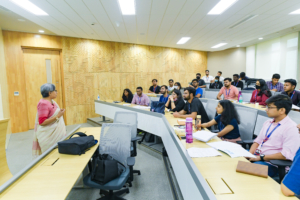
MBA students at BITSoM, the new business school based in Mumbai
Another key element of the BITSoM MBA is hands-on learning. Every MBA student is required to build and deploy an AI tool inside a real company.
“Teaching students the technicalities behind how large language models operate is very important,” Kesavan says. “It’s essential that our students learn by doing. This is one of the principles we build our program around.”
He believes the rise of AI is a turning point for management education: “I think the AI revolution is probably the best thing that has happened to MBA students,” he says. “They’re not just receiving workplace training anymore — they’re reverse mentoring the companies that hire them in AI.”
CURATED FACULTY, RESPONSIVE CURRICULUM
BITSoM also uses a unique faculty model — 90% visiting professors and just 10% resident. That flexibility, says Kesavan, allows the school to stay ahead of market shifts.
“With this model, we can curate our curriculum based on the changing demands of the workplace,” he explains. “We’re finding that visiting faculty offer an advantage you wouldn’t get with a 100% resident faculty model.”
That includes top professors from global institutions like the London School of Economics, teaching cutting-edge courses like The Future of Work — a class that didn’t exist at BITSoM just a year ago. The ability to adapt quickly, Kesavan says, is part of what sets BITSoM apart.
“We’re a small school, and that gives us the agility to respond to market needs every year — and to whatever may come our way.”
DON’T MISS NUMBERS THAT MATTER: DIVERSITY METRICS IN P&Q’S RANKED BUSINESS PROGRAMS and TRUMP TAKES AIM AT B-SCHOOL FACULTY DIVERSITY
The post India’s Most Diverse MBA? BITSoM’s New Class Breaks The Mold appeared first on Poets&Quants.