
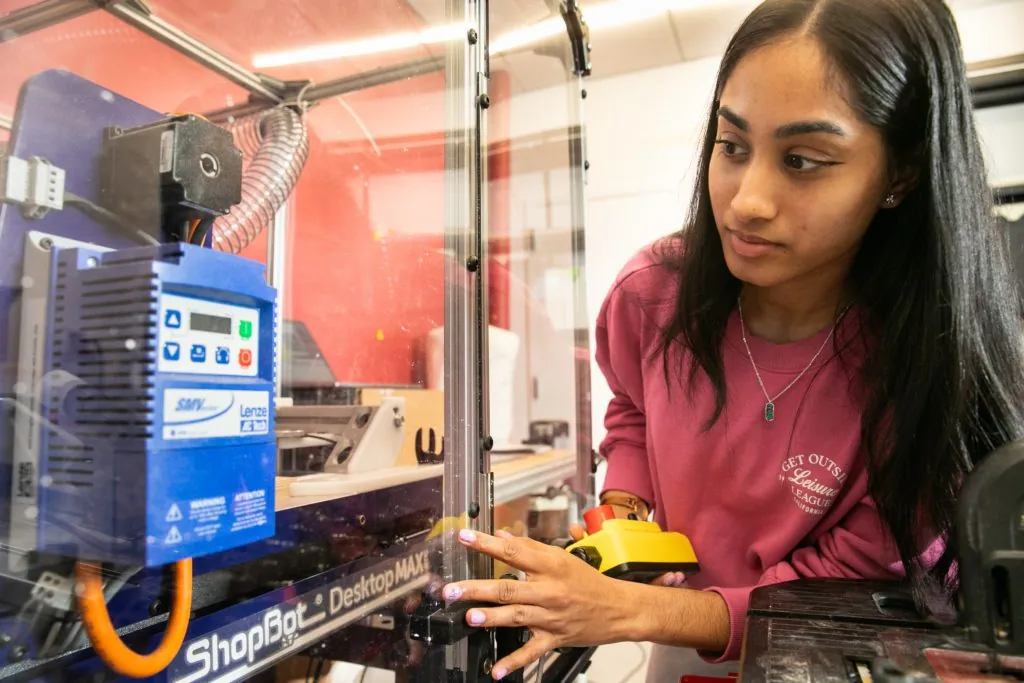
A Cornell Tech student working in the Wood Shop in the MakerLAB.
Poets&Quants’ entrepreneurship ranking for MBA programs is essentially a reporting exercise: We gather data from as many schools as possible and try to present it in an easy-to-digest way for our readers. Part of that process includes sharing the data used to calculate actual rankings and the weights we use for each dataset.
While no ranking is perfect, we believe transparency gives credibility while providing valuable information to school seekers and schools alike.
This year’s Best MBA Programs for Entrepreneurship includes 10 data points, down from 16 the previous cycle. (See our full 2026 methodology here.) In the pages to follow, you’ll see all the data we used to calculate the rankings, the weights assigned to each dataset, and a brief explanation of why the data point was included.
We truly view rankings as a jumping-off point into a research deep dive. So dive into the data as you examine and consider the different business schools and MBA programs.
See how schools fared category by category in last year’s entrepreneurship ranking data dump. Or return to the full ranking of the Top MBA Programs For Entrepreneurship in 2026.
STARTUPS LAUNCHED (25%)
Weighted at 25%, this is the average percentage of full-time MBAs to report launching a business within three months of graduation over the last five years: The Classes of 2020, 2021, 2022, 2023 and 2024.
Washington University in St. Louis’ Olin Business School (ranked No. 1 overall in the 2026 ranking) topped this metric, which is also the most highly weighted in our methodology. It reported that 27.8% of the MBAs over its last five classes have started ventures during or within three months of graduation.
That’s nearly a 5-point jump from the 22.8% average it reported for last year’s ranking when it came in second in the metric.
Clemson University’s Wilbur O. and Ann Powers College of Business had the second highest 5-year startup average at 24.5% followed by University of Michigan’s Ross School of Business at 22.4%.
Launching startups carries the most weight because it’s the clearest indicator of a school’s real-world impact, showing how effectively its programs, resources, and culture translate into actual venture creation.
Average Percentage of MBA Startups Launched (2020-2024) |
||
School |
Startup Average |
|
| 1 | Washington University in St. Louis (Olin) | 27.80% |
| 2 | Clemson University (Powers) | 24.50% |
| 3 | University of Michigan (Ross) | 22.40% |
| 4 | Johnson Cornell Tech MBA | 15.20% |
| 5 | IE Business School | 14.18% |
| 6 | Babson College | 13.56% |
| 7 | Woxsen University | 12.90% |
| 8 | CEIBS | 8.49% |
| 8 | DePaul University | 7.62% |
| 10 | EDHEC Business School | 7.54% |
| 11 | ESMT Berlin | 7.40% |
| 12 | Brigham Young University (Marriott) | 6.92% |
| 13 | Esade Business School | 6.60% |
| 14 | Rice University (Jones) | 6.43% |
| 15 | City St George’s, University of London (Bayes) | 6.36% |
| 16 | London Business School | 6.00% |
| 17 | Texas Christian University (Neeley) | 5.46% |
| 18 | University of California-San Diego (Rady) | 4.78% |
| 19 | UCLA (Anderson) | 4.30% |
| 20 | University of Oregon (Lundquist) | 4.20% |
| 21 | Carnegie Mellon University (Tepper) | 4.00% |
| 22 | Boston University (Questrom) | 3.30% |
| 23 | University of Minnesota (Carlson) | 3.20% |
| 24 | Arizona State University (W. P. Carey) | 3.02% |
| 25 | Georgetown University (McDonough) | 2.85% |
| 26 | University of Texas at Austin (McCombs) | 2.62% |
| 27 | Rutgers Business School | 2.58% |
| 28 | University of Virginia (Darden) | 2.30% |
| 29 | University of Arizona (Eller) | 1.86% |
| 30 | Southern Methodist University (Cox) | 1.23% |
| 31 | New York University (Stern) | 0.98% |
| 32 | Western University (Ivey) | 0.91% |
ELECTIVE COURSES (15%)
Weighted at 15%, this is the percentage of elective courses focused solely on entrepreneurship offered to MBAs during the 2024-2025 academic year.
EDHEC Business School in France led this category with 67% of its elective MBA courses being 100% entrepreneurial focused. That’s up from the 55% it reported last year when it also topped the metric.
Offering plenty of entrepreneurship-focused courses for MBAs is one of the most basic ways to foster an entrepreneurial environment, which is why we give it the second highest weight in the ranking.
EDHEC was followed by University of Virginia’ s Darden School of Business at 40.3% of elective courses. Esade Business School in Spain had the third highest percentage at 40%.
Percentage of Entrepreneurship Elective Courses |
||
Category Rank |
School |
Elective Courses |
| 1 | EDHEC Business School | 67.00% |
| 2 | University of Virginia (Darden) | 40.30% |
| 3 | Esade Business School | 40.00% |
| 4 | IE Business School | 38.10% |
| 5 | Clemson University (Powers) | 37.00% |
| 6 | UCLA (Anderson) | 35.20% |
| 7 | University of Oregon (Lundquist) | 35.00% |
| 8 | ESMT Berlin | 33.00% |
| 9 | Johnson Cornell Tech MBA | 32.00% |
| 10 | CEIBS | 29.50% |
| 11 | University of Michigan (Ross) | 29.00% |
| 12 | Brigham Young University (Marriott) | 28.10% |
| 13 | Woxsen University | 23.60% |
| 14 | Texas Christian University (Neeley) | 22.40% |
| 15 | Washington University in St. Louis (Olin) | 22.00% |
| 15 | University of California-San Diego (Rady) | 21.00% |
| 17 | University of Texas at Austin (McCombs) | 20.00% |
| 18 | London Business School | 19.40% |
| 19 | Arizona State University (W. P. Carey) | 18.00% |
| 20 | Carnegie Mellon University (Tepper) | 18.00% |
| 20 | Boston University (Questrom) | 16.90% |
| 22 | Georgetown University (McDonough) | 16.00% |
| 23 | Rice University (Jones) | 15.90% |
| 24 | Western University (Ivey) | 15.40% |
| 25 | DePaul University | 13.60% |
| 26 | Babson College | 12.50% |
| 27 | University of Arizona (Eller) | 11.90% |
| 28 | New York University (Stern) | 9.90% |
| 29 | University of Minnesota (Carlson) | 8.00% |
| 30 | Southern Methodist University (Cox) | 6.80% |
| 31 | City St George’s, University of London (Bayes) | 6.70% |
| 32 | Rutgers Business School | 4.80% |