
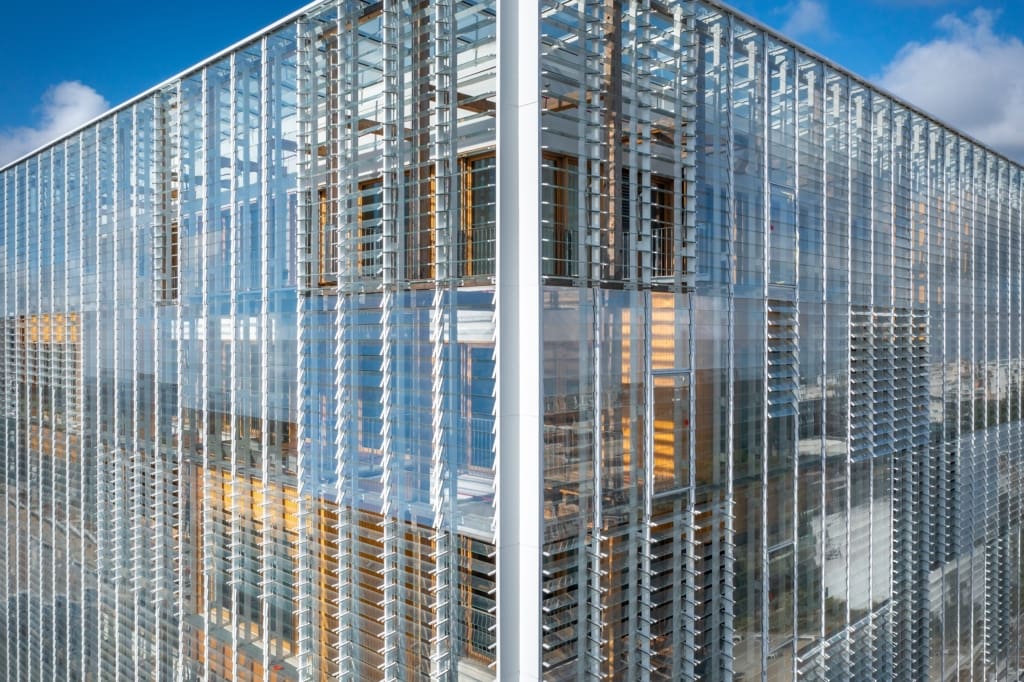
The Research Green Tower at ESSEC Business School’s Cergy campus, a centerpiece of its Next Generation campus, houses faculty offices, research spaces, and the Metalab for AI and data while showcasing the school’s commitment to sustainability and interdisciplinary innovation. The school is expanding its global footprint with new hubs in cities like Mumbai, New York, and London. Photo: ©Marc-Chesneau
In February, ESSEC Business School opened a new hub in Mumbai, India, in a joint announcement with Emmanuel Macron and India Prime Minister Narendra Modi.
The move underscores ESSEC’s long-term bet on India while advancing a central pillar of its Transcend strategy, a four-year roadmap launched in fall 2024 to build what the school calls “future-fit” business education.
“We strongly believe in India’s economic growth, demographic expansion, and the need to address the skills gap by developing hybrid competencies,” ESSEC Dean and President Vincenzo Vinzi tells Poets&Quants.
With the announcement, the French Business School now operates three campuses across three continents—Europe, Africa, and Asia-Pacific—and three hubs in New York, London, and now Mumbai. School leaders expect the Mumbai hub to evolve into a full campus over time, part of what Vinzi describes as “a broad and meaningful global presence.”
“At the same time, we continue to develop academic partnerships in other parts of the world, including Europe and beyond,” Vinzi says. “What we are building in India, combined with our existing network, provides a strong presence in the most relevant regions globally.”
Q&A WITH VINCENZO VINZI
The Mumbai hub anchors a broader push into interdisciplinary education through a “STEM-B” model developed in collaboration with CentraleSupélec, France’s leading engineering school. The goal is to blend business education with engineering, technology, and data science. The two schools already offer several joint-degree programs in France, including the MSc CentraleSupélec-ESSEC Entrepreneurs, the Master in Data Sciences & Business Analytics (DSBA), the BSc in Artificial Intelligence, Data and Management Sciences, and the Bachelor HEPTA — a program designed for high-level athletes to pursue both academic studies and elite training simultaneously.
ESSEC also plans to enhance its existing partnership with the Indian Institute of Management Bangalore (IIMB) through development of a double-degree program that would award students both an ESSEC Master in Management (MiM) and an IIM Bangalore MBA. ESSEC will also expand student mobility programs to strengthen the exchange of global talent and ideas through its collaboration with the Indian School of Business (ISB).
In this Q&A, Vinzi discusses the rationale behind ESSEC’s global expansion, the strategic importance of India, and how business schools must evolve to remain “future-fit” in an increasingly fragmented world.
Can you lay out the groundwork of your international and India strategy, and why it is important?
ESSEC has always made international openness a core pillar of its educational model. This is important because it is not new, which means we have built legitimacy, credibility, and an international footprint that now needs to be nurtured and adapted to a changing environment while maintaining continuity with what we have done for a long time.
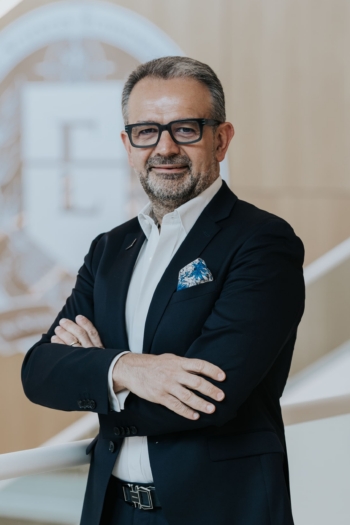
ESSEC Dean and President Vincenzo Vinzi
We are now operating in a world shaped by accelerating economic, social, geopolitical, demographic, and technological transformations. These challenges are interconnected, and we must avoid treating them in silos, which would be detrimental. In this context, we are strengthening our international presence through strategic hubs located in major global cities. We have three: New York for North America, London for the UK, and most recently Mumbai, which I had the honor to announce alongside French President Emmanuel Macron and India Prime Minister Narendra Modi.
These hubs serve as international anchors. They structure and amplify our global initiatives, supporting international outreach, mobility, partnerships, and careers. They foster academic and corporate partnerships, strengthen alumni communities, and enhance our international visibility. The idea is to combine a global vision with strong local integration. Whenever we have a physical presence in a region, it is not just about what we bring in terms of education, values, and research, but also what we learn from the local environment. This local embeddedness is part of our DNA and has already been proven in Singapore and Morocco. We continue this approach with our hubs.
This allows us to embed ESSEC within key ecosystems and contribute to educating the next generation of leaders. At the same time, we combine in-person and digital models. Digital allows us to expand our reach beyond physical locations, enhancing both content delivery and experiential impact. Our campuses act as laboratories where knowledge is transformed into real-world action alongside regional ecosystems. This international footprint is not a future ambition; it builds on what we have already achieved in Asia-Pacific and Africa.
Tell us more about your India strategy specifically.
Regarding India, our strategy is built on three pillars: physical presence, partnerships with top academic institutions, and the development of a STEM business school model. This model integrates management with science, technology, engineering, and mathematics, including AI, to create hybrid competencies.
We have strengthened our footprint in India through partnerships with eight leading universities, focusing on student exchanges, joint academic initiatives, and deeper engagement aligned with India’s economic priorities. This reflects our commitment to local embeddedness—addressing the specific needs of the country.
This strategy led to the opening of our hub in Mumbai. It represents not just a physical presence, but a new phase in ESSEC’s development in South Asia. India offers strong economic growth, a young and expanding population, and a clear need to address the skills gap between what companies require and what education currently provides.
Our strong alliance with the top French engineering school, CentraleSupélec, is central to this approach. It allows us to deliver programs that combine management and technology, meeting the needs of a transforming industry. We are also working with institutions such as Indian School of Business and Indian Institute of Management Bangalore, developing dual-degree programs and expanding student exchanges.
Through these collaborations, we aim to provide a comprehensive educational offering in India, starting from undergraduate programs and extending to advanced degrees, all built on this interdisciplinary model.
Broadly, how is ESSEC engaging with the growing geopolitical turmoil around the world?
Geopolitical tensions have become a major factor impacting companies, organizations, and higher education. They influence decision-making in many ways, from rivalries between major trading blocs and protectionism to competition for resources and restrictions on international investment. Geopolitics has now embedded itself abruptly and, I would say, permanently at the boardroom table.
In response, we have embedded geopolitics into our strategy. This is extremely important because we want to leverage multidisciplinary expertise to prepare students for today’s world. When we talk about the economy, it is not just economic—it is also political, social, and environmental. We cannot leave it to students to piece this together on their own at the end of their studies. We need to provide a structured, multidisciplinary—indeed transdisciplinary—approach that prepares them for a fragmented global environment.
We are also transforming our global partnerships into what I call strategic knowledge corridors. These corridors allow us to turn regional developments into learning opportunities for students, helping them become resilient leaders. The goal is not to turn ESSEC into a political science school, but to embed geopolitical awareness into leadership training so that graduates are not only high-performing and inclusive, but also capable of navigating geopolitical complexity.
Our global presence—with campuses across Europe, Africa, and Asia-Pacific, as well as our international hubs—supports this approach. It is not just about offering international experiences, but about connecting those experiences into a broader understanding of how economics, politics, and geopolitics interact.
We have also created an Institute for Geopolitics and Business, along with a barometer that surveys business leaders. It shows that 97% of French leaders have already experienced the direct impact of geopolitical shocks on their business models. There is a clear rise in awareness. However, far fewer organizations have taken a proactive approach to integrating geopolitics into their strategy, revealing a gap between awareness and action.
Have you seen changes in international student mobility, particularly with geopolitical shifts? Are more students choosing France and ESSEC, or are they staying in their home countries?
As for student mobility, we have not seen significant structural changes. Students still choose from a wide range of international destinations. That said, the broader context is evolving, and mobility is increasingly shaped by geopolitical considerations. For us, the key is ensuring that mobility is not just an experience, but part of a deeper learning framework—these strategic knowledge corridors—that help students understand the connections between global forces.
In terms of student composition, ESSEC has more than 100 nationalities across its programs. China is the largest source of students, followed by India and Morocco, with several European countries next. For MBA programs, India is the largest source, followed by increasing interest from France. Notably, we are also seeing a steady rise in applications from the U.S. and UK. Combined, they now represent our third-largest source of MBA applicants.
This reflects a broader shift. While globalization is evolving, it remains central to business education. What is changing is how students navigate it—seeking environments that offer both international exposure and geopolitical stability.
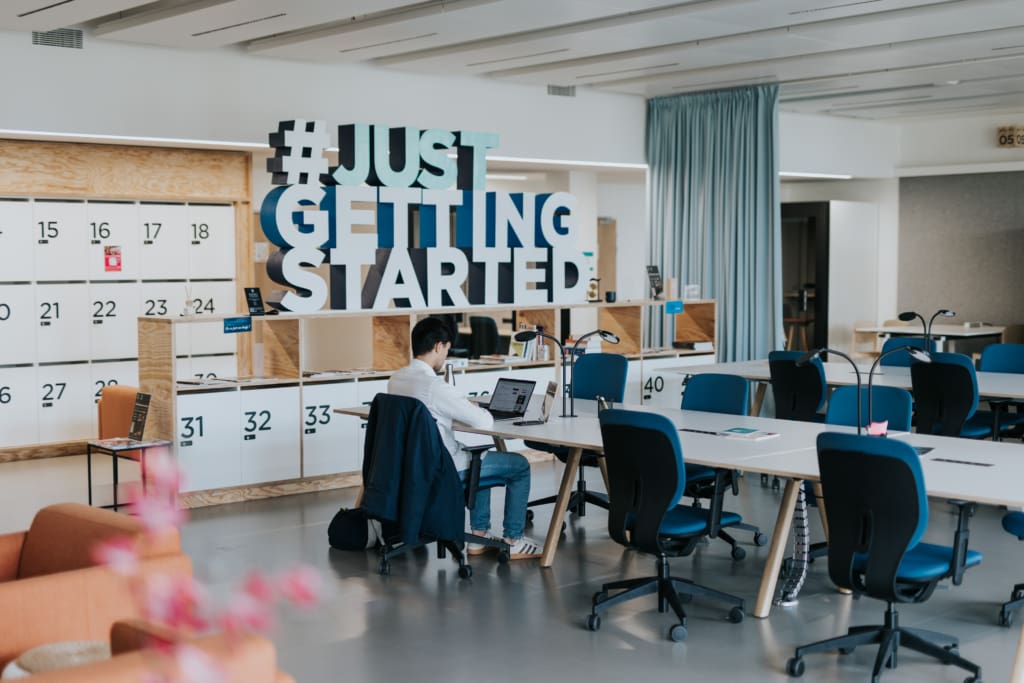
A student works in a collaborative space at ESSEC Business School, where experiential learning and innovation are central to the school’s “future-fit” Transcend strategy.
What is the case for globalization in business education today, given rising nationalism and policy shifts in countries like the U.S. and UK?
Our positioning is that ESSEC is a global destination for talent. This is not simply a reaction to what is happening in other countries; it reflects who we are and how we operate. France itself remains a desirable destination for many reasons. There is access to a wide range of industries, including global hubs such as luxury, along with high-quality higher education institutions and clear visa pathways after graduation.
When you bring these elements together, France remains an attractive environment for international students. The same applies to the regions where we operate. Our campuses across three continents allow us to offer a multicultural and international experience within ESSEC itself. Students can gain exposure to different geopolitical and economic environments while staying within the same institution.
At the same time, students choose schools for their career impact. Rankings matter, but what matters more is access to international networks and opportunities that align with a globalized economy. From a European perspective, Europe continues to stand out as a stable and predictable geopolitical environment. Business schools here are internationally oriented, with diverse cohorts, multi-country experiences, and cross-border projects that reflect the realities of global business.
By contrast, countries like the United States and the United Kingdom, while still home to excellent institutions, are facing tighter visa policies and political shifts that create uncertainty for international students, particularly around post-MBA career opportunities. This has made Europe—and France in particular—more attractive due to its relative stability and openness.
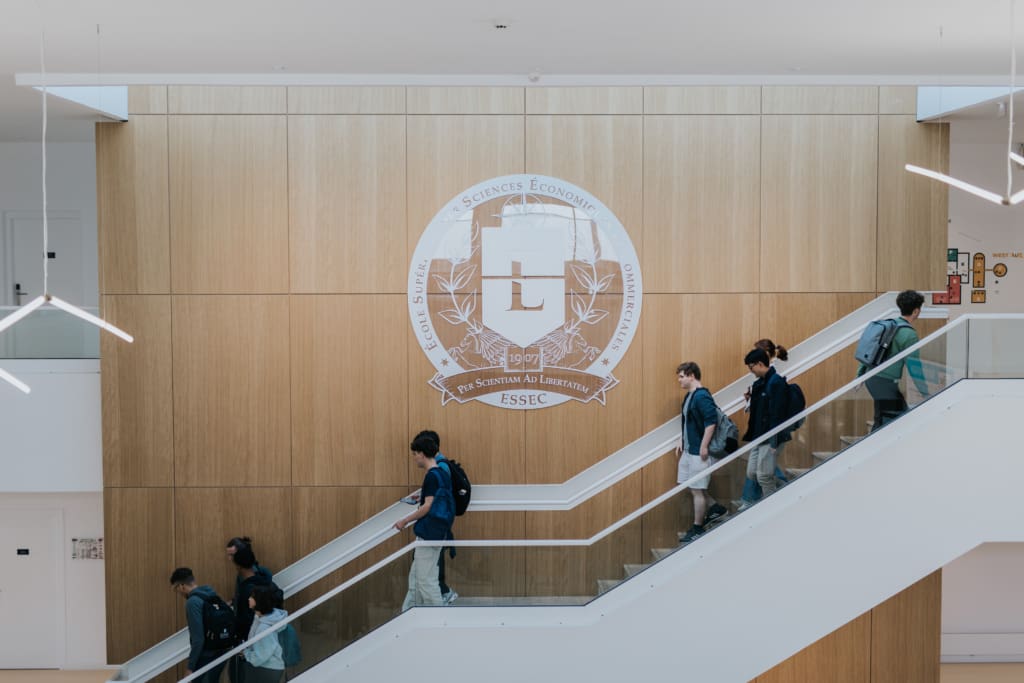
Students walk through an atrium at ESSEC Business School’s campus.
Can you provide an update on the Transcend strategy and the key developments since we last spoke?
One major development is the expansion of our international footprint, which includes physical presence, partnerships, student mobility, and increased attractiveness for students from different countries. This aligns with the broader vision of the Transcend strategy, which is to develop future-fit business education.
Future-fit education has two key dimensions. The first is ensuring that our graduates remain relevant in a world where skills become obsolete more quickly than before. Reports from organizations like the World Economic Forum and OECD highlight this acceleration. We are preparing students for jobs that may not yet exist or that may disappear over time. This is a unique moment for business schools.
Technological change plays a major role in this. Artificial intelligence is evolving rapidly, with multiple waves of innovation, from earlier forms of AI to generative AI and beyond. At the same time, other technological shifts, such as quantum developments, are emerging. These revolutions are happening faster than organizations can fully absorb them.
As a result, being future-fit is not only about delivering cutting-edge knowledge. It is also about developing social, emotional, and transversal competencies that enable students to take a proactive role in continuously updating their skills. I often say that business schools used to provide a passport that lasted a lifetime. Now, we provide a visa. A passport is something you rarely think about, but a visa has an expiration date, and you must actively renew it. This reflects the need for lifelong learning and continuous adaptation.
The second dimension of future-fit education is engagement—helping students contribute to building a more prosperous and resilient world. This involves not just individual success, but a broader responsibility toward society.
To support this vision, we are implementing tangible changes across programs, student experiences, and partnerships. One example is our corporate chairs. These bring together professors, companies, and students around specific sectors or topics. We now have 24 such chairs, more than ever before. They demonstrate how we connect academic expertise, student talent, and industry needs, reinforcing the relevance of our approach.
Our corporate chairs illustrate the breadth of what we are doing, covering topics from the future of finance to the circular economy, sustainable luxury, social innovation, and sports and business. This diversity reflects how we connect academic research, industry needs, and student engagement.
What are some other key achievements and developments under the Transcend strategy so far?
In artificial intelligence, we have developed partnerships with companies such as Mistral AI and worked with tools like Google Gemini. Our approach is to practice what we preach: using AI responsibly as a way to augment work rather than replace it. We provide access to a range of tools, recognizing that each has its own biases, and this diversity allows for more balanced and critical use.
Within Transcend, we have also structured our efforts around four institutes: environmental and social transition; entrepreneurship and innovation; artificial intelligence (Meta Lab); and geopolitics and business. These institutes focus on transversal topics and encourage collaboration across disciplines. The goal is to avoid treating major challenges—AI, environmental issues, and geopolitics—in isolation. These topics are deeply interconnected and must be approached holistically.
Another major development is the growing emphasis on lifelong learning. We are expanding executive education through initiatives such as ESSEC Acceleration and our “future-fit leadership” programs. These are designed not only to give professionals a taste of the ESSEC experience, but also to help them reskill and adapt to rapid changes. We believe it is essential to support experienced professionals, not just younger students, as they navigate technological and organizational transformation.
We have also launched new academic programs, including a master’s in artificial intelligence and an accelerator master’s linking sustainability to strategy. These programs reflect our commitment to integrating emerging fields into business education.
What about for students?
On the student experience side, we have reinforced our commitment to diversity and inclusion. Diversity in terms of gender, nationality, and academic background is a strength, but inclusion ensures that every student fully belongs. To support this, we have expanded scholarships and fee exemptions with an additional €4 million investment, doubling our financial support for students from less advantaged backgrounds over two years.
In terms of infrastructure, we have inaugurated a next-generation campus in France in fall 2025. The campus incorporates environmentally responsible design, including reduced energy consumption, solar panels generating part of our energy, water recycling systems, and the use of bio-based materials. We have also introduced initiatives such as sourcing food locally and implementing “Green Monday,” where no meat or fish is served to raise awareness about environmental impact.
Finally, we are addressing the carbon footprint of international education. Around two-thirds of our emissions come from mobility—students, faculty, and staff traveling internationally. While international experience remains essential, we are implementing a responsible mobility policy. This includes reducing the number of trips, encouraging longer stays, prioritizing lower-impact transportation such as trains within Europe, and raising awareness across the entire community.
These developments reflect a broader commitment to making our educational model both globally relevant and environmentally responsible, while continuing to evolve at a rapid pace.
ESSEC reimagined and relaunched its Global MBA in fall 2024 with an emphasis on strategic sustainability, innovation and entrepreneurship, and the digital transformation. What would you say about the MBA’s relevance today, given rapid changes like AI and geopolitics? Can it adapt to the current environment?
Yes, the MBA remains valid and relevant—as long as it continues to evolve. In many ways, the answer lies in the question. The MBA is still highly relevant for its target audience, but its content and format must adapt to the changing world.
At ESSEC, we have a broad MBA portfolio, including a Global MBA, Executive MBA, and programs in partnership across regions, as well as a blended Executive MBA that combines online and in-person learning. This reflects the need for flexibility in how education is delivered.
The key is evolution. Take artificial intelligence as an example. It is not enough to offer a single course on AI or expect participants to learn it elsewhere. AI is reshaping business, economies, and society. It must be embedded into the MBA as a transversal theme, alongside sustainability, innovation, and geopolitics. The more these topics are integrated across the curriculum—not treated in silos—the more relevant the MBA becomes.
Another critical dimension is the learning experience itself. I prefer the term multicultural rather than international. “International” can remain descriptive—how many nationalities, campuses, or faculty you have. But “multicultural” is a commitment. It means participants truly experience and engage with different perspectives. In today’s world, that intercultural dimension is essential.
Finally, the MBA must align with the idea of being future-fit. It is not just about delivering knowledge, but about developing transversal, social, and emotional competencies. Graduates must learn how to keep learning. The MBA is no longer a passport that lasts a lifetime—it is a visa. It requires renewal through continuous learning and intellectual agility.
As long as MBA programs help participants adapt, remain agile, and continue developing their skills beyond graduation, they will remain highly relevant in a rapidly changing world.
DON’T MISS: EXIT INTERVIEW: JOHN BYRNE ON BUILDING POETS&QUANTS, BREAKING BIG STORIES & WHAT BUSINESS EDUCATION REALLY NEEDS AND 10 BIGGEST SURPRISES IN THE 2026 U.S. NEWS MBA RANKING
The post The P&Q Interview: A New Hub In Mumbai, A Bigger Global Play For ESSEC appeared first on Poets&Quants.